
5 Forms of Unlawful, Punitive Force Delhi Police May Have Used Against CJP Protesters
From the Editor’s Desk
July 22, 2026
By Surabhi Singh, Newsreel Asia
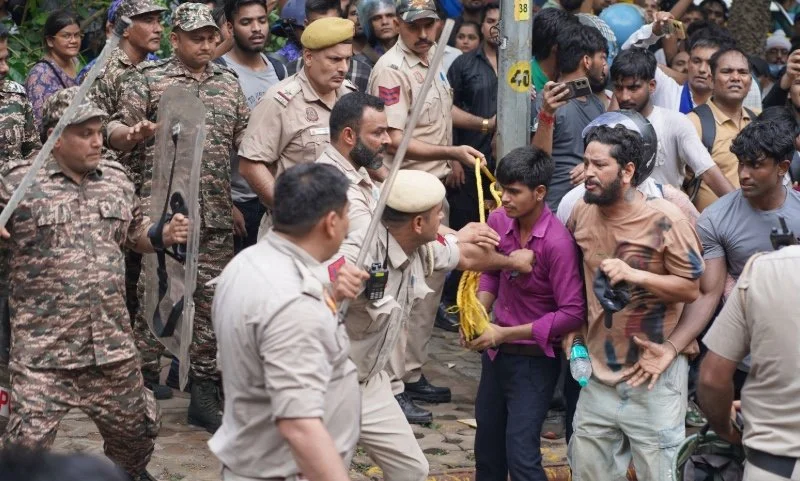
Delhi Police and Rapid Action Force (RAF) personnel used batons and tear gas against thousands of protesters during the Cockroach Janta Party’s (CJP) “Chalo Sansad” march on July 20, leaving scores injured and dozens detained. Eyewitness accounts from journalists covering the protest, including those from Newsreel Asia, and videos circulating on social media point to at least five serious forms of possibly unlawful and punitive force.
It must be first acknowledged that Delhi Police had the authority to prevent protesters from marching into the high-security zone around Parliament on July 20. It also had a duty to protect police personnel, members of the public and public property from violence.
Delhi Police has alleged that protesters formed an unlawful assembly, obstructed officials, committed violence and damaged public property. It has registered four cases under the Bharatiya Nyaya Sanhita (BNS) and the Prevention of Damage to Public Property Act. It has also said that 118 police and security personnel were injured. Those allegations must be investigated, and protesters responsible for violence should be prosecuted.
None of these powers, however, gave police or RAF personnel the right to beat people as punishment, retaliate against protesters, use improvised weapons or stones, conceal the identities of members of police force making arrests, or neglect injured people. The conduct of the police during the march cannot be judged solely by whether the protest had permission or whether some participants broke barricades, attacked police personnel or damaged property. Those alleged offences must be investigated separately and cannot be used to justify alleged unlawful police conduct.
Legal Use of Force
Section 163 of the BNSS allows a magistrate to prohibit or regulate a gathering to prevent an urgent danger or disturbance, and this provision had been invoked. Section 148 separately governs the police power to order certain assemblies to disperse and, if necessary, use force for that limited purpose.
The provision identifies the purpose for which force may be used. That purpose is to disperse the assembly and, where necessary, arrest or confine its members so that they may be dealt with according to law. Even if the July 20 march violated a valid prohibitory order, the violation authorised prosecution or necessary dispersal, not retaliatory or indiscriminate beatings.
The Supreme Court has ruled on this distinction after the police operation against protesters at Delhi’s Ramlila Maidan in June 2011. In its 2012 judgment, the Court found that some personnel who had been provoked or injured used excessive force. It referred to footage in which four or five police personnel surrounded one person before a member of police force beat him. The Court found that such a lathi charge was uncalled for and said restrictions on constitutional rights must be enforced with the “least invasion” of those rights.
The judgment is directly relevant to July 20. Police personnel do not acquire a “right to lose control” because they have been insulted, pushed or provoked. Professional restraint is part of their legal responsibility. A member of police force may strike someone to stop an immediate attack but they are not authorised to chase and strike someone who is retreating, restrained, lying on the ground or no longer dangerous.
Misconduct by some protesters does not make every protester a lawful target. It does not authorise indiscriminate baton blows or permit members of police force to use the street as a place of “summary punishment.” Police are well aware that criminal responsibility is “personal.” A student walking away from a confrontation cannot lawfully be beaten because another person threw an object at police somewhere else in the crowd.
Now, let’s deal with the five serious forms of possible unlawful or punitive force.

By Surabhi Singh, Newsreel Asia
First, numerous police actions appeared directed towards beating people rather than dispersing them.
Newsreel Asia journalists witnessed most of the beatings as protesters were running away, with members of police force repeatedly striking individuals rather than delivering a single blow, as videos recorded by other journalists covering the protest also appear to show. Police also beat a female journalist covering the protest for Newsreel Asia.
A dispersal action should create routes through which people can leave, communicate clear instructions, use force progressively and stop striking a person once that person complies. A punitive action, on the other hand, involves chasing people who are already leaving, surrounding individuals, continuing to beat someone after that person falls, targeting those who shout at police, or using repeated blows where a push, restraint or arrest would have achieved the lawful purpose.
The Supreme Court’s Ramlila Maidan 2012 judgment leaves little room for ambiguity on this point. The Court found that some personnel, after being incited by provocation or injury, used excessive force, carried out an uncalled-for lathi charge and threw stones at members of the public. It treated offences by protesters and excessive force by police as separate acts requiring separate accountability.
There is therefore a need to study the July 20 evidence incident by incident. The few seconds before and after every recorded beating are important. Was the person attacking anyone? Was an order to disperse audible? Was an exit available? Was the person walking or running away? Had the individual fallen or submitted? How many members of police force were involved? Did the blows continue after the supposed need had ended?
Force that continues after its lawful purpose has ended is not part of crowd control; it becomes punishment without charge, trial or judicial authority. Depending on the injuries and the objects used, individual acts could constitute voluntarily causing hurt, grievous hurt or hurt by dangerous weapons under the BNS.
Second, some police personnel were seen throwing stones at protesters and at least one carrying sticks that appeared to have nails protruding from them.
Newsreel Asia witnessed police personnel throwing stones at protesters after some protesters threw stones at them, as videos recorded by other journalists covering the protest also appear to show. And, in at least one verified and fact-checked video, a policeman is purportedly shown carrying a stick with nails.
A conventional police baton can cause serious injury and must be used with restraint. And a stick fitted with nails carries an additional risk of penetrating wounds, organ damage, heavy bleeding and infection. It has no place in professional crowd-control equipment.
Protesters who attacked members of police force with stones can be identified, arrested and prosecuted. Police personnel cannot respond by throwing the stones back into the crowd. Stones are not authorised crowd-control equipment, and their use in retaliation could cause grave or fatal injury to people who had no involvement in the original attack.
This could also be evidence of a serious loss of professional discipline. Police are trained and equipped to respond to violence through formations, protective equipment, lawful arrests and proportionate crowd-control measures. They cannot adopt the methods of violent protesters and then claim to be enforcing the law. Depending on how a stone was thrown and the injury caused, its use by a member of police force could amount to voluntarily causing hurt under Section 115 of the BNS or hurt through a dangerous weapon or means under Section 118.
If nail-fitted sticks were carried by police or people acting with them for use against protesters, their presence would suggest “preparation” to inflict penetrating injuries rather than an attempt to disperse a crowd with the least necessary harm. And actual use could attract Section 118 of BNS. More serious offences could apply depending on the intention, the part of the body targeted and the injury caused.
The evidence also raises a question about command responsibility. A crowd-control operation of this scale is planned, staffed and supervised. Senior officers decide deployment, equipment, formations, warnings, arrest teams, medical arrangements and the point at which force may be used. Responsibility cannot end with identifying a constable captured in one video.
Third, unidentified men in civilian clothes were seen standing with police and beating students with batons.
Newsreel Asia journalists spotted a few men in civilian clothes carrying the same type of batons as the police, while videos recorded by other journalists appear to show some of these men beating protesters.
Their status remains unknown, and they may have been plain-clothes police personnel, members of another government unit, civilians formally called upon to assist the police, or private individuals acting without lawful authority.
Delhi Police must identify them.
Section 148(2) allows an authorised magistrate or senior police officer to require assistance from civilians in dispersing an assembly and, if necessary, making arrests. However, this provision does not allow unidentified private persons to attach themselves to a police operation and beat protesters at will. Civilian assistance must be required by a competent authority, exercised under official supervision and confined to the statutory purpose of dispersal or necessary arrest.
The police must therefore disclose who called these men, under whose command they operated, what instructions they received and whether their names were recorded. If they were plain-clothes police personnel, the force should say so and identify their units. If they were private individuals, the authorities must explain why people without uniforms, visible identification or evident crowd-control equipment were permitted to use batons against citizens.
Permission to assist the police is not immunity from criminal law. A civilian who deliberately beats someone without lawful necessity may commit the offence of voluntarily causing hurt under Section 115 of the BNS, punishable by imprisonment for up to one year, a fine of up to 10,000 rupees, or both. If the assault causes grievous hurt as defined in Section 116, the offence under Section 117 is punishable by imprisonment for up to seven years and a fine. Grievous hurt includes a fracture or dislocation of a bone or tooth, permanent damage to sight or hearing, permanent disfigurement of the head or face, an injury endangering life, or an injury causing severe bodily pain or inability to carry out ordinary activities for 15 days.
Police officers who knowingly authorised or allowed punitive assaults could face criminal as well as departmental scrutiny.
Fourth, many Delhi Police and RAF personnel were not wearing visible name tags.
Newsreel Asia journalists observed that most of the personnel deployed wore no visible personal identification on their uniforms, as videos recorded by other journalists covering the protest also appear to show.
This omission makes it difficult for victims, witnesses and investigators to identify which member of police force used force, made arrests or handled detainees. It appears to contravene the Supreme Court’s binding directions in D.K. Basu v. State of West Bengal.
“Carrying out the arrest and handling the interrogation of the arrestee should bear accurate, visible and clear identification and name tags with their designations,” it stated.
According to media reports, at least 70 protesters were detained on July 20, meaning that the members of police force who arrested or handled them were required to display such identification.
As for members of police force accused of using batons or otherwise beating protesters, concealing or removing their names during the crackdown places the burden of identifying them on injured citizens, while the police retain control of deployment records, official video and CCTV footage. Identifying individual members of police force responsible for possible misconduct then becomes extremely difficult.
Delhi Police should preserve the relevant duty rosters, deployment records, police video, CCTV footage and control-room logs and make them available to any independent or judicial inquiry into the operation.
Fifth, police did not appear to move injured students swiftly to hospitals.
Difficult conditions and a large number of casualties can cause unavoidable delays, so delay alone does not establish criminality. Police conduct becomes legally troubling, however, if members of police force knew that someone was seriously injured, had the means to secure treatment, prevented others from helping or placed detention and crowd clearance above urgent medical care.
Newsreel Asia journalists witnessed injured people lying unattended in police presence, just as videos recorded by other journalists covering the protest also appear to show.
The Supreme Court addressed this issue directly in its judgment on the police action at Ramlila Maidan. It found that police personnel who were present but failed to assist in evacuating the gathering and transporting sick and injured people to hospitals had made themselves liable to disciplinary action. The ruling establishes that the responsibility of police during a crowd-control operation does not end with dispersal. It includes helping injured people reach medical care.
The BNSS imposes additional duties where an injured person has been arrested. Section 53 requires an arrested person to be medically examined soon after arrest, with injuries recorded in the examination report. Section 56 requires the person having custody of an accused to take reasonable care of that person’s health and safety. A female detainee must be examined by, or under the supervision of, a female medical practitioner.
Delhi Police should account for the medical arrangements made for July 20, including the number of ambulances deployed, the time taken to move injured people, the hospitals to which they were taken and whether injured detainees received the medical examinations required by law.
Need for an Inquiry
An independent inquiry should establish who ordered the baton charges, whether the statutory conditions under Section 148 were met, what warnings were given, whether safe routes for dispersal remained open and how senior officers responded after personnel began acting individually or vindictively. It should also determine whether civilians were formally called upon, why personnel lacked identification, why women members of police force were apparently insufficient at points of confrontation and how improvised or nail-fitted sticks entered the operation.
Police accounts of injuries and violence by protesters must also form part of that inquiry. So must footage of attacks on members of police force and damage to property.
An inquiry conducted only by the same police organisation would not command public confidence.
You have just read a News Briefing, written by Newsreel Asia’s text editor, Vishal Arora, to cut through the noise and present a single story for the day that matters to you. We encourage you to read the News Briefing each day. Our objective is to help you become not just an informed citizen, but an engaged and responsible one.
What happened in Mumbai on October 2 may have been only one day of protest, but the issues behind it are unlikely to disappear with the dispersal of the crowd. The protest was centred around concerns over the Election Commission, electoral rolls and the Special Intensive Revision (SIR) exercise, with protesters demanding accountability from Chief Election Commissioner Gyanesh Kumar. At the same time, similar mobilisation has been taking place across different parts of the country, with student groups, Opposition parties and civil society organisations raising concerns over the electoral process. Newsreel Asia spent the day at Mumbai Protest capturing the preparations, the police presence, conversations with protesters, the atmosphere on the streets and how the day unfolded. The speech of Cockroach Janta Party's leaders and sentiment of protestors seemed larger than the concerns regarding the electoral process. Will this lead to something bigger?