
A New Book Offers an Anatomy of a Decade of Lynching
By Asad Ashraf
September 23, 2026
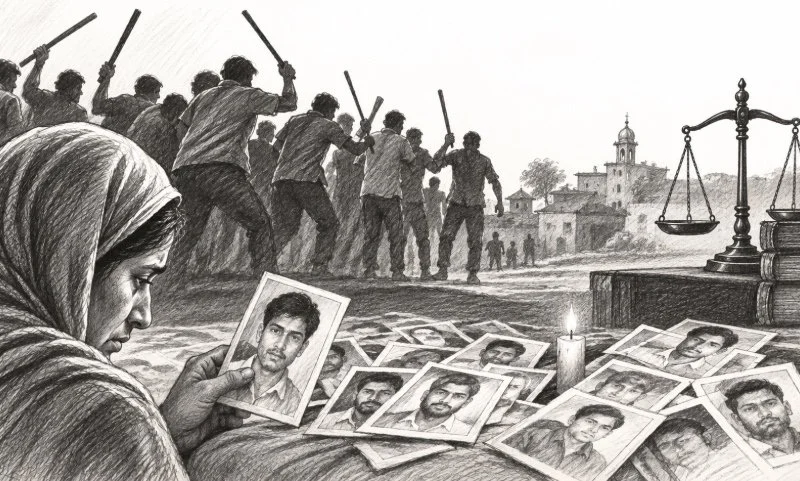
The word “lynching” carries a history rooted in racial violence. In the United States, it became associated with the public killing of African Americans by white mobs, where violence was used not only to kill individuals but also to intimidate an entire community. The public nature of these killings made lynching a form of collective “punishment” outside the law. India has its own long history of mob violence, communal killings and caste violence, but the word acquired renewed prominence in public discourse during the last decade as killings involving Muslim men, cattle allegations, religious identity and other accusations began appearing with greater frequency in news reports.
A new book attempts to bring these scattered incidents into one record. “Mob Lynching in India: A Record 2014-2024,” compiled by journalist and former Delhi Minorities Commission chairman Zafarul-Islam Khan, documents 1,743 incidents during the 10-year period. Published by Pharos Media, the 744-page volume brings together case studies, photographs, newspaper reports, references and source links. The book was launched in New Delhi on September 22 at an event organised by the Association for Protection of Civil Rights. The volume is less a conventional narrative than an archive, bringing together cases involving allegations of cattle theft, beef consumption, religious identity, child lifting, road disputes, personal conflicts and other accusations.
The Record of Violence
Speaking to Newsreel Asia, Khan explained that the purpose of the exercise was to prevent these incidents from disappearing from public memory. “If we do not bring these things into the record, 10 or 15 years later someone can say that nothing happened,” he said. Khan also placed the decade in a longer history, pointing out that mob violence was not new to India and citing earlier episodes of communal and mass violence. What the book attempts to capture, he maintained, is the scale and character of incidents documented between May 2014 and May 2024.
The significance of the record, however, is not contained in the number 1,743 alone. It is in the names.
Syeda Hameed, former member of the Planning Commission, went through dozens of the case studies in the book and listed the names of victims including Mohsin Sheikh of Pune, Riyaz Shamli, Mohammad Akhlaq of Dadri, Imtiyaz Khan, Pehlu Khan, Mohammad Afrazul of Rajsamand, Mohammad Asim of Hapur, Tohid Ansari of Jharkhand, Akbar Khan, Rakbar Khan, Zainul Ansari, Tabrez Ansari, Faizan and 18-year-old Zafar Ahmed. As she went through the cases, Hameed stressed that the volume should not be read merely as a compilation of statistics. “These are not just numbers,” she emphasised, pointing to the photographs, reports and references that accompany the individual cases.
For Hameed, the documentary value of the book rests partly in the ability of readers to return to the original material. “The references are there. The newspapers are there. People can check where the information came from,” she explained. She also called for the documentation to reach international media and researchers, arguing that the incidents should form part of the historical record available to audiences beyond the immediate news cycles in which individual killings first appeared.
The problem of preserving such a record is familiar to historians of lynching elsewhere. In the United States, anti-lynching organisations understood that documenting each killing was itself a form of resistance. Individual deaths could otherwise remain local incidents, known to a small community and then forgotten. India has faced a similar problem with episodes of collective violence. The country witnessed mass violence during Partition, the anti-Sikh violence of 1984 and the Gujarat violence of 2002, among numerous other episodes. The recent debate over lynching therefore does not begin with 2014. What the last decade has produced is an increasingly visible body of cases in which a crowd has assumed the authority to identify an alleged offender, determine guilt and impose punishment without waiting for investigation or trial.
That distinction becomes particularly important in cases involving cattle. For example, following the killing of Mohammad Akhlaq in Dadri in September 2015, public discussion repeatedly turned to the question of whether the meat found in his refrigerator was beef. Speaking to Newsreel Asia, Khan argued that the focus on the alleged meat had obscured the more fundamental issue of how a group of people had entered a private home and assumed the right to conduct its own search. “The question should have been how those people entered his house, how they opened his refrigerator and who gave them the right to do that,” he observed.
An allegation of an offence can be investigated by the police, evidence can be collected and a court can determine guilt. A lynching removes those stages and places accusation, judgment and punishment in the hands of a crowd.
The Supreme Court addressed the issue in its 2018 judgment in Tehseen S. Poonawalla v Union of India, laying down preventive, remedial and punitive measures for states, including the appointment of nodal officers and action against those involved in mob violence. The court’s directions were intended to create institutional mechanisms for preventing such attacks and responding to them when they occurred. The persistence of lynching despite those directions raises the question what happens when legal safeguards exist but the institutions responsible for enforcing them do not respond effectively?
Lynching as a Message
Human rights activist and writer Harsh Mander has spent years following that question from the other end of the violence, sitting with families after their relatives have been killed. Mander began the Karwan-e-Mohabbat initiative in 2017, travelling to the homes of families affected by communal and targeted violence and documenting their experiences. For him, one of the most disturbing features of contemporary lynching is that the violence is frequently video-recorded by those participating in it.
Mander told Newsreel Asia that the camera changes the nature of the act because the assault is no longer confined to those standing at the scene. It can be transmitted through mobile phones and social media to thousands of people who were nowhere near the location.
Mander connected this phenomenon with the older history of lynching in the United States, where killings of African Americans could become public spectacles. The violence was performed before an audience, and its visibility was part of its power. “The performance is important. It is a theatre of violence to give a message to the entire community,” he said.
The victim, in this understanding, is only one part of the intended audience. Mander elaborated that the violence communicates to the victim’s community what can happen to one of its members. The humiliation, torture and killing become a warning. “It tells the entire community that this is what we can do to one of your people,” he remarked.
During his travels, Mander recounted, Muslim young men had told him that their families had become afraid of their travelling by train. Some had been advised not to reveal their religious identity while travelling. “One lynching is enough to create fear in an entire community,” he said.
He recalled young men telling him that their mothers would call while they were travelling and ask them not to greet someone with “Assalamu Alaikum” because another passenger might realise they were Muslim. In Mander’s account, the fear therefore enters ordinary decisions about what someone eats, what they wear, where they travel and how openly they identify themselves. An individual killing acquires a social life of its own because people who were nowhere near the incident can alter their behaviour after hearing about it.
What Happens After the Killing
Mander’s work with victims’ families has also brought him into contact with the aftermath of killings that received considerable media attention. He contended that families can encounter another form of violence within the legal process when the circumstances of a mob attack are reduced to an ordinary altercation. “Many times, when we see the FIR, it does not even say that it was a lynching. It says there was an argument, the crowd became agitated and then the person was killed. The whole nature of the crime gets changed,” he explained.
He referred to Pehlu Khan, who was attacked in Rajasthan in 2017 while transporting cattle. The accused in his murder case were acquitted by a trial court, while members of Khan’s family continued to face legal proceedings. The case became one of the most prominent examples in the debate over cow-related violence and the criminal justice system.
For families, Mander pointed out, the distinction between a mob attack and an ordinary altercation can determine how the crime is recorded, how responsibility is pursued and whether the larger circumstances surrounding the killing are properly investigated.
The families he has met also provide a different way of understanding the word “lynching.” It is not merely a category used by journalists and activists. It is an experience that can continue for years after the killing. Mander recalled relatives asking why their loved ones had been subjected to prolonged torture before death. “They say, ‘If only they had shot him. If only they had stabbed him. Why did they torture him so much before killing him?’” he asked.
In many cases, the violence is not limited to killing. There can be prolonged beating, humiliation and the recording of the assault, with the resulting footage then circulated widely. For Mander, this is why the recording itself forms part of the violence rather than merely documenting it afterwards.
His Karwan-e-Mohabbat initiative was conceived as a response to that message. Instead of answering hate with another form of collective hostility, the initiative sought to visit affected families and demonstrate solidarity with them. Mander explained that his team tells families that others share their grief, that there is shame over what has happened, that their struggle for justice will be supported and that their stories deserve to be told. He estimated that the journeys had taken the initiative to more than 100 families.
The emphasis on memory runs through the new book as well. Hameed’s listing of victims brings the discussion back from statistics to individual lives. Among the names she read were young men killed in different circumstances and different parts of the country. Some were attacked over allegations involving cattle, others because of religious identity, while several cases emerged from disputes that escalated into collective violence.
Who Is Responsible?
The circumstances differed, but the question remained the same: who had given the crowd the authority to punish? That question was also raised by Apoorvanand, professor at University of Delhi. He argued that mob violence creates a form of collective criminality among those who participate in it. “When a mob lynching happens, there may be people who later regret that they participated. They may ask themselves why they went there. But by then they have already committed a criminal act,” he explained.
Apoorvanand elaborated that participation can bind people to one another through a shared act of wrongdoing, making it harder for individuals to distance themselves from the violence afterwards. His other concern was the effect on Muslims who begin to feel that ordinary public spaces are unsafe. “They do not know whether a particular road is safe, whether they should travel alone, whether they should go somewhere or whether something could happen to them,” he said.
He connected that uncertainty to democratic participation, arguing that if people begin avoiding public spaces because they fear being identified or attacked, the consequences are wider. He also questioned the responsibility of police and administrators, maintaining that political pressure cannot remove an official’s responsibility to enforce the law. “If the police or administration did not act, there has to be accountability for what they did and what they failed to do,” he said.
Malik Mohtasim Khan, General Secretary of the Association for Protection of Civil Rights, placed the issue in the context of legal reform. He called for legislation dealing specifically with hate crimes against religious minorities. “We should move towards legislation dealing with hate and atrocities against religious minorities,” he proposed.
Khan also argued that a legal framework would have little effect if those responsible for implementing it were not held accountable. “The people who write books have done their work. The responsibility now belongs to society as a whole,” he said.
The question of political responsibility arose repeatedly during the discussion, particularly around the perception that perpetrators can sometimes receive public support while victims and their families struggle with the consequences. Khan, the book’s compiler, has argued that the period after 2014 deserves particular attention because of the frequency with which allegations involving cattle and religious identity became associated with mob attacks. The book notes that lynching existed before 2014, while its compilation focuses on the May 2014 to May 2024 period.
The distinction is important because it avoids treating lynching as a phenomenon that suddenly appeared in one year. The history is longer. The question is why a particular form of mob violence became so visible during this decade and why so many cases could move from allegation to assault before the formal legal system intervened.
Why the Accusation Matters
The cases also show that the phenomenon cannot be reduced to one accusation. The book includes incidents involving road rage and brawls, religious identity, allegations of cattle-related offences and other disputes. It has recorded 53 cases involving allegations of beef possession or cow slaughter, 89 linked to religious identity and 571 arising from road rage or brawls. That range is significant because the social acceptance of collective punishment can lead to a multiplication of the reasons invoked to justify it.
For Malik Mohtasim Khan, this is why accountability cannot stop with the individual who commits the physical violence. “Lynching of anyone is wrong, whether the victim is Muslim, Hindu, Dalit or Christian. But we also need to know who carried it out and what happened to them,” he maintained.
Building a Record That Can Be Checked
The question of who carried out the violence is one of the gaps that documentation seeks to address. A newspaper report may record the victim’s name, the location and the allegation that preceded the attack, while a court record may later identify the accused and the family may have photographs, medical records or videos documenting what happened. The book brings some of these fragments together.
Hameed stressed that this was why the references were important. “If you want to cross-check something, you can go back to the source,” she explained.
This approach allows future researchers to study the language used in media reports, the allegations that preceded attacks, the identities of victims, the responses of police and politicians and the legal outcomes that followed.
For Mander, however, the record cannot be separated from the people behind it. The families he met did not speak in terms of statistics. They spoke about sons, husbands, fathers and brothers. Their questions were often simple: Why was he killed? Why was he tortured? Why did nobody stop it? Why did justice not follow?
These questions have appeared repeatedly in the history of lynching. In the United States, the anti-lynching movement eventually turned documentation into a sustained campaign against racial terror. In India, the task of recording contemporary mob violence is being assembled through books, journalism, court records and civil society initiatives.
The new book adds another layer to that archive. Its 1,743 cases do not constitute a final account of lynching in India, and the number represents incidents the researchers were able to identify and document from available sources. What the book provides is a consolidated record of a decade in which individual killings repeatedly raised questions about the rule of law, institutional accountability and the place of fear in everyday public life.
You have just read a News Briefing, written to cut through the noise and present a single story for the day that matters to you. We encourage you to read the News Briefing each day. Our objective is to help you become not just an informed citizen, but an engaged and responsible one.
What happened in Mumbai on October 2 may have been only one day of protest, but the issues behind it are unlikely to disappear with the dispersal of the crowd. The protest was centred around concerns over the Election Commission, electoral rolls and the Special Intensive Revision (SIR) exercise, with protesters demanding accountability from Chief Election Commissioner Gyanesh Kumar. At the same time, similar mobilisation has been taking place across different parts of the country, with student groups, Opposition parties and civil society organisations raising concerns over the electoral process. Newsreel Asia spent the day at Mumbai Protest capturing the preparations, the police presence, conversations with protesters, the atmosphere on the streets and how the day unfolded. The speech of Cockroach Janta Party's leaders and sentiment of protestors seemed larger than the concerns regarding the electoral process. Will this lead to something bigger?