
‘No Village Is Safe’: Kuki-Zos Demand President’s Rule After Fresh Killings in Manipur
By Asad Ashraf
September 22, 2026
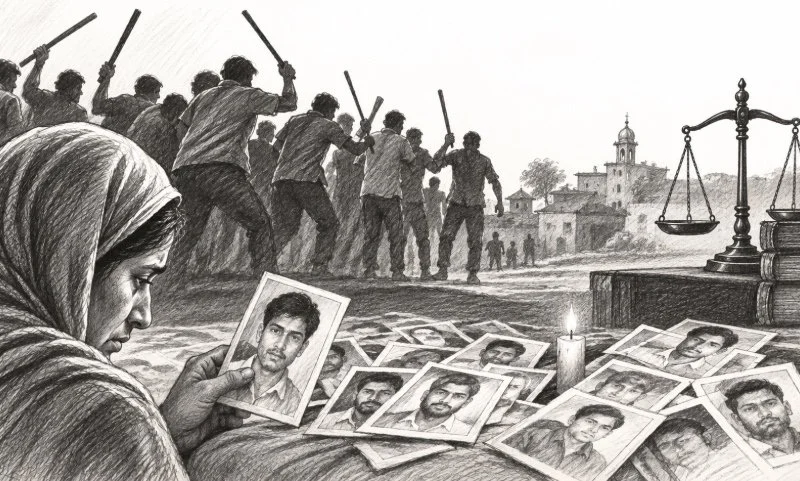
At around four o’clock in the morning on September 13, gunmen entered a house in L. Tollen village in Tamenglong district of Manipur. They shot Lhingzangai Singsit as she slept beside her husband, Seineh. He took a wound that killed him days later. Their son Henminsang, four years old, was hit by the same gunfire, and the injury to his hand has needed continuous treatment since.
Two days later, in a jhum field at Leisangphai, also in Tamenglong district, a 76-year-old widow gathering firewood and a 28-year-old nurse who had come home to help her parents were shot within the same afternoon, according to reports. Six Kuki-Zo civilians reportedly died in 72 hours. This was the week that brought the Kuki-Zo Women’s Forum, Delhi and NCR, to the Constitution Club of India on September 18.
Five speakers told Newsreel Asia that the killing of Kuki-Zo civilians in Manipur has not stopped since May 2023. That it has only moved from place to place, and every speaker returned, in the end, to the demand for the reimposition of President’s Rule.
Where the campaign began
Mercy Khongsai, Vice President of Kuki Students’ Organisation (KSO) Ukhrul district, traced the current run of deaths to a single morning. On March 11, armed men, whom she called “Tangkhul terrorist gangs” abducted four Kuki civilians who had gone out to repair a village water line, she told Newsreel Asia.
Two of the four, Thenkhogin Baite and Thangboimang Khongsai, were found dead the next day. Kuki villagers had released Tangkhul hostages of their own, allegedly in retaliation for the killing of Kuki pastors, shortly before, “on humanitarian grounds,” in the hope that their own men would come home alive.
Khongsai read out a list that has grown month by month. A Christian pastor and two clergy were killed on the Kotzim-Kotlen route in May. Tinmary Haokip, a seven-month pregnant woman, was killed with her husband at Loibol Khullen in June.
Two women were shot dead in their own houses at N. Teikhang on August 31. By Khongsai’s count, 24 Kuki-Zo civilians have died since March. She asked that the two unborn children be counted alongside their mothers, which would put the toll at 26.
“A village quiet this month is not safe next month,” she said. “A woman who survives an attack on her neighbour’s house is not safe in her own field 48 hours later.”
A history the room could not set aside
W.L. Hangshing, a retired officer of the Indian Revenue Service, asked the audience to hold the present alongside an older record. Around 1900, he said, the population of Manipur split close to evenly between valley and hills, with most people settled in the hills because disease was common in the valley below.
The Imphal capital area grew ethnically distinct after the king’s conversion to Hinduism, which brought advisers and cultural figures from Bengal into the court. Intermarriage followed, and so did what Hangshing called the “ten years of devastation” inflicted by Burmese forces in the nineteenth century, a period that changed the population of the valley further.
He rejected the claim that Kuki-Zo and other hill communities are recent arrivals or foreign settlers. That claim, he said, is “just political.” After independence, constituencies were drawn so that the valley held twenty-one seats to nine from the hills, though the two populations were close to equal in size.
“Discrimination started at that time,” he told Newsreel Asia. Eight assembly constituencies from the valley reached into the hills, a design he called a source of resentment in Imphal because it curtailed the autonomous powers the hill areas might otherwise have held.
He drew a line from that arrangement to the present one. Kuki-Zo leaders asked the Nagas to stand with them in May 2023, when Kuki-Zo people came under attack by the Meiteis. The Nagas chose neutrality instead, a position Hangshing summarised only as, “at least they’re not against us.”
He linked the more recent tension between Kuki-Zo and Naga communities to an effort by the National Socialist Council of Nagaland – Isak-Muivah (NSCN-IM) to draw Naga groups together against the Kuki-Zo, a pattern he compared to a territorial conflict between the two communities in 1992.
Two governments, one failure
Dr. Robert Thongkholal Haokip, a professor at JNU, aimed his sharpest words at both the central government and the “popular” government installed in Manipur this year. He told Newsreel Asia that the length of the conflict owes itself to what he called “selective accountability.”
Crimes committed in the Imphal valley by Meiteis, he said, have gone largely unpunished, while men from Kuki-Zo villages accused of similar acts have tended to be picked up within the year. He described search operations concentrated almost entirely in Kuki-Zo settlements, with only two comparable operations recorded in Naga villages over the same period.
His argument rested on a sequence of dates that he asked the Union to answer for directly. President’s Rule was imposed in February 2025 after the resignation of then chief minister, N. Biren Singh. It was lifted a year later, the same day a popular government under Chief Minister Yumnam Khemchand Singh took office.
Within the same week, the Ministry of Home Affairs replaced its Northeast adviser, A.K. Mishra, with a retired Intelligence Bureau officer named Ajit Lal, who took charge of both the Naga talks and the Kuki-Zo dialogue. Every killing on the 2026 list, Haokip pointed out, falls after that handover.
“Representation (of Kuki-Zo in the popular government) was offered as the substitute for security,” he said. “The record since then is the opposite of a substitute.” A government with a Meitei Chief Minister and Deputy Chief Ministers from the Kuki-Zo and Naga communities, he added, has not prevented a single one of the killings that followed its own swearing-in.
He extended little patience to the Chief Minister’s public promises either. A pledge to send the Ukhrul killings to the NIA, made in the Assembly in March, has not been matched by an equivalent commitment for any of the deaths that came after it. “A promise made in March and buried by September is not accountability,” he told Newsreel Asia. “It is contempt.”
The women named
Sylvia Hatpi Kipgen, spokesperson for the Kuki Women Union in Sadar Hills area in Manipur, read the names of seven women one by one, so the room would have to hear them rather than a summary count.
A woman, Loibol Khullen, was shot at while seven months pregnant. Another woman was murdered in her own house at N. Teikhang, and a second woman killed in the same house an hour later. A mother was shot at in L. Tollen village while her son lay wounded beside her.
A woman was killed near Longpi while carrying rice home, two months pregnant. A grandmother was shot while collecting firewood. A nurse was shot in a field on the day she had chosen to spend helping her parents.
“None of them was armed,” Kipgen told Newsreel Asia. “None of them was a combatant.” Pregnancy had given none of them shelter, nor had age, nor had a nursing certificate earned only weeks before.
She said thousands of Kuki-Zo children have already spent years in relief camps since 2023. Two of the orphaned children from L. Tollen village were seen at a protest in Tamenglong the day after their parents died, “calling for their parents.”
State assurances of ex-gratia payment and rehabilitation within 30 days do not establish who will legally care for an orphaned child, what injuries the child has, what treatment is needed, or what protection and rehabilitation the child requires, she said. They require formal assessments and orders from the relevant authorities, such as the Child Welfare Committee, she added.
A vacuum both governments have allowed
Hangshing returned to the question of protection later in the conference, and here too his criticism fell on Imphal and Delhi in equal measure. He told Newsreel Asia that the September 13 attack at L. Tollen took place a few hundred metres from Kaimai Police Station, an area that falls under the Armed Forces Special Powers Act.
Earlier attacks in Kangpokpi district had gone ahead despite an agreement that district police, rather than village volunteers, would guard those settlements. He recalled that the late Prime Minister Atal Bihari Vajpayee had stated, years earlier, that the ceasefire covering Naga armed groups did not extend to Manipur.
That position remains on record even as fighters linked to the same ceasefire process are named, village after village, as the killers of unarmed Kuki-Zo civilians. “A government that can swear in ministers in February and cannot prevent the abduction of four Kukis in March is a government in name,” Hangshing said.
Central forces have not closed the gap between promise and protection, he said, and the interlocutor’s office has produced talks without producing safety for the villages those talks are meant to concern. “Security that arrives after the firing is not security,” he told Newsreel Asia. “It is documentation of failure.”
What the Naga side has said
When Kuki Inpi Manipur named NSCN-IM in the killing of two civilians in June, the group issued a rebuttal calling the allegation an “opportunistic attempt to exploit human tragedy for political gain.” It accused Kuki organisations of “concocting and circulating unsubstantiated allegations,” according to a statement carried by Ukhrul Times.
NSCN-IM has also framed itself as a target rather than an aggressor in parts of this conflict. After two civilians were killed in Ukhrul in April, the outfit blamed Kuki Suspension of Operations cadres and said their actions had “exceeded all tolerance limits,” a claim reported by the same outlet. It warned that Nagas might be pushed toward “defensive measures” of their own.
Investigators have, at points, struggled to assign responsibility with the certainty either side offers. A police officer told Al Jazeera in May that it remained hard to say “whether they were armed village volunteers or individuals linked to insurgent groups,” and a senior official told the same outlet that armed groups from the Meitei, Kuki and Naga sides were all active on the ground, which made the killers difficult to tell apart.
That uncertainty has not softened the accusations from either community.
What the Forum has asked for
Chong Haokip, convenor of the Forum, closed the conference with the demand that gave it its title. President’s Rule, revoked in February on the promise that an elected government could hold Manipur together, should return, she said, because the machinery it replaced has broken down again.
The popular government in Imphal, she said, had failed the first duty of any administration, which is the protection of life, and the Union had failed in turn by treating a change of interlocutor as a substitute for enforcement. “The Union must resume direct responsibility until Kuki-Zo villages can be defended,” she told Newsreel Asia.
She asked for a central investigation into the full list of killings rather than scattered local files, for the arrest of those responsible for the Ukhrul abductions, and for a public accounting of what instructions have reached armed groups since the change of interlocutor.
She asked too for the statutory placement of the Tollen children before a Child Welfare Committee, with a named guardian and continuous treatment for Henminsang at state expense. On September 16, two days before the press conference, the Forum had already placed memoranda before the National Commission for Women and the National Commission for Protection of Child Rights.
“We will not accept condolence tweets in place of protection,” Haokip said. “We will not accept a popular government that cannot keep its women alive.”
Neither the state government in Imphal nor the Union government in Delhi had, by the Forum’s account, produced a single arrest the public could point to. Chong Haokip left one sentence hanging in the room as the speakers rose to leave. “If the Indian State cannot keep a grandmother and a nurse alive at three in the afternoon,” she said, “it must say so, and act, before an eighth Kuki-Zo woman is added to this list.”
You have just read a News Briefing, written to cut through the noise and present a single story for the day that matters to you. We encourage you to read the News Briefing each day. Our objective is to help you become not just an informed citizen, but an engaged and responsible one.
What happened in Mumbai on October 2 may have been only one day of protest, but the issues behind it are unlikely to disappear with the dispersal of the crowd. The protest was centred around concerns over the Election Commission, electoral rolls and the Special Intensive Revision (SIR) exercise, with protesters demanding accountability from Chief Election Commissioner Gyanesh Kumar. At the same time, similar mobilisation has been taking place across different parts of the country, with student groups, Opposition parties and civil society organisations raising concerns over the electoral process. Newsreel Asia spent the day at Mumbai Protest capturing the preparations, the police presence, conversations with protesters, the atmosphere on the streets and how the day unfolded. The speech of Cockroach Janta Party's leaders and sentiment of protestors seemed larger than the concerns regarding the electoral process. Will this lead to something bigger?