
July 20 CJP Protest Defies Government Narrative of Who Dissenters Are
From the Editor’s Desk
July 21, 2026
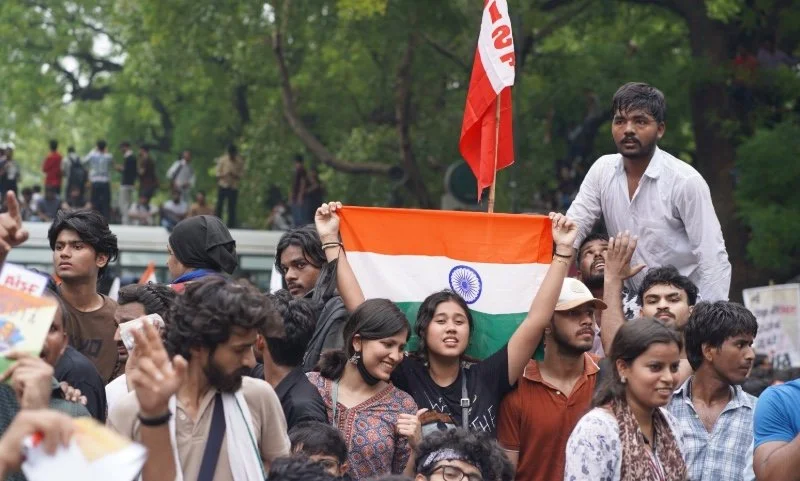
By Surabhi Singh, Newsreel Asia
Tens of thousands of young people converged around Delhi’s Connaught Place area on July 20, responding to a call by the Cockroach Janta Party (CJP) for its “Chalo Sansad” march towards Parliament. Most of them belonged to no party, community or movement the government could name, and their active participation appeared to shatter its claim that dissent or grievances in India are confined to a few groups that can be conveniently bracketed into Muslims, Christians, communists, left-leaning civil society, farmers and independent journalists.
As the protests in Delhi had been going on for over 20 days, the government led by the Bharatiya Janata Party and the police were well aware that the protesters were ordinary students from all walks of life, and that for many it was the first protest they had ever witnessed or taken part in. The protesters had also communicated their one demand and its solid basis: the resignation of Union Education Minister Dharmendra Pradhan over alleged irregularities in the NEET-UG examination. And they had remained peaceful despite some pro-government groups shouting slogans at them at the Jantar Mantar protest site earlier. Delhi Police had still refused permission for the march on July 20 and erected multiple layers of barricades around the area.
The police’s refusal, it appears, did not deter the youngsters. Newsreel Asia journalists covering the protest estimated at least 50,000 people at Jantar Mantar for the march to Parliament, and at least another 50,000 outside it, in the Connaught Place area, many in groups of 30 to 200. Those outer groups had formed on their own, without any lead from the CJP or its founder Abhijeet Dipke, or activist Sonam Wangchuk, who was forcibly removed from the protest site and taken to Safdarjung Hospital on the 20th day of his fast.
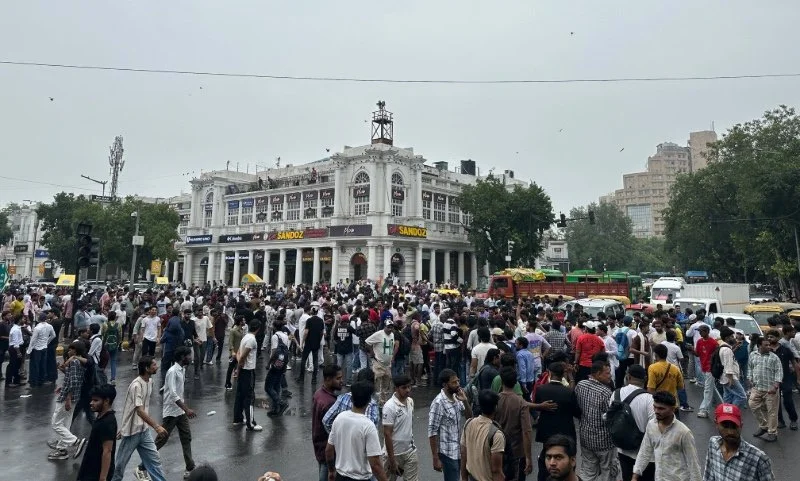
By Harshita Rathore, Newsreel Asia
They kept shouting slogans and singing the national anthem in the face of police baton charges that at times appeared to single out individuals. Police appeared to use batons and tear gas many a time without any provocation and at times with an apparent intent to beat the protesters rather than disperse the crowds. The police accused sections of the crowd of breaking barricades, throwing stones and damaging vehicles, which appears to be only partially true. At least 60 protesters were injured and 70 detained, and the crowds did not budge.

In the afternoon, rumours went round on social media that Dipke had been detained. Newsreel Asia journalists also witnessed a police official announcing at the Jantar Mantar protest site, which the police had dismantled, that Dipke had ended the protest. It was a lie, but even otherwise, it made no difference at Jantar Mantar.
In any case, the 50,000 in the streets outside Jantar Mantar did not appear to be looking to Dipke for directions. They kept standing and walking in the lanes off Connaught Place. It seemed as if the police’s apparent aggression were born of frustration at not being able to crush the spirit of the protest.
For years the government’s reply to grievances has been to find one of the three brackets to attach to them, Muslim or Christian or communist, read as “anti-national,” and to tell the rest of the country it was not their fight and the anger was not theirs to share. However, the young people at Connaught Place had only two things in common, their age and their grievances about the system, just one of which is Pradhan’s resignation.
The CJP had given these crowds their first occasion to gather, and they no longer seem to need it to carry on. Similar gatherings are being reported in several states with no single leadership binding them. Videos of police beating young men and women, and of protesters begging officers to show some conscience, have gone viral on social media, and the message the youngsters take from them is that the government does not care. That they have gone viral means millions of young social media users are resharing them as an expression of their anger.
The government has the barricades, the batons and the power to detain, and it used all three on July 20. What it may have lost is its defence thus far, the tendency to pin a suspect label on a crowd so the rest of the country would look away. The crowds of young citizens who continue to come out on the streets, despite the possibility of heavy-handed treatment, fit none of the labels the government has been using.
Would the government now create another bracket and say that ONLY Muslims, Christians, communists, left-leaning civil society, independent journalists, farmers AND youngsters (their family members included) are dissenters, and that the few left outside these brackets are its supporters?
You have just read a News Briefing, written by Newsreel Asia’s text editor, Vishal Arora, to cut through the noise and present a single story for the day that matters to you. We encourage you to read the News Briefing each day. Our objective is to help you become not just an informed citizen, but an engaged and responsible one.
What happened in Mumbai on October 2 may have been only one day of protest, but the issues behind it are unlikely to disappear with the dispersal of the crowd. The protest was centred around concerns over the Election Commission, electoral rolls and the Special Intensive Revision (SIR) exercise, with protesters demanding accountability from Chief Election Commissioner Gyanesh Kumar. At the same time, similar mobilisation has been taking place across different parts of the country, with student groups, Opposition parties and civil society organisations raising concerns over the electoral process. Newsreel Asia spent the day at Mumbai Protest capturing the preparations, the police presence, conversations with protesters, the atmosphere on the streets and how the day unfolded. The speech of Cockroach Janta Party's leaders and sentiment of protestors seemed larger than the concerns regarding the electoral process. Will this lead to something bigger?