
Why Governments Feel Threatened by Women Protesters
From the Editor’s Desk
August 12, 2026
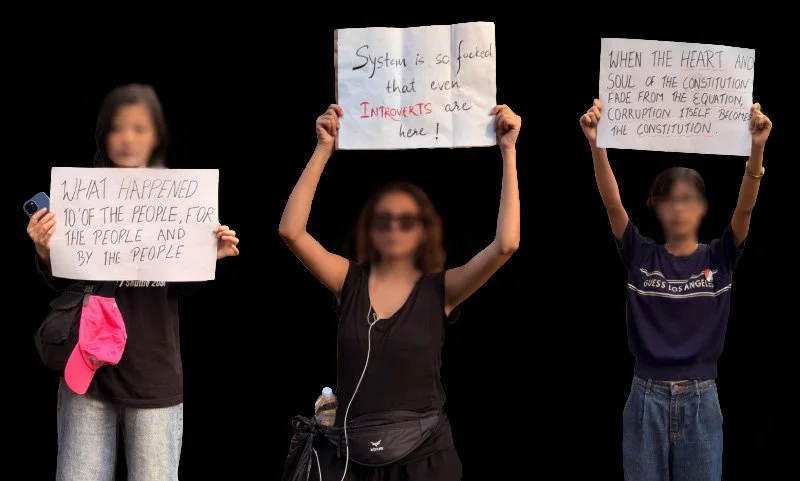
After the Cockroach Janta Party (CJP) protests ended in Delhi’s Jantar Mantar on July 25 following Education Minister Dharmendra Pradhan’s resignation, women and girls who had participated publicly and visibly in the agitation became the principal targets of a doxxing and harassment campaign. The campaign reveals that those behind it see women protesters as a threat and want to push them into roles defined by their own patriarchal beliefs.
The campaign involved cropped photographs, AI-fabricated images, exposure of personal information, sexual threats, pressure on families and, in the case of a 15-year-old girl, criminal proceedings over words spoken at the protest, as reported by The Wire and Alt News.
Extensive research into women’s participation in civil-resistance movements has shown that their visible presence can be especially troubling to those in power, making a protest more politically powerful and the use of force against its participants more politically costly.
For example, a 2019 report by political scientist Erica Chenoweth and researchers Conor Seyle and Sahana Dharmapuri analysed the Women in Resistance dataset, covering 338 violent and nonviolent campaigns across the world from 1945 to 2014. The researchers found that extensive participation by women on the frontlines was strongly associated with nonviolent discipline and campaign success.
“The greater the extent of women’s frontline participation, the greater the probability of success,” stated the report, suggesting that a government may see large-scale participation by women as evidence that a movement is gaining social legitimacy, nonviolent discipline and a greater chance of success.
Large numbers of women at a protest signals to the public that the grievances are not politically manufactured. Their presence makes the protest look more representative of society and its grievances more credible to people who might otherwise remain uninvolved. A government, therefore, may find difficult to dismiss such protests as an organised opposition campaign.
Women also make repression or crackdown more difficult to justify.
In an online survey experiment conducted in Russia in October 2021, political scientist Martin Naunov presented 1,350 Russian adults with fictional news reports about a protest, varying the gender composition of the protesters. Published online in 2024 and in the February 2025 issue of the American Political Science Review, the study found that “protests involving extensive participation by women are perceived as less violent and meriting of repression than male-dominated protests.”
The finding suggests that police violence against a protest involving many women may be harder to justify publicly and more likely to damage the government’s credibility. Police violence against such a crowd may therefore generate sympathy for the protesters and attract more people to the movement. This leaves those in power with an uncomfortable choice, allow the protest to expand or suppress it at the risk of making it stronger. In the case of the CJP-initiated protests in Delhi on July 20, the central government apparently chose suppression and paid a political price for it.
Following the protest’s success, the campaign against women protesters in Delhi, Mumbai and elsewhere can be understood as an attempt to force them back into socially prescribed roles as quiet daughters concerned with their reputations, dependent on family permission and absent from the streets.
Protesters of different genders reportedly used abusive language, but women and girls were singled out, identified and presented as indecent. A 15-year-old girl was made to apologise publicly, while comparable demands were apparently not made of boys and men. Prime Minister Narendra Modi’s reference to protesting students as “daughters” also placed the women within a family role, as if their conduct required paternal judgment and forgiveness rather than an equal citizen’s right to political expression.
It is as if a “daughter” is expected to be obedient, respectable and subject to male authority rather than someone with agency of her own. Calling the protesters daughters while punishing them for speaking as citizens turns apparent concern into a form of control. The issue is not merely their use of abusive language, but whether women are allowed the same political anger, public presence and margin for error that society routinely allows men.
The campaign also sends a message to women who never attended the protest. Publishing one student’s photograph, threatening another with sexual violence or contacting a third woman’s family can lead thousands of families to discourage women from attending future demonstrations. Those behind the campaign appear to be using fear after the protest to accomplish what direct repression failed to achieve during it.
The campaign should not be treated as an unrelated outbreak of online misogyny following a successful movement. It appears intended to make women pay such a high price for exercising their rights as citizens that they, and others watching, retreat from public life.
You have just read a News Briefing, written by the text editor, Vishal Arora, to cut through the noise and present a single story for the day that matters to you. We encourage you to read the News Briefing each day. Our objective is to help you become not just an informed citizen, but an engaged and responsible one.
What happened in Mumbai on October 2 may have been only one day of protest, but the issues behind it are unlikely to disappear with the dispersal of the crowd. The protest was centred around concerns over the Election Commission, electoral rolls and the Special Intensive Revision (SIR) exercise, with protesters demanding accountability from Chief Election Commissioner Gyanesh Kumar. At the same time, similar mobilisation has been taking place across different parts of the country, with student groups, Opposition parties and civil society organisations raising concerns over the electoral process. Newsreel Asia spent the day at Mumbai Protest capturing the preparations, the police presence, conversations with protesters, the atmosphere on the streets and how the day unfolded. The speech of Cockroach Janta Party's leaders and sentiment of protestors seemed larger than the concerns regarding the electoral process. Will this lead to something bigger?