
Delhi’s ‘Jantar Mantar Republic:’ the India Its Youngsters Want, and Are Building
By Vishal Arora
July 24, 2026
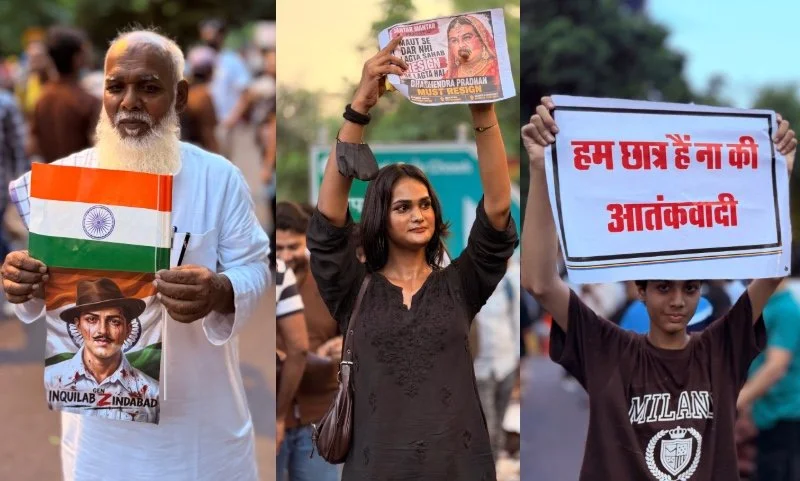
Photos by Newsreel Asia
A huge, leaderless crowd of protesters has been gathering at Connaught Place in Delhi alongside the organised Cockroach Janta Party (CJP) protest at a designated site at Jantar Mantar. By July 23, it looked at least four times the size of the CJP protest. Even without any leadership, except a few self-appointed volunteers doing crowd management, they seem to be living out the India they want, one they seem to be building themselves, an India where your identity and agency are never questioned but accepted with mutual trust and protection for one another.
The initial trigger for the parallel protest, made up of ordinary people and many small and varied groups, was police forcibly taking activist Sonam Wangchuk to a hospital on July 18, on the 22nd day of his fast at the CJP protest site. And it increased manifold after the brutal and allegedly illegal police crackdown of July 20. After that day, when people apparently realised that not only had the protest's demand for the resignation of the education minister, Dharmendra Pradhan, gone unmet but that the government was not even willing to listen, the numbers at Jantar Mantar and the wider Connaught Place area rose steeply. They have been arriving asking nothing of any leader and instead bonding with whoever stands beside them.
People from lower-income backgrounds move through the crowd feeling part of it, and are being received the same way in return. A slogan begins by the voice of any random person, and is finished by neighbours and passers-by who had never met the person who started it.
Families are bringing their children and staying even where the crowd grows dense and the police-created exit points narrow into places where a stampede may begin. The people around them behave in a way that keeps them safe.
Young women are arriving dressed however they are comfortable, some in shorts, and moving through the gathering without any harassment, in a city where the same clothing invites staring and comment on an ordinary street that’s not even crowded.
People from the LGBT community are coming and finding no one there to judge them, moving through the crowd with the same ease as everyone around them.
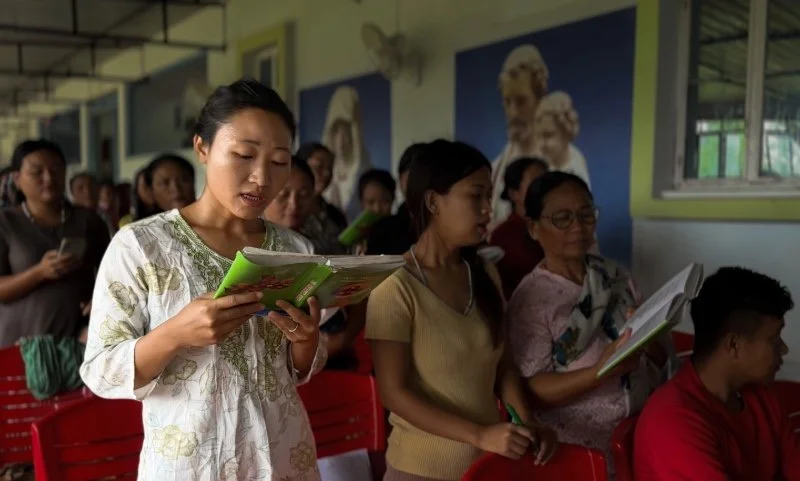
Some Muslims are coming in skull caps, in burqas and in hijabs, and are being treated by those around them as belonging fully to the same body of people, their visible faith and identity attracting neither suspicion nor distance from anyone nearby. Similarly, some Christians are coming with crosses on their t-shirts and receiving the same welcome.
A large number of teenagers are turning up with placards and slogans they had thought up themselves and are standing as equals among protesters much older than they are, neither looked down upon nor patronised by anyone around them.
Indeed, all kinds of people are arriving, and some appear to be rowdy. The youths who look aggressive have, at least thus far, kept their aggression pointed at the government and have not turned it on any fellow protester, a discipline the crowd has imposed on itself rather than one supplied by marshals or police.
What these young people have proved in a few days is that the India so often called impossible can be made to exist, and made to exist even by ordinary people acting without a leader to obey or a law to compel them. That the police are beating such youngsters and subjecting them to alleged surveillance makes the actions of the government highly condemnable.
Their rejection of the last decade is visible. The people in power have spent these years teaching Indians to see one another as threats and to divide by faith, dress and caste. The young at Connaught Place have refused all of it. Given a country trained to divide on sight, they seem to be building one that sees a fellow protester before it sees a religion, and they have done it in the same streets where their elders insist such trust is not possible.
You have just read a News Briefing, written by Newsreel Asia’s text editor, Vishal Arora, to cut through the noise and present a single story for the day that matters to you. We encourage you to read the News Briefing each day. Our objective is to help you become not just an informed citizen, but an engaged and responsible one.
What happened in Mumbai on October 2 may have been only one day of protest, but the issues behind it are unlikely to disappear with the dispersal of the crowd. The protest was centred around concerns over the Election Commission, electoral rolls and the Special Intensive Revision (SIR) exercise, with protesters demanding accountability from Chief Election Commissioner Gyanesh Kumar. At the same time, similar mobilisation has been taking place across different parts of the country, with student groups, Opposition parties and civil society organisations raising concerns over the electoral process. Newsreel Asia spent the day at Mumbai Protest capturing the preparations, the police presence, conversations with protesters, the atmosphere on the streets and how the day unfolded. The speech of Cockroach Janta Party's leaders and sentiment of protestors seemed larger than the concerns regarding the electoral process. Will this lead to something bigger?