
By Adv Robin Christopher
August 3, 2026
Tamil Nadu’s courts appear to have quietly narrowed a constitutional right over the last seven years without ever admitting they were doing so. Every order still cites the same protection for peaceful prayer, but the burden to prove that prayer is harmless has effectively moved from the state to the worshipper. That change is invisible in any single ruling, and becomes clear only when the rulings are read one after another, in the order they were made.
At least 30 petitions asking whether a citizen may pray inside her own home, or a congregation may worship inside its own building, without a government official’s prior permission, were decided by Tamil Nadu’s courts between January 2019 and April 2026.
Fifteen of the 30 orders, issued by the Madras High Court and, on one occasion, the Tamil Nadu State Human Rights Commission, favoured the person seeking to pray or worship. The other 15 went against them, an even split when the cases are counted without regard to when they were decided.
Counted this way, the numbers are misleading. Once the same 30 orders are sorted by date instead of by outcome, the even count gives way to a clear reversal. Of the first 10 orders, decided between 2019 and August 2022, eight favoured the worshipper. Of the 10 most recent orders, decided since November 2024, eight went against her, so the ratio has nearly turned around within seven years. That reversal shows a right sliding downward, even as the rule meant to protect it has barely changed over the same seven years.
Every one of the 30 orders, from the earliest to the latest, repeats the same basic rule, found in Article 25 of the Constitution, the provision that protects the freedom to practise religion. The rule says no citizen needs permission in advance to pray peacefully, and that the state may step in only when there is real evidence of a nuisance, not merely a suspicion that one might occur. No bench has thrown out that rule. Each has instead left it standing while narrowing, case by case, what falls under its protection, so that the duty to prove prayer is harmless has moved from the state, which is supposed to justify stepping in, to the worshipper, who now has to justify the worship itself.

Sorting the same 30 cases a second way, by the kind of worship rather than by date, produces a clearer pattern still. Eleven of the cases involve just one person or one family praying inside an ordinary house, and home prayer succeeds in about nine of these 11.
In January 2019, hearing Pastor R. Jeganathan Israel’s case, the Court held simply that no permission was needed and ordered the police to stay away. Nearly identical rulings followed within the same year for S. Asirvatham Daniel, Selvaraj and V. Thinakaran, each order citing the one before it. The rule still has exceptions. V. Jeeva’s petition was dismissed, and, in a separate 2024 case, the Court itself ordered a family’s prayer meeting to stop. Even so, going by the evidence available, this remains the stronger half of the picture.
The other 18 or so cases are different in kind. They involve a trust, a mission, a pastorate or a congregation, meaning a formally organised religious body rather than an individual household, seeking to build, convert, register or simply keep open a recognisable place of worship. Here the community loses roughly 13 of these eighteen cases, and on grounds that no home-prayer petitioner was ever asked to meet. K. Vedanayagam’s 2023 case upheld a Collector’s refusal to allow a prayer hall to be converted, a refusal that partly rested on what the order itself called “the wishes of 80% of the local people,” a headcount of the religious majority treated as a legitimate reason to deny a minority congregation a place to worship.
Miller Mancing’s 2026 request for a No Objection Certificate, the official clearance needed before certain buildings can be used, covered a prayer hall that had stood for fifteen years. It was refused because earlier paperwork had labelled the building a “community hall,” a technical label the Court treated as disqualifying, even though there was no nuisance involved at all, and the order closed by quoting scripture against the petitioner’s good faith. A. Yosuva’s case fell into the same trap. Dismissed in 2019 and again on appeal in 2023, it turned on the fact that permission had originally been sought for a residence, the building was later used as a prayer hall, and the request to have that use formally recognised was, in the Court’s own words, “rightly rejected.”
The Gideon Gospel Mission’s petition, filed in 2012, was not decided until 2025. A separate congregation’s appeal, arising from a 2009 building dispute, was also not resolved until 2025.
A single Tirunelveli pastor’s dispute ran from 2016 through a dismissal in 2022 and a dismissal on appeal in 2025, nine years, one church, one address.
In January 2022, ruling for a pastor’s family against a neighbour’s objection, the Court dismissed the complaint. It then advised the family to “practice tolerance and restraint” and to pray “in a gentle manner,” while the neighbour, on his second such complaint, faced no penalty.
In one case, a private objector filing his third harassment petition was fined ₹25,000. In none of the 30 cases has any Tahsildar, a local revenue official who issues many of these notices, police officer or Collector personally faced any consequence for issuing a notice a court later found baseless.
A related case from Karnataka, outside the thirty and still pending, began on 26 October 2021. The Station House Officer of Kundapura Rural Police Station in Udupi district issued a notice to a seventy year old Christian woman accusing her of “calling persons from outside her family for prayers and preaching without a license,” and warning that doing so violated the law without prior police permission.
She replied within two days, on 28 October, disputing the notice’s legality. The notice remained in force anyway, and she was unable to pray in her own home for nearly two months before the High Court intervened.
On 22 December 2021, the Court granted an ad interim order, a temporary ruling issued while the full case is still being heard, invoking her rights under Articles 14, 15, and 21 of the Constitution, together with her right to religious freedom under Article 25.
The order attached four conditions. It permitted no “much congregation” of worshippers, with a numerical cap justified by reference to Covid-19 and the Omicron variant, no “disturbance or nuisance” to neighbours, and no “scope” for “allegations of conversion activities.” It provided for automatic rescission on any breach, whether genuine or alleged, and it permitted the police to audio and video record her prayer meetings without interference, as a permanent feature of the relief.
The order also accepted the state’s characterisation of the area as “communally sensitive” and of the prayer group as a threat to “peace & harmony.”
Delay functions as a second and quieter penalty on institutional worship, one that never appears in the text of any single ruling. The Gideon Gospel Mission waited thirteen years for a decision, the 2009 building dispute took sixteen years to resolve, and the Tirunelveli pastor spent nine years contesting a single dispute through two dismissals.
A right that takes a decade or more to vindicate functions, in practical terms, as a weaker right than one a court can confirm within a year, even when the printed rule is identical in both cases.
The asymmetry in who pays for being wrong runs through the cost structure of these disputes. A neighbour whose second complaint against a pastor’s family was dismissed faced no penalty at all, and the family itself received only a judicial lecture on practising tolerance in a gentle manner.
The one occasion on which an objector was fined, ₹25,000 for a third harassment petition, stands out precisely because it happened only once in thirty cases. Officials fare better still, since no Tahsildar, police officer or Collector has personally faced any consequence for issuing a notice a court later found baseless, which means the incentive on the ground favours filing a complaint or a notice first and letting a court sort out the consequences years later.
The Karnataka case shows what conditional protection looks like even when a court rules for the petitioner, because relief and restriction arrived in the same order. The ruling invoked her rights under Articles 14, 15, 21 and 25, and in the same breath imposed a numerical cap on her prayer meetings, made an unproven accusation about conversion activity a standing condition that she had to keep disproving, and permitted the police to record her prayer meetings on a permanent basis.
A woman who went to court to stop the police from watching her pray left with an order that made the surveillance official. The fact that the order accepted the state’s own characterisation of the area as “communally sensitive” without contest suggests how easily an official label, once entered into the record, becomes part of the relief a citizen is granted rather than something a court tests.
None of this doctrinal detail captures what happens to the households and congregations waiting on the other side of a docket number. A household that stops meeting for prayer the moment a notice arrives, or a trust that waits thirteen years only to be refused, experiences the law as a risk to be managed rather than a right secured.
A judgment that vindicates the right nine or 16 years later, as in the Gideon Gospel Mission and Tirunelveli cases, arrives too late to restore the years during which a congregation had no place to exist as a congregation.
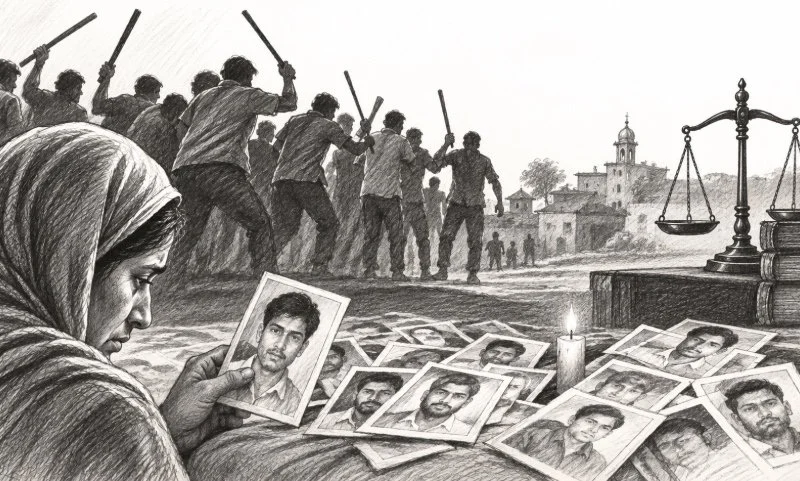
None of this required one dramatic reversal. It took 30 ordinary orders, each defensible on its own and each citing the one before it, for majority sentiment, deference to district officials, technical classification and judicial lectures on restraint to achieve together what no single ruling ever set out to do on its own.
A right that looked unconditional in 2019 has become, by 2026, a conditional liberty available mainly to those without a difficult neighbour, an ambiguous form or a congregation large enough to need a building of its own, and least available to those whose faith has grown visible enough to need one. The legal doctrine has survived unchanged. The freedom it was meant to protect has grown smaller around it.
You have just read a News Briefing, written to cut through the noise and present a single story for the day that matters to you. We encourage you to read the News Briefing each day. Our objective is to help you become not just an informed citizen, but an engaged and responsible one.
On October 12, opposition leaders, MPs, MLAs, student organisations and political workers came together in a massive march against Chief Election Commissioner Gyanesh Kumar, raising serious concerns over the Special Intensive Revision (SIR) of electoral rolls and the alleged mass deletion of voters’ names. The march brought together a broad coalition, including the INDIA bloc, AISA, SFI and other student unions, as part of a wider nationwide mobilisation against the SIR exercise and concerns surrounding electoral integrity.