
The ‘Politics of the Unprotected Body’: Why Women From Northeast India Remain Vulnerable to Violence
By Ngurang Reena
June 8, 2026

Repeated racial and gender-based abuse against women from Northeast India points to a deeper structural failure of the Indian state to provide equal protection to all citizens. Law enforcement agencies, courts and policymakers often acknowledge such incidents, yet their racial dimension frequently disappears from legal and institutional responses, producing a pattern of unequal citizenship. Women from the Northeast thus occupy what may be called the “unprotected body,” formally included within the republic but repeatedly denied the full protection of its institutions.
A nation reveals itself not in the grandeur of its Constitution or the solemnity of its public ceremonies, but in ordinary moments of insult, when one citizen decides that another may be humiliated, assaulted or even killed with impunity. It reveals itself in quarrels between neighbours, in street-side sneers, in police complaints that record the injury but ignore the motive, and in the confidence with which some men ask certain women, tu kya kar legi (what will you do)?
That question is a declaration of impunity that India has heard for far too long.
In recent months, videos from New Delhi’s Malviya Nagar circulated widely, showing three young women from Arunachal Pradesh being verbally abused by neighbours following a dispute over renovation dust. The slurs were familiar to many of us from the Northeast. Racial mockery came intertwined with sexual insinuation, dhandewali, the old suspicion that women from the Northeast are morally corrupt or socially suspect. The state responded after the violence had occurred. Arrests were made and procedures were followed. However, the deeper question remains unresolved. Why does the law in India continue to behave as though each such incident were a new discovery?
The answer lies in a persistent refusal to confront what these incidents represent. They are more than quarrels between individuals. They are evidence that, for certain citizens, particularly women from Northeast India, belonging remains actively contested. The insult emerges from a social order in which some bodies move through the republic with the assurance of protection, while others move with the knowledge that protection may or may not arrive.
This condition is what I call the politics of the unprotected body. It describes a structural arrangement, a pattern of governance in which the state’s protective function is distributed unequally along racial and gendered lines. The unprotected body is not a body outside the law. It is a body formally inside the republic, holding a passport, voting in elections and recognised by the state from birth to death. But institutions register its injuries without recognising the structure that produced them.
As the same categories of bodies have been left unprotected repeatedly, that repetition has itself functioned as a form of governance. Unprotection, sustained over time and across institutions, has become a political statement, one that tells certain citizens precisely where they stand.
The political philosopher Hannah Arendt identified the most fundamental human entitlement as the “right to have rights.”Rights exist in constitutions and legal codes, but they become meaningful only when institutions recognise someone as fully belonging to the political community whose protection those rights presume. When institutions hesitate, that right quietly collapses.
In “Frames of War and Precarious Life,” the philosopher Judith Butler argues that not all lives are equally grievable. It simply means that not all suffering is recognised as worthy of public mourning or structural remedy. The treatment of women from Northeast India appears to reflect this pattern. Their humiliation often circulates as spectacle, attracts brief condemnation, and then fades from public memory. The result is an absence of sustained outrage, collective shame, or meaningful reform.
These incidents are registered as “unfortunate” and are not registered as a wound to the republic. Such violence can be simultaneously visible and politically weightless, the frames through which public attention operates do not yet place these women inside the category of those whose degradation demands an enduring response.
The anti-colonial thinker Frantz Fanon argued that in societies structured by racial hierarchies, people often carry assumptions about a person before they know anything about them. The individual is seen through the lens of prejudice rather than encountered on their own terms. In the Malviya Nagar videos, the women are addressed not as neighbours or individuals but as a category of people, their appearance marking them as outsiders before a word is spoken. The bodies of those young women became the site on which belonging was judged, questioned and denied.
Indian feminist scholarship helps explain the structures behind this experience. The Indian historian Uma Chakravarti, whose work focuses on gender and caste, argues that control over women’s bodies has historically helped maintain caste hierarchies in India. Gender and caste function as interconnected systems, each sustained through the regulation of the other. The Indian feminist scholar Nivedita Menon extends this argument into the present. In “Seeing Like a Feminist,” she argues that sexual violence in India is often understood, both institutionally and culturally, as an offence against family honour and social order rather than as a violation of an individual’s rights and bodily autonomy.
But neither scholar fully accounts for a woman who stands outside the caste hierarchy. Women from Northeast India have no clear place within brahmanical social categories. Seen as culturally foreign, they face both racialised and gendered violence. However, their experiences remain unaccounted for within the Indian feminist scholarship. The politics of the unprotected body fills that gap.
The violence in Manipur’s ongoing ethnic conflict reveals the consequences of unequal protection in its most extreme form. Kuki-Zo women were stripped and paraded naked by a mob, and their humiliation was recorded and circulated. The Cameroonian political philosopher Achille Mbembe argues that modern states exercise power not only by protecting life but also by determining whose lives receive protection and whose lives remain exposed to violence. He calls this necropolitics, a system in which some groups face greater exposure to injury and death than others.
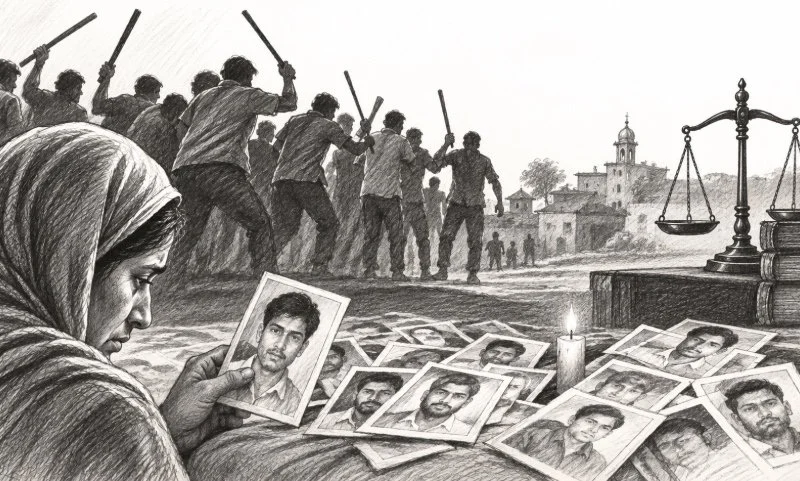
A similar though less extreme collapse appeared in 2014, when a woman from the Northeast who filed a molestation complaint was assaulted by advocates inside the Tis Hazari court complex in Delhi. The victim entered the justice system and encountered intimidation within it. Arendt warned that the most dangerous political condition is not always the absence of law but the moment legal protection ceases to operate for particular bodies.
For women from Northeast India, the street and the conflict zone are connected by a common structure. We are racialised as outsiders and subjected to assumptions about our sexuality and moral character. Our bodies carry the combined weight of racial, gendered and regional prejudice, expressed through racial mockery in Indian cities and ethnic violence in our own region. In both settings, the female body becomes a site of humiliation while the state watches, hesitates, or arrives too late.
The Triangle of Failure
India has long been aware of this problem. The killing of Arunachal student Nido Tania in Lajpat Nagar in 2014 prompted the Bezbaruah Committee, which documented widespread racism against people from the Northeast and recommended legal reforms. More than a decade later, legal reform remains incomplete. Courts have acknowledged the problem but left the task of legislative action to Parliament.
Law enforcement continues to process such cases under general criminal provisions, including assault, intimidation and offences against a woman’s modesty, while racial and gendered motivations disappear from First Information Reports. The result is a triangle of institutional failure. Policymakers acknowledge the problem, courts defer action to Parliament, and bureaucratic processes strip away the racial dimension of the violence, failures that render racial violence difficult to see within the legal system.
The irony is difficult to miss. India is a signatory to the International Convention on the Elimination of All Forms of Racial Discrimination, condemning racism internationally while remaining reluctant to name it within its own borders. The German philosopher Karl Jaspers, writing after the Second World War, argued that nations must confront the structures and prejudices that make certain forms of violence possible. Each time the law fails to recognise those structures, responsibility no longer rests solely with the individual perpetrator. It belongs also to institutions, politics, and the moral imagination of the nation itself.
I write these words from Germany. I have left India, but its questions remain with me. Distance brings the contradiction into sharper focus, the gap between the country’s constitutional ideals and the everyday vulnerability experienced by many of its citizens.
The demand must be stated plainly, and with specificity. India requires standalone legislation criminalising racial hate crimes, including racialised and gendered violence against people from Northeast India. The Bezbaruah Committee recommended this a decade ago. The Bharatiya Nyaya Sanhita, which replaced the Indian Penal Code in July 2024, was a missed opportunity. It could have introduced hate crime provisions with enhanced sentencing for racially motivated offences. It did not. Parliament should now amend the BNS to introduce racially aggravated offence provisions and require police training on recording racial motivation in First Information Reports, so that official records no longer erase the structures behind such violence.
India should not wait for another viral video of an assault or another death to recognise a problem it already understands. The time has come to treat the issue with constitutional seriousness and implement the Bezbaruah Committee's recommendations. Until then, the promise of equal citizenship will remain incomplete, and those most exposed to violence will continue to bear the consequences of that failure.
(Ngurang Reena is a writer and researcher from Arunachal Pradesh, currently based in Germany. Her work focuses on race, gender, and citizenship in India, with particular attention to the structural vulnerabilities faced by people from Northeast India. She writes on political philosophy, feminist theory, and the politics of belonging.)
You have just read a News Briefing, written to cut through the noise and present a single story for the day that matters to you. We encourage you to read the News Briefing each day. Our objective is to help you become not just an informed citizen, but an engaged and responsible one.
What happened in Mumbai on October 2 may have been only one day of protest, but the issues behind it are unlikely to disappear with the dispersal of the crowd. The protest was centred around concerns over the Election Commission, electoral rolls and the Special Intensive Revision (SIR) exercise, with protesters demanding accountability from Chief Election Commissioner Gyanesh Kumar. At the same time, similar mobilisation has been taking place across different parts of the country, with student groups, Opposition parties and civil society organisations raising concerns over the electoral process. Newsreel Asia spent the day at Mumbai Protest capturing the preparations, the police presence, conversations with protesters, the atmosphere on the streets and how the day unfolded. The speech of Cockroach Janta Party's leaders and sentiment of protestors seemed larger than the concerns regarding the electoral process. Will this lead to something bigger?