
By Asad Ashraf
August 5, 2026
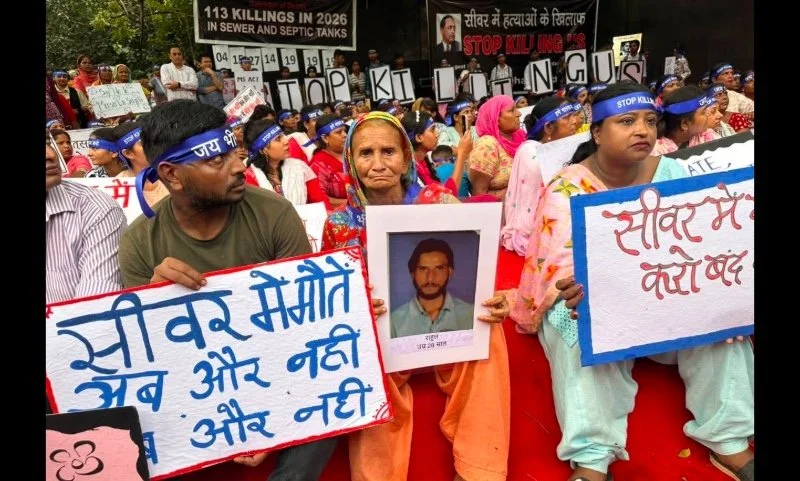
Photo by Safai Karmachari Andolan
New Delhi’s summer heat had not eased by the afternoon of August 4. At the Jantar Mantar protest site, weeks after the Gen Z protests made national and international headlines, the crowd carried something heavier than the burden of the heat. Sanitation workers, their families and activists had gathered under the banner of the Safai Karmachari Andolan, demanding that the government answer for deaths that it had spent a decade denying had occurred at all.
Forty-two-year-old Satyawati stood among them, wearing a headband that read “Stop killing us.” She had come to reopen a wound that never fully closed. On March 20, 2009, her brother-in-law left home for his job with the Municipal Corporation of Delhi and never returned. His name was Ashok Kumar. He had been sent, without warning or training, to clean a septic tank in Narela.
“He worked with the Municipal Corporation of Delhi as a cleaning staff. His routine work entailed collecting garbage,” Satyawati told Newsreel Asia. “Later, we received a call stating that Ashok went to clean a septic tank and never returned.”
Seventeen years on, that call has continued to define her family’s relationship with the state. It is a relationship shared, in one form or another, by thousands of Dalit families whose men continue to be sent down into pits the country claims it no longer has.
According to figures compiled by the Safai Karmachari Andolan, 101 workers have died in sewers and septic tanks this year alone, in just 188 days, a rate of one death roughly every 45 hours. Twelve of those deaths occurred in the Delhi-NCR (National Capital Region) area. Last year, the annual count stood at 121. A decade ago it stood at 39. The Andolan’s organisers noted that this year’s toll has already been reported from 16 states, a spread that shows this crisis has less to do with geography than with who is sent to perform it.


Since the Prohibition of Employment as Manual Scavengers and their Rehabilitation Act came into force in 2013, the Andolan has recorded 1,726 deaths. Seven states account for more than two-thirds of that toll. Tamil Nadu leads with 332 deaths, followed by Gujarat with 216, Delhi-NCR with 157, Maharashtra with 155, Uttar Pradesh with 148, Haryana with 104 and Bihar with 91. None of these states is known to have taken a measure to stop the deaths, the Andolan said.
In July 2023, the central government launched the National Action for Mechanised Sanitation Ecosystem, a scheme meant to end manual entry into sewers. It carried an allocation of 3.4973 billion (349.73 crore) rupees, a fraction of the nearly 190 billion (19,000 crore) rupees already spent under the Swachh Bharat Mission to build 120 million (12 crore) toilets. Three years on, sanitation work in India has allegedly remained almost entirely unmechanised. The 1993 law was meant to abolish dry latrines. They have allegedly not disappeared.
Ministers have repeatedly told Parliament that no one dies from manual scavenging in India. The claim has been made often enough, and denied often enough by the dead, that it has stopped surprising anyone tracking the numbers.
For the men and women who do this work, the state’s arithmetic makes little sense.
Paleram is 60, a daily-wage worker from Rohini who moved from Haryana. He began cleaning septic tanks some 25 years ago, with no training and no idea what the job would cost him. He started as a sweeper, earning 50 rupees a day. Cleaning clogged tanks paid better, 70 to 100 rupees, so he switched. His only instruction was to climb down slippery iron rungs and clean until the tank was empty. He recently fractured his leg after slipping inside one. Gloves have come only when an NGO happened to donate them. Most days he must go in wearing almost nothing at all.
Deepti Sukumar is 64 and has spent 35 years within the movement. “This is murder under the state’s watch,” she said, arguing that a government aware of a job’s hazards has no excuse for the bodies it keeps producing.
The demonstration drew Communist Party of India (Marxist) leader Brinda Karat and Rajya Sabha MP Manoj Kumar Jha, both of whom placed the deaths within a longer political failure.
Talking to media, Brinda Karat said, “These cleaners are invisible when they are alive, and when they are dead, the government treats them like they existed.” Jha pointed to the caste line running underneath the statistics. Sanitation work has remained hazardous by design, legal protections have remained minimal, and the men sent into tanks and sewers have overwhelmingly belonged to communities that the country has pushed to its margins for centuries.
None of this is new. Efforts to stop manual scavenging began in 1949, when Bombay convened a committee to study the practice and recommend its abolition. Committees followed in 1957, 1965, 1968, 1969, 1980, 1985, 1991 and 1992, according to the Dalit scholar Anand Teltumbde. A law prohibiting manual scavenging was finally passed in 1993. No one is known to have ever been prosecuted under it. A new law replaced it in 2013. That law carries its own defect. It does not count sewer work done with protective equipment as hazardous, and it never specifies what adequate gear looks like. For workers like Paleram, who has never owned a mask, the distinction counts for nothing.



Government data on manual scavengers has remained contested and incomplete. The 2011 Census recorded over 2.6 million dry latrines still in use. A Socio-Economic Caste Census the following year found over 180,000 households dependent on manual scavenging as a livelihood. The Safai Karmachari Andolan’s own surveys put the true number of manual scavengers above one million, nearly all of them Dalit.
Activists have long pointed to the Indian Railways as the country’s largest employer of manual scavengers. The Railways has avoided the label by calling such workers sweepers, hired through contractors, to clear excreta from tracks and platforms at a station like New Delhi, where hundreds of trains can pass through in a single day.
“It is absolutely criminal and shameful that the government is busy hiding the figures and misleading the country by portraying these deaths from manual scavenging as mere workplace accidents. It is a matter of national shame that, instead of preventing these deaths, the government is focused only on obscuring the truth,” said Bezwada Wilson, one of the founders and National Convenor of the Safai Karmachari Andolan, said at a press briefing.
At Jantar Mantar, the protesters wanted the 2013 law enforced, compensation and rehabilitation for the families of the dead, and a plain admission from Prime Minister Narendra Modi that a sewer death has occurred roughly every two days in his country this year.
Satyawati is still waiting for that admission, 17 years after the call about Ashok Kumar. So too are the families behind the other 1,726 deaths counted since the law meant to prevent them came into force, still waiting for the same acknowledgement.
You have just read a News Briefing, written to cut through the noise and present a single story for the day that matters to you. We encourage you to read the News Briefing each day. Our objective is to help you become not just an informed citizen, but an engaged and responsible one.


Hundreds of protesters gathered at Bangla Sahib in Delhi at 1 PM on October 23 for a protest called by People Against SIR, a collective of over 100 organisations mobilising against the Election Commission of India’s Special Intensive Revision (SIR) of electoral rolls across the country. Along with detentions and use of force, security personnels are using another tactic - blowing whistles to silence the voices.