
From the Editor’s Desk
August 24, 2026

More than 87 million (8.7 crore) Indians age 15 to 29 are not studying, working or getting any training, according to report by NITI Aayog, the Indian government’s policy think tank.
The figure appears in a report titled “Reimagining Skilling for Viksit Bharat@2047,” released in August 2026. NITI Aayog said the estimate comes from 2021 data collected in round 78 of India’s National Sample Survey.
The think tank calls this group NEET, an acronym meaning they are neither enrolled in school nor employed nor getting any training. The report defines NEET youth as people age 15 to 29 who are not in school, do not hold jobs and are not undergoing training, including those who are unemployed.
In the report, NITI Aayog’s own data table puts the NEET population, not counting people actively seeking jobs, at close to 90 million, or about 11% of that age group, using the 2021 survey. Nearly 88% of that narrower group is engaged in domestic duties, the table says.
NITI Aayog sorts India’s labour force and learners into five groups, NEET youth, women, school students, tertiary students, and the formal and informal workforce, which together add up to roughly 600 million people. The count includes 120 million school students from grade six onward, 44 million people studying at the tertiary level, 70 million workers whose positions come with some form of social security coverage and 270 million more whose work carries none. Among women, only 3% hold formal jobs, while 71% work informally or fall into the NEET group, the report found.
“NEET youth are constrained by the absence of income and the sunk cost of prior education,” the report said, adding that many in this group are already juggling other money obligations and cannot take on paid training at the same time.


The report also said NEET youth and women need affordable or subsidised training options, paired with targeted financial support where the barriers are greatest. It said every group it studied needs some way to earn money while they train.
For workers already in jobs and for NEET youth, the report said the need moves toward mid-career reskilling, self-employment paths and training tied to local demand and growing sectors.
Students from low-income households, already stretched by college costs and private tutoring, often cannot afford paid skilling on top of a degree, the report said. Many take whatever job pays after finishing school, even a low-paying one, so they can help support their households, while others fail to find work and become NEET, it said.
Only 8.25% of graduates work in jobs matched to their qualifications, the report said, citing the Economic Survey 2024-25. It said many graduates get too little hands-on practice or training matched to what employers want, which limits their job prospects even after earning a degree.
The report said 82% of NEET respondents pointed to a lack of job-interview preparation and placement support as a gap in existing skilling programs, citing the government’s State of Skills Survey 2024. Lack of awareness about available programs was also common, the report said, with 43% of NEET youth and 47% of women naming that gap as one of their top reasons for not pursuing skilling.
Since 2014-15, more than 76.7 million people have been trained under India’s skilling programs, the report said. The Union budget for the 2025-26 fiscal year set aside 340 billion rupees for skilling-related spending at several national government ministries.

State governments have run their own initiatives alongside the national effort, the report said, citing Tamil Nadu’s Naan Mudhalvan and Maharashtra’s Mahaswayam as examples. It said civil society groups and private companies have also added to the skilling system.
The report said it drew on a mix of national employment data, field-based interviews and comparisons with skilling systems in other countries to reach its conclusions.
The report places the ongoing youth protest movement initiated by the Cockroach Janta Party (CJP) in a deeper economic and social context. Protests over examination leaks, poor educational facilities, delayed recruitment and unemployment arise from a much larger failure to provide young people with a reliable path from education to dignified work. Even a degree offers little protection if only 8.25% of graduates find work suited to their qualifications, while millions cannot afford further training or do not receive the placement support needed to enter the labour market.
A generation repeatedly told that it will build a developed India now learns from the government’s own policy body that tens of millions of young people remain outside education, employment and training. Treating their anger primarily as a law-and-order problem would ignore the report’s deeper warning, that India’s large young population cannot remain an advantage if opportunities are scarce, costly and unfair. Under such conditions, economic frustration can become a wider loss of trust in the government and its institutions.
You have just read a News Briefing, written by Newsreel Asia’s text editor, Vishal Arora, to cut through the noise and present a single story for the day that matters to you. We encourage you to read the News Briefing each day. Our objective is to help you become not just an informed citizen, but an engaged and responsible one.
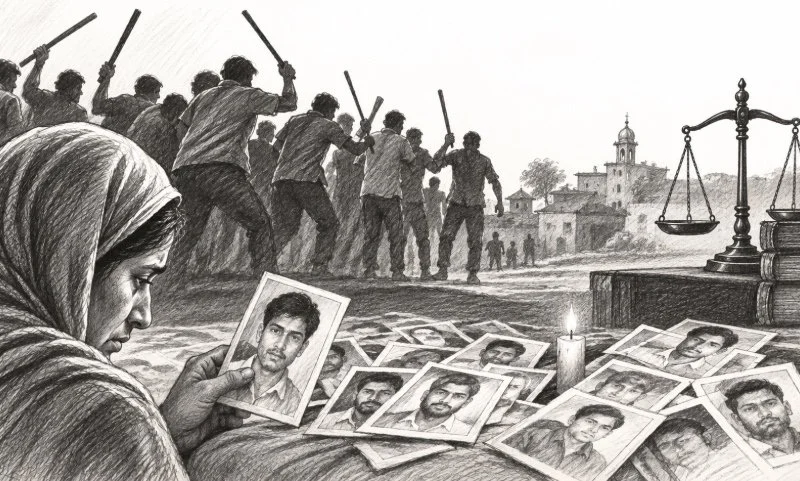

Hundreds of protesters gathered at Bangla Sahib in Delhi at 1 PM on October 23 for a protest called by People Against SIR, a collective of over 100 organisations mobilising against the Election Commission of India’s Special Intensive Revision (SIR) of electoral rolls across the country. Along with detentions and use of force, security personnels are using another tactic - blowing whistles to silence the voices.