
Manipur: Kuki-Zo Groups Denounce Shaurya Chakra Award to CRPF Officer
From the Editor’s Desk
January 27, 2026
A Kuki-Zo tribal group has condemned the Indian government’s conferment of the Shaurya Chakra to a Central Reserve Police Force (CRPF) officer allegedly involved in the November 2024 killing of 10 civilians in Manipur, calling it a “state endorsement of the extrajudicial killing.”
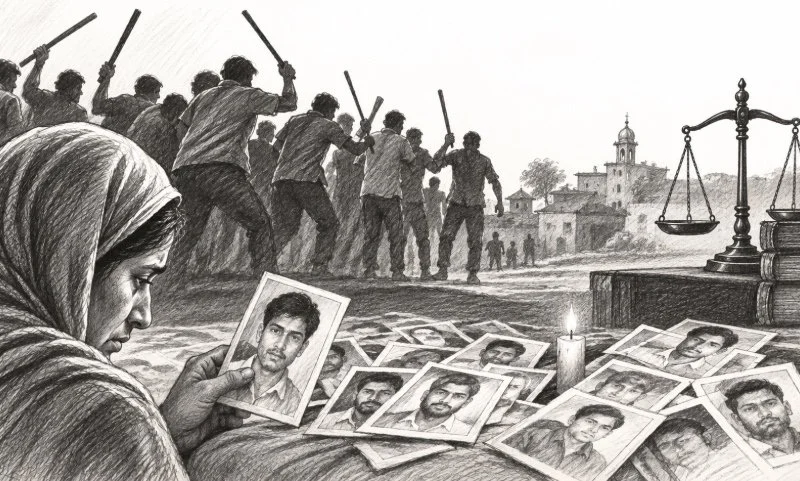
The Kuki Organisation for Human Rights Trust denounced the Shaurya Chakra awarded to Assistant Commandant Vipin Wilson of the CRPF’s 20th Battalion on Republic Day, alleging his role in the “extrajudicial killing” of 10 Kuki-Zo village volunteers, all men aged 16 to 31, in Manipur’s Jiribam district on Nov. 11, 2024.
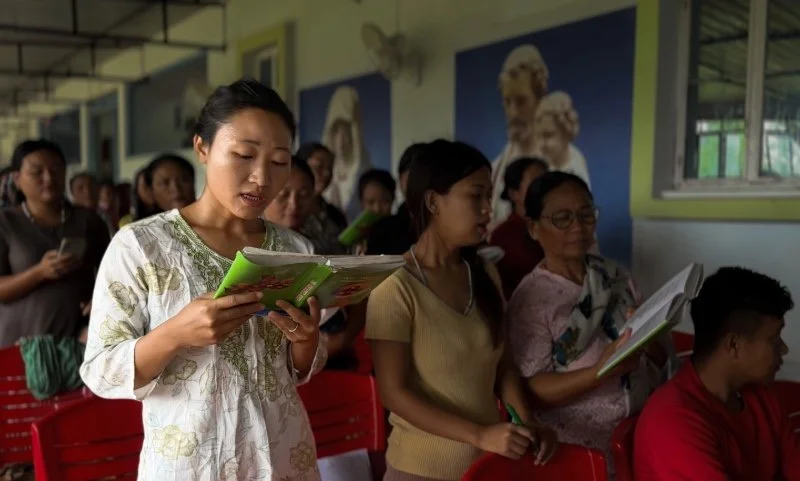
The “village volunteers” in Manipur are armed civilian groups that formed after May 3, 2023, when large-scale violence erupted amid a longstanding conflict between the majority Meitei community and the minority Kuki-Zo tribal groups. Comprising mostly young men and women from Kuki-Zo communities, these volunteers began guarding their villages with locally made guns and basic weapons to protect their people, homes, places of worship and relief camps from repeated attacks.
The violence has killed more than 250 people, destroyed homes across hundreds of villages, and displaced tens of thousands.
Autopsy records, reviewed by Newsreel Asia at the time, indicated that seven of the victims were shot from close range, five were shot from behind or below, and several sustained additional physical injuries inconsistent with gunfire alone.
Four days before the incident, a Kuki-Zo woman was allegedly gang-raped and burned to death, triggering widespread fear and tension in the region. The volunteers had reportedly been searching for those involved in the assault when they reportedly approached a CRPF checkpoint in Jiribam district.
The CRPF has stated through media that the 10 individuals were “militants” who had attacked a police station and a CRPF camp. The force claims its personnel returned fire from a bulletproof multi-purpose vehicle, killing the attackers who, it says, were trying to divert attention from a planned assault on a relief camp for Meitei civilians.
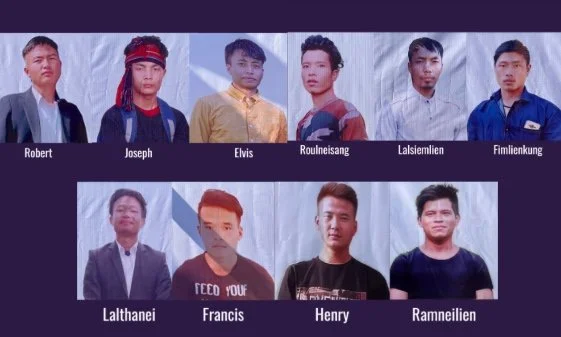
Medical evidence cast doubt on this version. Two of the 10 men, Fimlien and Ramneilien, were shot directly from behind. Six others, namely Robert, Joseph, Francis, Henry, Lalthanei and Roulneisang, sustained gunshot wounds from multiple directions. Lalsiemlien and Elvis were shot from the right and left sides of their bodies, respectively.
Seven men had blackened entry wounds on their bodies, typically a sign of firing at very close range. One of them, Francis, had 11 such wounds. The blackening occurs when soot and gunpowder residue from the barrel settle around the skin, suggesting firing occurred at close quarters.
Bullet trajectories in five victims indicated upward movement of the projectiles. This suggests that the shooter was either below the victim or firing at an upward angle, which forensic experts say is inconsistent with firing from a vehicle-mounted weapon.
Six of the deceased had physical injuries that were not consistent with gunfire. Joseph, Elvis, Henry, Ramneilien, Lalsiemlien and Fimlienkung had blunt-force injuries, abrasions and pressure wounds. Joseph’s autopsy showed a crush injury on his thumb and fingers. Elvis had a grazed abrasion roughly the size of an A4 sheet and a diffuse neck contusion extending to prevertebral tissue, possibly from strangulation.
Lalsiemlien’s body showed five pressure abrasions and a fractured sternum. Henry had five separate lacerated wounds. In total, five of the bodies had lacerations likely caused by blunt objects. Such wounds are typically sustained in physical assault, not combat.
Four of the men, Lalsiemlien, Henry, Francis and Fimlien, were missing one eye each. The missing eyes appeared to be post-mortem injuries, raising questions about whether the bodies were desecrated while in the custody of security personnel after the killings.
The youngest victim, Robert Lalnuntluong, was 16 and had completed Class 10. Other deceased included construction workers, farmers, daily-wage labourers and a graphic designer. None had a criminal record or reported links to insurgent groups.
The paramilitary force did not issued any official public statement on the incident. The state and central governments also remained silent.
The Kuki-Zo rights group has called for the award to be revoked and demanded a Supreme Court-monitored probe involving independent human rights observers.
The 10 deaths occurred in the larger context of ethnic violence, which continued despite the deployment of security forces, imposition of curfews and intermittent suspension of mobile internet.
You have just read a News Briefing, written by Newsreel Asia’s text editor, Vishal Arora, to cut through the noise and present a single story for the day that matters to you. We encourage you to read the News Briefing each day. Our objective is to help you become not just an informed citizen, but an engaged and responsible one.
What happened in Mumbai on October 2 may have been only one day of protest, but the issues behind it are unlikely to disappear with the dispersal of the crowd. The protest was centred around concerns over the Election Commission, electoral rolls and the Special Intensive Revision (SIR) exercise, with protesters demanding accountability from Chief Election Commissioner Gyanesh Kumar. At the same time, similar mobilisation has been taking place across different parts of the country, with student groups, Opposition parties and civil society organisations raising concerns over the electoral process. Newsreel Asia spent the day at Mumbai Protest capturing the preparations, the police presence, conversations with protesters, the atmosphere on the streets and how the day unfolded. The speech of Cockroach Janta Party's leaders and sentiment of protestors seemed larger than the concerns regarding the electoral process. Will this lead to something bigger?