
Is Iran War Pushing India Into a Kitchen and Energy Crisis?
From the Editor’s Desk
March 14, 2026
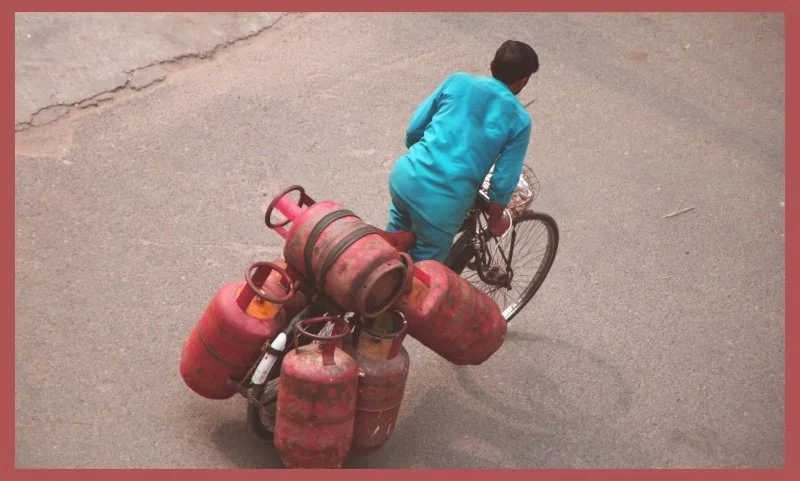
The ongoing U.S.–Israel confrontation with Iran is already reaching Indian kitchens, petrol pumps, factories and household budgets. Disruptions to shipping in the Strait of Hormuz have slowed or halted tankers carrying oil and gas, triggering supply shocks that are spreading through India’s energy system and everyday economic life. The effects are visible on the ground in long queues outside LPG agencies, restaurants cutting menus because commercial cylinders have run short, and factories pausing production for lack of fuel.
The Strait of Hormuz is one of the most strategically sensitive waterways in the global economy. Around one-fifth of the world’s traded oil moves through this narrow corridor between Iran and Oman. India depends heavily on that route. About half of the country’s crude oil imports pass through Hormuz, roughly 2.5 to 2.7 million barrels per day sourced from Iraq, Saudi Arabia, the United Arab Emirates and Kuwait.
Around 85 to 90 percent of India’s LPG, liquefied petroleum gas, imports and a large share of its LNG, liquefied natural gas, shipments move through the same route. LPG serves mainly as a cooking fuel in households, restaurants and small businesses, while LNG is used largely by power plants, fertiliser factories and other industries that depend on natural gas for energy and production.
In the first weeks of the conflict crude prices rose by about 15 to 17 dollars per barrel, briefly pushing Brent into the range of 100 to 120 dollars. Spot prices for LPG and LNG rose sharply as well, in several cases exceeding previous levels by more than half.

The United states has temporarily eased some sanctions on Russian oil shipments for 30 days, allowing tankers already loaded with Russian crude to reach buyers without triggering U.S. penalties. However, Brent soon climbed again above the 100 dollar mark, trading around 103.24 dollars per barrel on the evening of March 13, according to The Associated Press. On February 27, the eve of the conflict’s escalation, Brent traded at about 72.87 dollars per barrel.
Iranian officials have also issued warnings that suggest further escalation in energy markets. Ebrahim Zolfaqari, spokesperson for Tehran’s Khatam al-Anbiya military command headquarters, said on March 11 that Iran may move from the current pattern of retaliatory strikes to continuous attacks on its adversaries. “Get ready for the oil barrel to be at $200 because the oil price depends on the regional security which you have destabilised,” Zolfaqari said.
As of now, the most visible pressure has appeared in cooking gas supply.
More than 300 million Indian households depend on LPG for daily cooking, along with countless restaurants, hotels and small eateries. The government invoked emergency powers in early March, directing refineries to increase domestic LPG production by about 25 percent. Domestic LPG production now allows refineries to meet roughly 40 to 50 percent of national demand, compared with the usual level of about 38 percent before the crisis. The rest still depends on imported LPG cargoes and supplies from existing national stockpiles.
Authorities also diverted supplies toward households and essential institutions including hospitals and schools, according to news reports. Officials say India holds about 30 days of LPG stock as a national buffer. Emergency kerosene allocations of about 48,000 kilolitres have also been released as a backup fuel.


These measures have eased some household pressure but created severe stress in the commercial cooking sector. Refineries shifted supplies away from commercial 19-kilogram cylinders toward domestic distribution. Restaurants, hotels, cloud kitchens and street vendors depend heavily on those commercial cylinders. In cities including Bengaluru, Mumbai, Hyderabad, Chennai, Patna, Bhopal and several districts of Kerala, restaurant associations report that many establishments have reduced their menus, shortened operating hours or temporarily closed.
Some restaurants have removed items that require long cooking times such as rotis, parathas or pizzas. Others have shifted partially to induction cooktops or kerosene stoves. Delivery platforms such as Swiggy and Zomato report delays as kitchens struggle with irregular fuel supply.
Ordinary households have also begun experiencing strain. Booking systems for LPG refills have repeatedly crashed as demand surged. The refill cycle that usually runs around 20 to 25 days has stretched toward 25 to 45 days in some areas. Long queues outside gas agencies have appeared in cities and small towns across northern India.
Black market activity has been reported in several states. Gagandeep Singh Sapra, a restaurant owner in Delhi, wrote on social media “We are shutting down too now — gas is finished. Black marketeers are now asking for Rs 5000+++ for gas cylinders. If there is no supply for commercial cylinders, how do they have it in the black market? That is the big question. Where are the so-called ED/CBI? Who is the babu or neta backing this black marketing?”
Government officials maintain that household LPG supply remains secure and stress that diplomacy has already allowed a few LPG tankers to reach India safely through the strait. Authorities also say enforcement measures against hoarding and black marketing are underway.
Industrial sectors are showing early signs of disruption as well. The ceramic manufacturing hub of Morbi in Gujarat depends heavily on propane and natural gas. About 170 factories there have reportedly shut operations, and several hundred more face closure if fuel supply remains uncertain, as reported by The New Indian Express.
Fertiliser production presents another vulnerability. Natural gas-based urea plants account for about one quarter of India’s fertiliser capacity. Supply constraints raise the possibility of higher fertiliser prices and a larger fertiliser import bill, which could reach about 18 billion dollars in the current financial year, a surge of 76% from a year earlier, according to Reuters.
Transport fuel remains another major concern. Retail petrol and diesel prices have stayed largely unchanged so far even as global crude prices have surged, because the government and state-owned oil companies are absorbing part of the cost increase. Economists say sustained high crude prices will eventually place pressure on pump prices if the conflict continues. Under prolonged supply stress, petrol and diesel could move toward or beyond about 100 to 120 rupees per litre in many cities.
Higher transport costs quickly filter through the entire economy. Freight charges rise, food prices follow, and electricity generation costs increase where power plants rely on imported fuels. Taxi drivers, delivery workers and small traders may face immediate income pressure if operating costs climb.
You have just read a News Briefing, written by Newsreel Asia’s text editor, Vishal Arora, to cut through the noise and present a single story for the day that matters to you. We encourage you to read the News Briefing each day. Our objective is to help you become not just an informed citizen, but an engaged and responsible one.



On October 12, opposition leaders, MPs, MLAs, student organisations and political workers came together in a massive march against Chief Election Commissioner Gyanesh Kumar, raising serious concerns over the Special Intensive Revision (SIR) of electoral rolls and the alleged mass deletion of voters’ names. The march brought together a broad coalition, including the INDIA bloc, AISA, SFI and other student unions, as part of a wider nationwide mobilisation against the SIR exercise and concerns surrounding electoral integrity.