
India Fared Worse on Governance and Per-Capita Income Than It Would Have Without Modi, Study Says
From the Editor’s Desk
August 27, 2026

Generated with AI
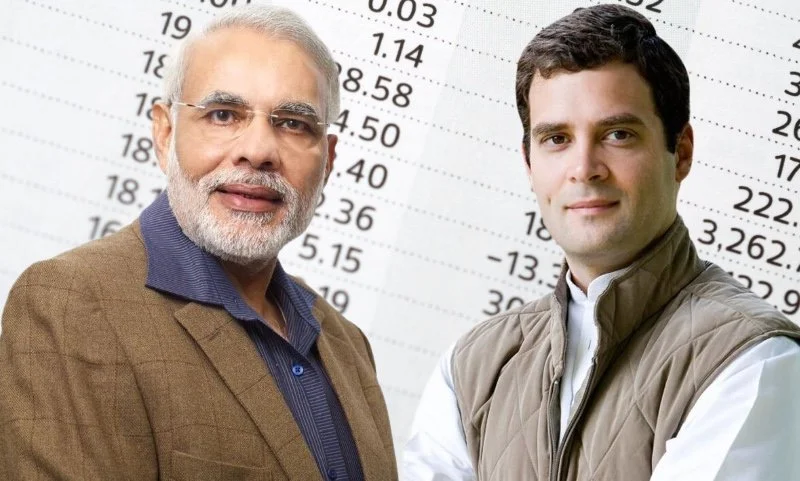
Governance in India weakened, and economic growth fell short of what a comparable country might have achieved during the decade in which Narendra Modi and the Bharatiya Janata Party (BJP) governed the country, according to a new study.
The study, conducted by Kevin Grier of Texas Tech University’s Department of Political Science and Robin Grier of its Department of Agricultural and Applied Economics, was released in August 2026. The researchers used a statistical technique called the synthetic control method. They created a model of a country resembling India, but without Modi and the BJP in power, to estimate how India might have performed had the party not taken office in 2014.
The researchers combined data from several countries to create this model, which they call “Synthetic India”. They selected and weighted the countries differently for each measure so that the model closely matched India’s actual performance during the 30 years before Modi took office. According to the authors, Synthetic India closely tracked real India on all 10 governance measures before 2014.
The study examined 10 governance indicators over the 10 years from 2014 to 2023, producing 100 annual comparisons. India performed worse than Synthetic India in 96 of them. By 2023, India’s real income per person was also about 10 percent lower than the model estimated it would have been without the change of government in 2014.
One of the indicators was the polyarchy index, which measures whether elections are genuinely open and competitive. By 2023, the gap between real India and Synthetic India on this index was equivalent to 60.2 percent of India’s own 2013 score. On the liberal democracy index, which also considers legislative and judicial checks on the executive and the protection of civil liberties, the gap was equivalent to 69.1 percent of India’s 2013 score.
The gap in legislative checks on the executive was equivalent to 28.8 percent of India’s 2013 score, while the gap in judicial checks was 12.7 percent. The corresponding gaps were 56.2 percent for freedom of expression, 29.6 percent for freedom of association, 30.4 percent for equality before the law and 26.1 percent for equal protection under the law.
Freedom of religion recorded the largest gap. The difference between real India and Synthetic India was equivalent to 168.7 percent of India’s 2013 score. This figure does not mean that religious freedom literally fell by more than 100 percent. It expresses the size of the gap in relation to India’s earlier score on an index that uses an interval scale. Political corruption, meanwhile, was 46.8 percent higher by the same calculation. This was a negative result because a higher score on that index indicates greater corruption.

All 10 governance measures passed the study’s strictest statistical test. The researchers applied the same method to other countries, treating each one as if it had experienced a comparable political change. In every case, the gap recorded for India was larger than the artificial gaps produced by these placebo tests.
To estimate how India’s income might have grown without Modi, the researchers created another version of Synthetic India using economic data from Bangladesh, China, Ethiopia, Pakistan and the Philippines. Before 2014, this model differed from India’s actual annual income per person by an average of about $59, or roughly 1 percent of India’s 2013 income. The researchers considered this a close match.
After 2014, the gap between India’s actual income per person and the model’s estimate began at about $400 a year. It widened to more than $1,000 a year and continued growing until the end of the study period. The study therefore estimates that India’s annual income per person is now roughly $1,000 lower than it would have been under what the authors call a “business as usual” scenario.
The authors treated India’s 2016 demonetisation policy as part of the government’s record because it was a deliberate policy decision, rather than an external event. They treated the Covid-19 pandemic as a global disruption because it also affected the countries used to create Synthetic India.
The researchers also conducted a placebo test in which they assumed that Modi had taken power in 2001 rather than 2014, although no such change occurred that year. This test found no meaningful effect. According to the authors, this strengthens the case that the difference appearing after 2014 reflects a real change rather than a built-in flaw in their method.

The study also examined how Modi and the BJP continued winning elections during a period in which these governance and economic indicators declined. In the 2014 general election, the BJP received 31.3 percent of the national vote but won a majority of seats in the Lok Sabha. Opposition parties competed separately, dividing the votes cast against the BJP. That year, 61 percent of the winning candidates secured their seats despite receiving less than half the votes cast in their constituencies.
The BJP’s national vote share rose to 36.6 per cent in 2024, but the party won only 240 seats. It lost its single-party majority for the first time in a decade after opposition parties formed the Indian National Developmental Inclusive Alliance, or INDIA, in 2023 and coordinated their electoral campaigns. The BJP now governs with the support of its National Democratic Alliance partners, the study noted.
The study cited Uttar Pradesh as an example of the effect of opposition coordination. The BJP’s vote share in the state changed only slightly, from 42.3 percent in 2014 to 41.37 percent in 2024. Its number of seats, however, fell from 71 out of 80 to 33. The Samajwadi Party and Congress, which were no longer dividing the anti-BJP vote to the same extent, won a combined 43 seats.
The authors concluded that two factors have helped Modi remain in power: a loyal base of Hindu nationalist voters and an opposition that has repeatedly divided its own vote. They argued that these factors allowed him to govern with the support of roughly one-third to two-fifths of the national electorate.
Finally, the researchers tested whether developments in neighbouring countries or an unrelated crisis coinciding with Modi’s time in office could explain India’s performance. They found no evidence that either explanation accounted for the results. The authors argue that these tests strengthen their conclusion that the changes are associated with Modi’s government.
You have just read a News Briefing, written by Newsreel Asia’s text editor, Vishal Arora, to cut through the noise and present a single story for the day that matters to you. We encourage you to read the News Briefing each day. Our objective is to help you become not just an informed citizen, but an engaged and responsible one.
What happened in Mumbai on October 2 may have been only one day of protest, but the issues behind it are unlikely to disappear with the dispersal of the crowd. The protest was centred around concerns over the Election Commission, electoral rolls and the Special Intensive Revision (SIR) exercise, with protesters demanding accountability from Chief Election Commissioner Gyanesh Kumar. At the same time, similar mobilisation has been taking place across different parts of the country, with student groups, Opposition parties and civil society organisations raising concerns over the electoral process. Newsreel Asia spent the day at Mumbai Protest capturing the preparations, the police presence, conversations with protesters, the atmosphere on the streets and how the day unfolded. The speech of Cockroach Janta Party's leaders and sentiment of protestors seemed larger than the concerns regarding the electoral process. Will this lead to something bigger?