
By Ngurang Reena
August 26, 2026

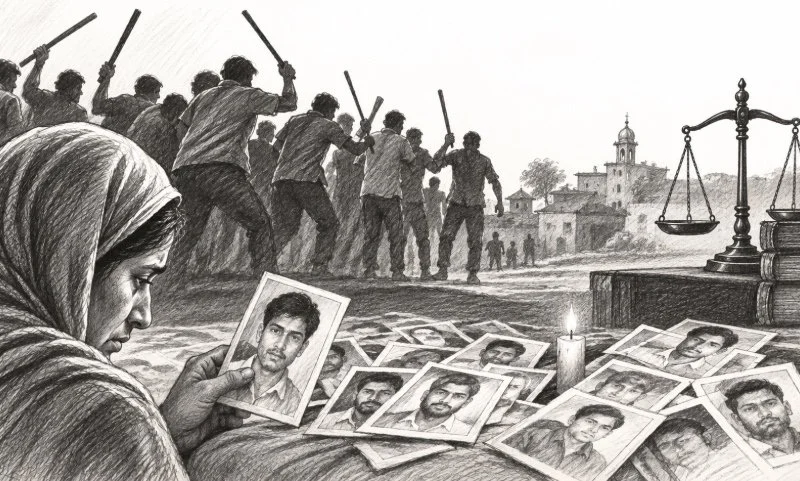
An AI-generated illustration
Growing up in a polygynous household taught me how a man’s decision to take another wife can alter the lives of the women and children who are given no say in it. It divided my father’s time, money and presence between two families, leaving my mother and her daughters to live with the consequences, though I do not hold him alone responsible for what followed.
Unlike the holidays that had come before, that summer would be different, though I did not know it yet. My younger sibling and I had been counting the days with the uncomplicated greed of children who want nothing more than to escape school and return home. After my father, who is now dead, arrived in his white jeep, we climbed in, thrilled and already arranging ourselves for joy. He had barely pulled onto the road before he spoke: “We are going to see your new mother today.”
A New Mother
I was five, perhaps six. I did not yet know the weight those words carried under Nyishi customary law, and I could not have foreseen what our lives would look like from that turning point onward. I knew only that the road we were taking was not the road home and that something in the air inside that jeep had changed. I did not cry immediately.
First came the incomprehension. Then the road turned and kept turning. Eventually, we arrived at a door that was not ours, and a woman who was not our mother stood in it. My father introduced her with the same calm authority with which he introduced everything: as settled fact, as the natural order, as the world arranging itself as it must. My mother was not there to be introduced. She was not consulted because, in a house built on custom, consultation was never part of the architecture. I cried then, but secretly. It changed nothing.
I grew up in a polygynous Nyishi household in Arunachal Pradesh, and for a long time, I did not have a name for what I was growing up inside. I was ashamed of my dysfunctional family. I was ashamed of myself.
The Nyishis are one of the largest tribes in the northeastern frontier state, and polygyny is not a secret among us. It is customary and uncodified, but binding, and has been practised across generations with the unremarkable confidence of things that have never been seriously challenged. A man with multiple wives is a man of standing. The practice is governed by no statutory law, which is precisely why it has never needed to answer to anything.
The first wife is, in theory, accorded respect and precedence. In practice, I watched my mother become a category, what the women of my community, without irony, call the destitute first wife. Years later, sitting across from women who used that same phrase to refer to themselves, I understood that it was not my family’s private shame, but a term with a whole unspoken sociology behind it. No divorce is available to her. There never was. The first wife. A position rather than a person.
My mother moved through all of this without complaint, which was its own form of dignity. I see her most clearly now when I am not trying to: sitting by the Immi, her face turned towards the flame, the wrinkles gathered across it looking, in that light, like something that happens to our flesh after a long drowning. She was tending the fire, making fodder or doing the next necessary thing. She was always doing the next necessary thing. The smoke rose around her as if in quiet agreement.
A Childhood of Rationed Care
What followed that day in the jeep was not a single rupture, but a slow redistribution of time, money and presence along lines that had never been equal to begin with. My father now divided himself between two households, and what had never been enough grew thinner still. He appeared less often. At birthdays, we would arrange ourselves around his absence, setting the table for someone who might not come and often did not. The festivals that had always meant his presence, his noise and his particular way of filling a room became exercises in waiting. A child does not understand structural obligation. She understands only that her father used to come and now does not, and draws the only conclusion available to her: that she is less important than she was.
The money thinned. This is perhaps the most undignified consequence of polygyny: its arithmetic is simply impossible. School fees began to arrive late, sometimes so late that we would receive notices from the school authorities. With them came a particular anxiety that settles in the body before it reaches the mind. I learned to read the fiscal weather of our household by watching the adults’ faces, listening to conversations held just beyond my hearing and understanding that my needs required careful timing. I did not ask for things directly. I learned to wait, to gauge and to make myself small in proportion to what I required.
I often fell ill as a child, and my body registered what my mind was still working to process. I quickly learned that illness was an imposition. This was not because my family was cruel, but because the resources for attention had already been stretched past their limits. So I shut down. I stopped reporting my illnesses. I would let sickness run its course in silence. Once it became impossible to hide, I would finally say something, braced for the feeling that I had caused a problem simply by having a body that needed care.
I remember one such illness with particular clarity. I was nine, perhaps ten, and had been burning with fever for days before anyone could act. This was not because of indifference, but for the more humiliating reason that there was no money and no car, and a doctor cost two or three hundred rupees that we did not have. My mother eventually travelled for hours to reach the house where my father now lived with his second wife and collect what we needed.
I was brought there too, my body still feverish. In that room, I witnessed the three of them arguing over two or three hundred rupees while I sat, small and waiting, understanding with the particular clarity that sick children sometimes have that the cost of my care was itself a point of contention. Eventually, I was taken to hospital. I recovered. But something else did not recover: the sense that my body’s needs were a problem to be negotiated among adults who already had other problems. That knowledge did not leave me after the fever did. It became the template.
Daughters, Not Heirs
Another pressure ran beneath all of this, quieter but no less insistent: the pressure to produce sons. In a Nyishi household, ancestral property and clan identity pass through the male line, and a woman who bears daughters has, by the community’s accounting, produced dependants rather than heirs. Even our own belonging to the tribe, I would learn only much later, ran through that same line. It was inherited, but never quite owned outright. In a polygynous household, this calculus becomes crueller still. The second wife arrives partly as a correction, an attempt to remedy what the first wife is presumed to have failed to provide. The girls caught inside this arrangement understand their position without being told.
We were loved. I believe that. But we were loved in the way that things are loved when they are not quite what was needed. The boys inherited differently, not just the land and ancestral claims, but the family’s forward-looking attention and investment in their futures. The girls inherited the present tense: the emotional labour of keeping the household functional and the unspoken expectation that we would absorb the family’s distress so that it did not have to be acknowledged. We became, at a very young age, the load-bearing walls of a structure that would not credit us for holding it up.
My Father and the System
My father was not a simple villain in this story, and I refuse to write him as one. He was a man formed by the same customary world that formed all of us, a world in which his choices were not only permitted but socially rewarded, and in which a second wife was seen as a sign of prosperity rather than betrayal. He loved us. I believe that, and I hold on to one piece of evidence: he sold ancestral land, land that exists under our custom precisely to pass unbroken through sons, to put his daughters through school. It was an unusual thing for a man of his generation to do, and it earned him a strange, unstable reputation among the clan.
He was half admired as progressive and half quietly judged as a man who did not understand what a father was for. In this one respect, he exceeded the limits of his own system. But love in a polygynous household competes for time, money and presence, and love that must compete becomes, over the years, love that is rationed. We received our ration, land sold and all, and we were constantly reminded, especially by members of the clan, to be grateful for it.
The debate about polygyny, on the rare occasions it takes place, focuses on the wives: their legal standing, their rights under customary law and the question of reform within a framework that has never recognised women as rights-bearing individuals in the first place. But the children are also inside the house, and they are learning too. They are learning that their mother can be supplemented, that their father’s loyalty is a finite resource and that the family, the very unit meant to be the first site of safety, is itself a negotiation between a man’s desires and the women who must accommodate them.
Leaving, but Not Leaving It Behind
I left. First the household, then the state and, eventually, the country. Each departure was influenced by what the white jeep had taught me: that I was not the protagonist of the story being told around me and that, if I wanted a different story, I would have to go somewhere the old one had less authority.
Before my father died, he was devastated by my relationship with a man from outside the tribe. I had never seen him sob before. He said he was hurt, that I had disappointed him, and then he went silent for six months. This long period of silence tore through me in ways I was unprepared for, even after everything. Before the silence closed over us, he sent one SMS: “I hope you know what you are doing. There will be consequences for your decisions. You know that.” I read it the way I had learned to read everything in that household, looking for what lay underneath and bracing for what came next.
What I did not understand then, but understand now, is that his grief was also the grief of a system that had always assumed my choices were not fully mine to make. He had driven me to meet a new mother without asking whether I was ready. He could not understand why I had chosen a partner without asking whether the tribe approved. He had once sold his own land, exceeding the limits of that same system, but this, apparently, was the one boundary even he could not cross. He had introduced me to a settled fact. He expected me to do the same.
We met for the last time in August 2017 in New Delhi, three months before his death. He asked me if I was happy and if I was sure. It was the first time he had ever asked me anything about my own life rather than announcing its terms. I told him I would be happy if I were allowed the agency to exercise my own rights. He died in November. I do not know what he made of my answer. But I have thought about that question, “Are you happy? Are you sure?”, more than almost anything else he ever said to me. It came so late. It was something.

Learning What Safety Feels Like
Germany gave me something I had not known I was starved for: the anonymity of streets where no one knows your clan, your mother’s position or your father’s household arrangements. I can walk here without being someone’s daughter first. But the nightmares still follow me. The panic that lives in my body does not recognise the border I crossed. Europe taught me that safety has a geography and that geography is not the same thing as healing.
What it could not teach me, and what I am learning only now, slowly, from watching my husband’s family move through their ordinary lives, is what a functional family actually looks and feels like. The planned holidays. The showing up. The unremarkable fact of people coming when you need them. I did not grow up with this. I am learning it the way adults learn things they should have absorbed as children: carefully, with some disbelief, while unlearning older habits at the same time. At this late stage, I am learning how to be loved and how to love in return without bracing for the moment when love is rationed.
This is the inheritance of the polygynous household: the deep, cellular knowledge that you are negotiable. That your position in any room, any family or any community is subject to revision by forces that will not consult you.
I carried that knowledge out of Arunachal Pradesh, to Delhi and then to Europe, across borders that the men of my tribe have never had to cross in quite the same way. The house I grew up in taught me what I was worth inside its walls. Leaving taught me to ask a different question: worth, according to whom? I am still asking it. That, I have come to understand, is the only freedom that being the daughter of the first wife could not take from me.
(Ngurang Reena is a writer and researcher from Arunachal Pradesh who is currently based in Germany. Her work focuses on customary law, tribal identity and women’s belonging in Northeast India. She writes on political philosophy, feminist theory and the politics of belonging.)
You have just read a News Briefing, written to cut through the noise and present a single story for the day that matters to you. We encourage you to read the News Briefing each day. Our objective is to help you become not just an informed citizen, but an engaged and responsible one.
In this documentary, Newsreel Asia producer Harshita Rathore travels to Arunachal Pradesh to understand the decades-long debate surrounding the Arunachal Pradesh Freedom of Religion Act (AFRA), 1978. Through conversations with leaders from the Christian community and the Donyi Polo movement, she explores why the law was introduced, why it remained dormant for 46 years, and why its revival has sparked fresh protests after the Gauhati High Court's 2024 directive. The documentary also examines the history of religious conversion in Arunachal Pradesh, the revival of indigenous faiths like Donyi Polo, and the larger question of whether faith can ever be regulated by law.