
More European Ships Could Head to India for Scrapping, Raising Safety and Pollution Risks
From the Editor’s Desk
September 1, 2026
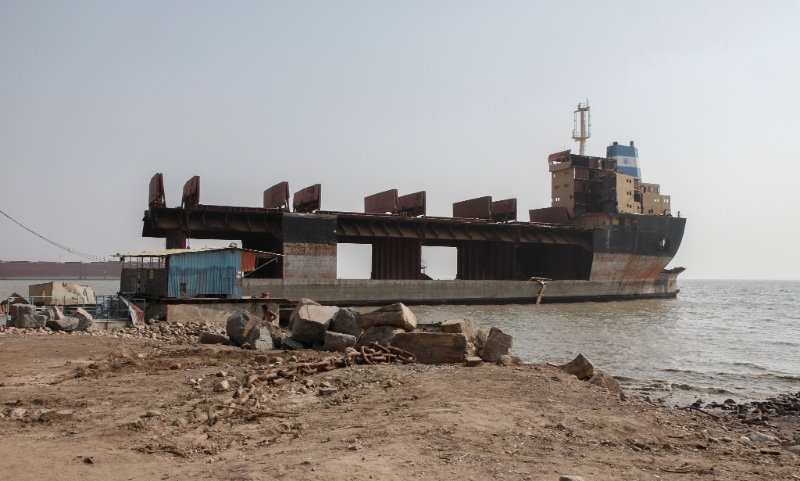
India could be facing a much larger influx of old European ships being dismantled on its beaches in the coming years, exposing Indian workers and coastal environments to the hazards of an industrial practice that Europe itself does not permit, according to a new report.
European shipowners are pushing for Indian beaching yards, which are a shipbreaking sites where old ships are driven directly onto a beach and dismantled there, often in the tidal zone, to receive EU approval, according to the report, “Capacity to Recycle Ships in the EU,” published by the NGO Shipbreaking Platform and the European environmental organisation Transport & Environment. This is despite India’s own Maritime India Vision 2030 saying beaching should eventually be replaced by the safer method of dismantling ships in dry docks.
Ships contain enormous quantities of reusable steel, so dismantling them is a valuable industry. But an old ship can also contain oil residues and other pollutants, and taking apart thousands of tonnes of steel is dangerous work.
In June 2026, an LNG carrier being dismantled at the Alang-Sosiya yard in Gujarat suffered damage to a fuel-oil tank during a high tide, releasing oil into the intertidal area. The company said it deployed booms and absorbent material to contain the spill, while the NGO Shipbreaking Platform alleged that oil spread outside the yard with the tidal flow.
Workers have also been killed while dismantling ships at Alang. In May 2025, a 20-year-old worker fell to his death while working on the seventh level of a ship being dismantled there. Shipbreaking can involve falls from considerable heights, fires and explosions, falling steel and machinery, and exposure to hazardous substances such as asbestos. A 2025 study of Alang workers also warned that asbestos-related diseases can emerge decades after exposure, by which time migrant workers may have returned to their home states.


At many South Asian yards, ships are “beached.” The alternative is to dismantle them in contained industrial facilities, such as dry docks, where pollutants can be better contained.
The report examined 706 ships owned or registered in Europe that were dismantled between 2019 and 2025. Of these, 345, almost half, were beached in India, Bangladesh and Pakistan. More significantly, these ships accounted for 66 percent of the total tonnage dismantled, meaning South Asia received a disproportionately large share of the ship material involved.
A separate study cited in the report analysed 11,902 EU-owned ships more than 10 years old. It forecasts a major wave of ships reaching the end of their working lives during the 2030s. At the peak, it projects 600 to 700 ships being demolished each year, producing between 12 million and 15 million tonnes of scrap steel annually. The largest concentration is expected between 2033 and 2037.
European shipowners therefore need somewhere to send this coming generation of old ships. According to the report, they are pressing the European Union to approve beaching yards in India as recycling facilities. Such approval could make Indian yards an officially accepted destination under European ship-recycling rules for this future flow of vessels.
Beaching is not permitted in the EU. The report says it is also explicitly prohibited in China and the UAE. India itself, through Maritime India Vision 2030, has identified beaching as something that should be replaced by dry docks. European approval of Indian beaching yards could therefore encourage precisely the method that India has said it ultimately wants to move away from.



The report argues that the attraction of South Asia is substantially economic. Old ships are sold to recycling yards, generally according to the value of their recoverable steel. A European recycling executive quoted in the report says shipowners looking for the highest price will often find it in India or Bangladesh, where she says environmental and worker-safety standards remain below EU ship-recycling standards.
European shipowners have argued that they need facilities outside Europe because Europe does not have enough recycling capacity, particularly for very large ships. The researchers tested that claim and concluded that European facilities could have handled all the EU-owned ships dismantled between 2019 and 2025. They also found that every EU-owned vessel sent to beaches in India, Bangladesh and Pakistan could have fitted into at least six to eight European recycling yards.
If the report’s analysis is correct, India may get valuable scrap steel, employment and economic activity from the industry, but Indian workers and coastal areas may bear occupational and environmental costs associated with beaching.
You have just read a News Briefing, written by Newsreel Asia’s text editor, Vishal Arora, to cut through the noise and present a single story for the day that matters to you. We encourage you to read the News Briefing each day. Our objective is to help you become not just an informed citizen, but an engaged and responsible one.



What happened in Mumbai on October 2 may have been only one day of protest, but the issues behind it are unlikely to disappear with the dispersal of the crowd. The protest was centred around concerns over the Election Commission, electoral rolls and the Special Intensive Revision (SIR) exercise, with protesters demanding accountability from Chief Election Commissioner Gyanesh Kumar. At the same time, similar mobilisation has been taking place across different parts of the country, with student groups, Opposition parties and civil society organisations raising concerns over the electoral process. Newsreel Asia spent the day at Mumbai Protest capturing the preparations, the police presence, conversations with protesters, the atmosphere on the streets and how the day unfolded. The speech of Cockroach Janta Party's leaders and sentiment of protestors seemed larger than the concerns regarding the electoral process. Will this lead to something bigger?