
US-Israel Strikes on Iran: What It Means for India
From the Editor’s Desk
March 1, 2026
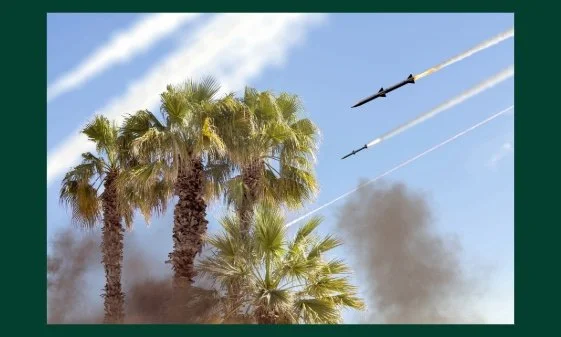
The United States and Israel carried out large-scale military strikes inside Iran on February 28, killing the country’s supreme leader Ayatollah Ali Khamenei. Iran responded within hours with drones and missiles aimed at Israel and at United States linked military sites across the Gulf, including Bahrain, Kuwait, Qatar and the United Arab Emirates (UAE). The confrontation marks one of the most dangerous escalations in West Asia in recent years and carries direct consequences for countries far beyond the immediate conflict zone, including India.
As exchanges of fire continued on March 1 during the writing of this briefing, airspace closures and missile activity spread across parts of the Gulf, according to Reuters.
Before examining why this matters for India, it helps to understand the basic context.
The Conflict
Iran’s relationship with the United States and Israel has stayed tense for decades because of three concrete disputes that repeatedly trigger crises.
The first relates to Iran’s nuclear programme. Iran operates uranium enrichment facilities, including sites such as Natanz and Fordow, which it says are meant to produce fuel for civilian nuclear energy. Washington and Tel Aviv argue that the same enrichment process, especially at higher purity levels, can shorten the path to building nuclear weapons. The dispute intensified after the United States withdrew in 2018 from the 2015 nuclear agreement, formally called the Joint Comprehensive Plan of Action, which had placed limits on Iran’s enrichment activities in exchange for sanctions relief. Since then, Western governments have accused Iran of expanding enrichment beyond earlier caps, while Tehran has maintained that its programme remains within its sovereign rights.

The second issue involves Iran’s missile capability. Iran has developed one of the largest ballistic missile arsenals in the Middle East, including medium-range missiles that can reach Israel and parts of the Gulf. Iranian officials call the missile programme a defensive necessity in a region where it faces technologically superior adversaries. The United States and Israel view the expanding range, accuracy and volume of these missiles as a direct security threat, especially in combination with Iran’s nuclear advances.
The third dispute concerns Iran’s support for armed partners across the region. Iran provides varying levels of funding, training and weapons to groups such as Hezbollah in Lebanon, several militia networks in Iraq and Syria, and the Houthi movement in Yemen. Tehran portrays these ties as part of a regional deterrence strategy. Washington and Tel Aviv see them as a network that allows Iran to project force indirectly and pressure adversaries without direct state-to-state confrontation.
These three issues have created a cycle of pressure, sanctions, covert action and periodic military escalation that has kept relations between Iran on one side and the United States and Israel on the other in a near constant state of friction.
The latest strikes moved the conflict from pressure and negotiation into direct attacks on senior leadership and core military infrastructure, raising the risk of a wider regional crisis.

India’s Energy Security, Shipping Routes
India’s most immediate exposure lies in energy security. India imports a large share of its crude oil, and global oil prices react quickly to instability in the Gulf. Tehran has warned the Strait of Hormuz could be closed. This narrow waterway carries a major share of the world’s seaborne oil exports. Even the threat of disruption tends to push oil prices upward.
For India, higher crude prices translate into more expensive fuel, rising transport costs and larger inflation across the economy. The government then faces a difficult balancing act between absorbing the shock by cutting fuel taxes or allowing domestic pump prices to rise.
Costlier oil raises input costs for industries that rely on petrochemicals, fertilisers and transport. Freight charges increase, airline fuel bills grow and food prices rise because moving goods becomes more expensive. If high oil prices continue, India’s current account deficit, which is the gap between what the country earns from the world and what it spends, can widen because India has to pay more foreign currency to import energy. This can further weaken the rupee and make economic management more difficult.
India relies heavily on sea trade to move both imports and exports. The conflict has already prompted warnings from Iran-backed Houthi forces in Yemen about fresh attacks on ships in the Red Sea. Along with possible risks in the Strait of Hormuz, this puts pressure on two of the world’s busiest sea routes. If shipping becomes riskier, insurance costs rise, vessels take longer routes and ports face delays. All of this makes trade more expensive for Indian businesses. Smaller firms usually feel the impact first because they work with tighter profit margins and have fewer options to reroute shipments or absorb higher costs.
Travel
Air travel disruption presents another layer of impact. Multiple countries in the region have temporarily closed airspace after the strikes, leaving large numbers of travellers stranded. India relies heavily on West Asian air corridors for flights to Europe and North America. Prolonged restrictions could mean longer flight paths, higher ticket prices and operational strain on airlines. For a country with large outbound labour flows and business travel to the Gulf, these disruptions carry practical consequences.
The safety of Indian citizens in the Gulf is also a serious concern. Millions of Indians live and work across the Gulf Cooperation Council countries. The reports describe missile interceptions, drone strikes and damage incidents in parts of the United Arab Emirates, Bahrain and Kuwait. Even limited attacks create uncertainty in labour markets, disrupt daily life and raise the possibility of evacuation planning. Remittances from Gulf-based Indians form a significant income stream for many Indian households. Any prolonged instability in host economies could ripple back into domestic consumption patterns in India.
India’s International Relations
India’s diplomatic position becomes more complicated as the conflict intensifies. India has strong strategic ties with Israel, a growing partnership with the United States and longstanding civilisational and connectivity interests involving Iran. Each side in the confrontation will watch how other countries respond.
Global forums such as the United Nations Security Council already show clear divisions. Russia and China have criticised the strikes, while the UN Secretary General has called for an immediate halt to the fighting. India is likely to face pressure to state its position carefully in a way that protects national interests while keeping working relationships open with all major players.
There is also a security dimension. Analysts warn that a regime facing existential pressure may use every available tool. That includes cyber operations, proxy activity and maritime disruption. Reuters has noted concern that cyber-attacks could target critical infrastructure. India, which already faces a steady stream of cyber threats, will need heightened vigilance across energy, financial and transport networks if the conflict enters a more prolonged phase.
Some regional analysts believe Iranian strikes across Gulf territory could push Arab governments closer to the United States and Israel. A more polarised regional climate would narrow diplomatic room and could lead to closer security coordination among United States partners in the Gulf. India has built strong economic and strategic ties with Gulf capitals in recent years. It would need to handle these relationships carefully while preserving its strategic autonomy.
In the near term, India’s priorities are likely to centre on three fronts. The first involves protecting energy supplies and cushioning the domestic economy from oil volatility. The second focuses on the safety and mobility of Indian citizens across the Gulf. The third requires careful diplomatic signalling that supports de-escalation while preserving India’s working relationships across competing blocs.
The situation remains fluid, and much depends on whether the current exchange settles into limited retaliation or expands into a larger regional confrontation. For India, the lesson is that developments in West Asia travel quickly into Indian economic and security calculations, often faster than public attention fully registers.
Armed conflict rarely produces clear winners. Sustained de-escalation efforts by major powers therefore remain critical to limit wider economic and security fallout.
You have just read a News Briefing, written by Newsreel Asia’s text editor, Vishal Arora, to cut through the noise and present a single story for the day that matters to you. We encourage you to read the News Briefing each day. Our objective is to help you become not just an informed citizen, but an engaged and responsible one.


On October 12, opposition leaders, MPs, MLAs, student organisations and political workers came together in a massive march against Chief Election Commissioner Gyanesh Kumar, raising serious concerns over the Special Intensive Revision (SIR) of electoral rolls and the alleged mass deletion of voters’ names. The march brought together a broad coalition, including the INDIA bloc, AISA, SFI and other student unions, as part of a wider nationwide mobilisation against the SIR exercise and concerns surrounding electoral integrity.