
The Psychology of Defending Lynching Convicts in Madhya Pradesh
From the Editor’s Desk
July 1, 2026

A judge in Madhya Pradesh who sentenced seven men to life imprisonment for their role in a lynching case is facing a campaign of protests, threats and abuse. It is disturbing that sections of the public have reacted not with concern about the man who was beaten to death by a mob, but with anger that those found guilty of the killing were punished. The reaction points to a particular way of thinking about mob violence, justice and the rule of law, and deserves a psychological explanation.
First, let’s look at what really happened.
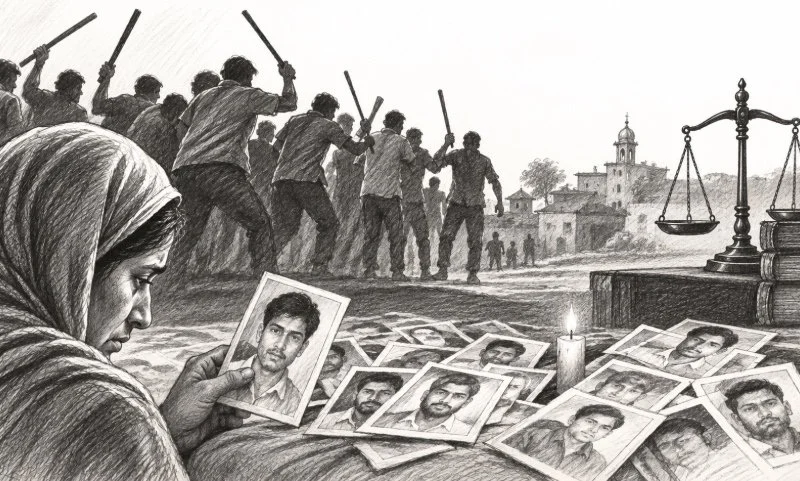
Additional District and Sessions Judge Tabassum Khan, from Narmadapuram district in Madhya Pradesh, sentenced seven men to life imprisonment in the 2022 Seoni Malwa lynching case, as reported by The Indian Express. The case arose from the killing of truck driver Sheikh Lala Nazir Ahmed, who was beaten to death by a mob on the night of August 2-3, 2022, after being accused of cow smuggling. Another man, Sheikh Mushtaq, survived the attack with injuries.
In its judgment, the court found that the prosecution had proved beyond reasonable doubt that the accused were part of an unlawful assembly armed with sticks and other weapons and had assaulted the victims with what it described as “extreme brutality.” The court treated the fact that the killing was a mob lynching as an aggravating factor while imposing life sentences.
The verdict was followed by protests, threats and abuse directed at the judge. Relatives of the convicted men reportedly attempted to stop police vehicles from taking the convicts to jail immediately after the judgment. In the following days, videos and social media posts emerged accusing Judge Khan of delivering the verdict because she is Muslim rather than on the basis of evidence and law. Some videos allegedly issued threats against her and demanded the release of the convicts, while demonstrations were organised calling for the life sentences to be overturned.

Now, let’s look at how some people understand violence, justice, and their relationship to the law.
According to social psychology, people rarely commit atrocities because they believe they are doing something evil. More often, they commit them because they are convinced they are doing something good. Psychologist Albert Bandura, a professor at Stanford University, called it “moral disengagement.” It occurs when people set aside ordinary moral restraints by persuading themselves that harmful actions serve a higher moral purpose. This makes them see violence as protecting religion, community, nation, tradition or some other sacred value. They no longer see victim primarily as a human being with rights and dignity, but as a symbol of an alleged threat. Further, the victim is not treated as an individual whose guilt or innocence must be established through due process, but as a representative of a category.
The social psychologist Jonathan Haidt has argued that people first arrive at moral conclusions emotionally and then construct rational arguments to justify them. We could say that people “feel” first and reason later. For a crowd that regards itself as defending a sacred value, what matters most is preserving the moral narrative that it has created about itself, and not evidence or legal procedure.
Psychologist Leon Festinger’s concept of “Cognitive dissonance” also helps explain this phenomenon. It’s the discomfort that arises when facts collide with deeply held beliefs. Human beings often resolve this tension not by changing their beliefs but by attacking the source of the uncomfortable information. In this case, the source is not merely the court’s judgment. It is also the judge herself.
Attacks on the judge’s religious identity point to another powerful psychological process, which scholars such as Dan Kahan call “identity-protective cognition.” People often assess facts in ways that protect their group’s status and beliefs. In this case, the question was no longer whether the evidence proved guilt. It became whether accepting the verdict would feel like a betrayal of one’s community. Once group identity entered the case, objective evaluation became much harder.
The effort to portray the judge’s religion as the explanation for the verdict is particularly troubling because it represents an attempt to replace legal reasoning with “tribal” reasoning. The verdict is being seen as illegitimate not because the evidence was weak or the law was misapplied, but because the person delivering it belongs to a different identity group.
We also see “dehumanisation” here. American philosopher David Livingstone Smith has argued that violence becomes easier when victims are seen as less deserving of empathy, protection, or equal moral concern. Dehumanisation need not involve open hatred. It can also work through indifference. In such moments, public sympathy can turn disproportionately towards the perpetrators, while the victim’s suffering recedes from view.



This inversion of concern also reveals what social psychologists call “in-group bias.” Henri Tajfel, who developed Social Identity Theory, argued that people tend to favour those they see as members of their own group. In ordinary circumstances, this tendency may remain relatively harmless. However, in conditions of conflict, it can produce a dangerous double standard, where violence committed by one’s own side is minimised, excused, or justified, while similar actions by outsiders are condemned. The result is a profoundly unequal moral universe.
A further concern is the sense of entitlement that seems embedded in many lynching incidents. Lynching is not merely an act of violence, but also a claim to authority. The mob effectively announces that it possesses the right to investigate, prosecute, judge, sentence and execute.
From a political science perspective, a lynching is more than an assault on an individual. It is an assertion that the crowd’s moral judgment should override the state’s legal authority. The sociologist Max Weber argued that the modern state is defined by its claim to a monopoly on the legitimate use of force. Lynching breaks that monopoly. This was visible in the supporters’ apparent belief that they had the right to punish the victim, and that the state had no right to punish them in return. That was an extraordinary claim of moral privilege.
The claim of moral privilege also fits what political psychologist Karen Stenner has identified as an authoritarian tendency to place conformity, group unity and social order above pluralism and legal safeguards. This tendency suggests that institutions that protect procedural fairness will be respected only so long as they affirm the group’s view of justice. When courts do not validate the group’s beliefs, they are treated as enemies.
Given this psychological and political context, the issue is not merely a single criminal act. It is a struggle between the rule of law and the psychology of the mob. History offers many examples of where such a path can lead, and not one of them is reassuring.
You have just read a News Briefing, written by Newsreel Asia’s text editor, Vishal Arora, to cut through the noise and present a single story for the day that matters to you. We encourage you to read the News Briefing each day. Our objective is to help you become not just an informed citizen, but an engaged and responsible one.
What happened in Mumbai on October 2 may have been only one day of protest, but the issues behind it are unlikely to disappear with the dispersal of the crowd. The protest was centred around concerns over the Election Commission, electoral rolls and the Special Intensive Revision (SIR) exercise, with protesters demanding accountability from Chief Election Commissioner Gyanesh Kumar. At the same time, similar mobilisation has been taking place across different parts of the country, with student groups, Opposition parties and civil society organisations raising concerns over the electoral process. Newsreel Asia spent the day at Mumbai Protest capturing the preparations, the police presence, conversations with protesters, the atmosphere on the streets and how the day unfolded. The speech of Cockroach Janta Party's leaders and sentiment of protestors seemed larger than the concerns regarding the electoral process. Will this lead to something bigger?