
The Problems with India’s Website Blocking System
From the Editor’s Desk
March 5, 2026

A large technical study has found that at least 43,083 websites were blocked through Indian internet service providers in the measurement carried out for the research. The findings draw attention more to a system marked by uneven enforcement and limited transparency than to the type of content being restricted.
The study, “Poisoned Wells: Examining the Scale of DNS Censorship in India,” by Karan Saini, an independent security researcher and internet censorship researcher, tested 294,480,735 (294.5 million) website domains and sent more than 1.76 billion technical queries through the networks of six internet service providers in India – Reliance Jio, Bharti Airtel, Atria Convergence Technologies, Mahanagar Telephone Nigam Limited, You Broadband and Connect Broadband – to observe how those networks respond when users attempt to access websites.
By analysing the responses to those queries, the study, funded by Open Technology Fund, identified tens of thousands of domains that had been deliberately interfered with so that users could not reach them through ordinary internet connections. Internet providers implement government blocking orders through a method called “DNS filtering,” in which the network interferes with the system that translates website names into the numerical addresses computers use to locate websites.
When the researcher tried to access a blocked domain, the DNS server often returned a characteristic response used in blocking systems, such as directing the request to a specific address or returning a response that falsely indicates the website does not exist. By identifying these technical signatures, the study confirmed that 43,083 unique domains were blocked. This represents a dramatic increase compared with earlier research. The largest previous studies had identified 4,033 blocked domains in 2020 and 6,787 in 2023.

The number of blocked domains varied significantly across internet providers. Airtel blocked the largest number, 27,649 domains. MTNL blocked 20,085 domains. Reliance Jio blocked 15,245 domains. ACT blocked 14,173 domains. You Broadband blocked 14,052 domains after removing several false positives. Connect Broadband blocked 9,414 domains. Once duplicate domains across networks were removed, the combined blocklist still contained 43,083 unique domains.
The number of blocked websites differs across internet providers because each company implements government blocking orders within its own network systems. Each provider therefore configures its own filtering rules and updates them at different times. Some networks block only the exact domain named in an order, while others block related domains or mirror sites that appear to host similar content. Technical errors or filtering rules can also lead to more sites being blocked on one network than another.
The researchers also analysed the types of websites that appeared most frequently in the blocklist. Domains associated with movie and television piracy accounted for the largest category, representing about 51.62 percent of the filtered blocklist. Pornography related sites accounted for 6.38 percent. File sharing services represented 5.53 percent. Gambling sites represented 3.91 percent. Sites associated with militant organisations accounted for only 0.53 percent of the blocklist.
Blocking behaviour also differed widely across networks. For example, sites associated with militant organisations showed the highest level of consensus among providers. Around 38.60 percent of these domains were blocked by all six networks. In contrast, piracy sites, which formed the largest category overall, showed very little universal blocking. Only about 4.54 percent were blocked across all six networks. Pornographic websites showed even lower agreement, with only 0.53 percent blocked universally. These variations suggest that internet providers implement blocking rules differently even when operating under the same national legal framework.



The figures suggest that copyright enforcement – movie and television piracy – has become the dominant driver of website blocking. From a public policy perspective, one may wonder whether a censorship mechanism originally justified in the name of public order and national security is now used primarily to enforce private intellectual property claims. The relatively small share of domains associated with militant organisations, about 0.53 percent of the blocklist, raises the question of whether a legal framework designed for exceptional circumstances has gradually expanded into routine content regulation.
The risk is that extraordinary powers justified by security concerns begin to normalise routine censorship. Once such powers exist, authorities may increasingly rely on them to address problems that could otherwise be handled through narrower legal mechanisms such as copyright enforcement, court orders against specific pages or civil litigation. And, as a result, the threshold for blocking websites may gradually lower, and the scope of state control over information may expand without public debate.
The data also reveal inconsistency in enforcement. If a domain is subject to a government or court blocking order, one would expect a reasonably uniform implementation across networks. The study shows the opposite. Only a small share of piracy or pornography domains are blocked across all six networks. This uneven implementation suggests that censorship operates through decentralised technical practices rather than a clear and transparent regulatory system. One may wonder if such inconsistency undermines legal clarity for both users and website operators.
Further, the study indicates broad blocking patterns that may go beyond the intended targets. Categories such as file sharing services and piracy sites often include domains that host both lawful and unlawful material. Blocking an entire domain because some pages host infringing content can remove access to a much wider range of information. From an internet freedom perspective, this raises concerns about overblocking, or restricting access beyond the specific material identified in a legal order.
The popularity analysis also points to limited transparency in the censorship process. Only about 21.73 percent of the blocked domains appear on the Tranco ranking of widely visited websites. This means that nearly four out of five blocked sites belong to parts of the internet that receive far less public attention. Journalists, researchers and regulators usually track well known platforms and high traffic websites, yet most blocked domains fall outside that visible space. As a result, a large share of internet censorship happens in areas of the web that few people monitor closely. Because government blocking orders are rarely made public, users often have no way of knowing which websites have been restricted or the reasons for those restrictions.
Finally, the study also raises structural concern about private infrastructure acting as the enforcement arm of censorship. Internet providers implement the blocking rules inside their networks, and they do so using technical methods that are largely invisible to users. This arrangement means that restrictions on access to information occur quietly within network systems rather than through public legal processes that citizens can easily observe or challenge.
You have just read a News Briefing, written by Newsreel Asia’s text editor, Vishal Arora, to cut through the noise and present a single story for the day that matters to you. We encourage you to read the News Briefing each day. Our objective is to help you become not just an informed citizen, but an engaged and responsible one.



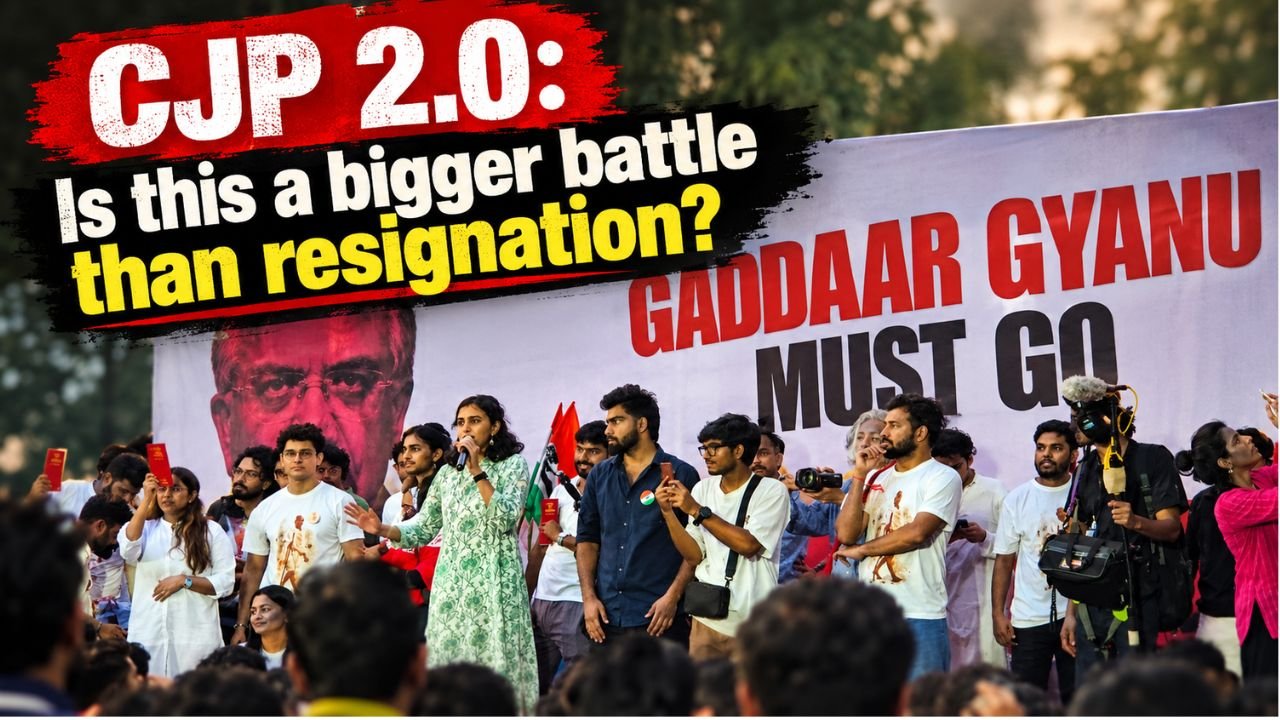
On October 12, opposition leaders, MPs, MLAs, student organisations and political workers came together in a massive march against Chief Election Commissioner Gyanesh Kumar, raising serious concerns over the Special Intensive Revision (SIR) of electoral rolls and the alleged mass deletion of voters’ names. The march brought together a broad coalition, including the INDIA bloc, AISA, SFI and other student unions, as part of a wider nationwide mobilisation against the SIR exercise and concerns surrounding electoral integrity.