
Why Kerala CM V.D. Satheesan’s “Menon” Oath Stirred a Caste Debate
By Mariya Rajan
May 27, 2026
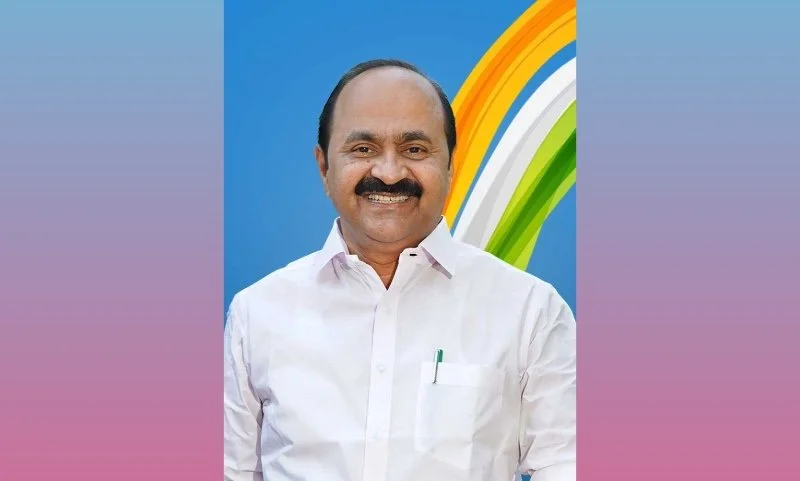
Photo by Sourya88, under a Creative Commons licence
Kerala Chief Minister V.D. Satheesan took oath as “Vadasseri Damodara Menon Satheesan,” unlike earlier occasions where he had dropped “Menon,” an upper-caste surname. Days later, he went to the Guruvayur Sri Krishna Temple and offered thulabharam (ritual weighing) with butter, a ritual in which a devotee is weighed against an offering made to the deity. Coming within a week of the formation of a Congress government, the two decisions have triggered unease in the state because the party had projected itself as secular and inclusive.
Satheesan was sworn in as Chief Minister on May 18 and used the longer name while taking oath as a member of the 16th Kerala Legislative Assembly. In 2021, after being elected from Paravur to the 15th Kerala Legislative Assembly, he had taken oath as an MLA using the name “V. D. Satheesan.”
“Menon” is a surname associated with the upper caste Nair community in Kerala. The state’s public politics has long presented itself as secular, reformist and influenced by social justice movements, but caste identities still influence party calculations in Kerala. The Nairs have been one of the powerful Hindu communities, and surnames linked to caste can still signal social standing, family background and political affinity.
The change unsettled some leaders within the Congress itself, who spoke openly against it. For example, Jinto John, a Congress leader, posted on Facebook that he would go simply by “Jinto John” and not “Thekkumkattil John Roman Catholic Jinto.” V.R. Anoop, another Congress leader, wrote that caste in Kerala still worked as “social capital and social power.”

However, Chief Minister Satheesan brushed aside the criticism. “Why is it wrong if I mention my father’s name? Shouldn’t I remember him?” he was quoted as saying in the media. He sought to explain that both his parents had died before he became a legislator and that his full name appeared in official records, including his passport. “It is a matter of pride to speak my parents’ name,” newspapers quoted him as saying.
His explanation did not settle the issue because the oath was a public constitutional moment, performed before the state, and the name used by a Chief Minister at that moment entered the official record.
Before Satheesan was named Chief Minister, leaders of the Nair Service Society and the Sree Narayana Dharma Paripalana Yogam were reported to be unhappy with his rise. The Nair Service Society is an influential body representing Nair interests. The Sree Narayana Dharma Paripalana Yogam grew out of the social reform movement associated with Sree Narayana Guru and represents Ezhava interests, another major community in Kerala’s caste and electoral politics. Both organisations have long had the ability to unsettle political parties, especially when elections are close and community leaders signal approval or disapproval.
Reports said leaders of these bodies had been pushing other names for the Chief Minister’s post. Satheesan had also skipped the usual courtesy calls on them, a practice many politicians in Kerala follow to avoid offending caste and religious organisations with local influence. Against that background, a name beginning with “Vadasseri Damodara Menon” sounded like a message to a community that had remained wary of him.
The temple visit reinforced that perception. Guruvayur is among Kerala’s most important Hindu temples and is dedicated to Lord Krishna. A thulabharam there is commonly performed as an act of devotion, gratitude or fulfilment of a vow. Butter also carries a strong association with Krishna worship because of stories linked to the deity’s childhood. However, since a newly sworn-in Chief Minister performed the ritual within his first week in office, the act was likely to be viewed as a public religious gesture, even if it also carried a personal explanation.
Satheesan’s choices have raised a question about whether the Congress is trying to reassure Hindu and upper-caste voters without saying so openly. The party may feel compelled to do so because it has to compete with the Left, which has built much of its identity around secularism, caste reform and minority outreach, while also trying to keep Hindu caste organisations from drifting away. However, sitting in between may not help anyone, least of all a party that came to power on a different pitch.
You have just read a News Briefing, written to cut through the noise and present a single story for the day that matters to you. We encourage you to read the News Briefing each day. Our objective is to help you become not just an informed citizen, but an engaged and responsible one.
On October 12, opposition leaders, MPs, MLAs, student organisations and political workers came together in a massive march against Chief Election Commissioner Gyanesh Kumar, raising serious concerns over the Special Intensive Revision (SIR) of electoral rolls and the alleged mass deletion of voters’ names. The march brought together a broad coalition, including the INDIA bloc, AISA, SFI and other student unions, as part of a wider nationwide mobilisation against the SIR exercise and concerns surrounding electoral integrity.