
Menstrual Discrimination Alarming Among Dalit Sanitation Workers, a Report Suggests
From the Editor’s Desk
April 22, 2026
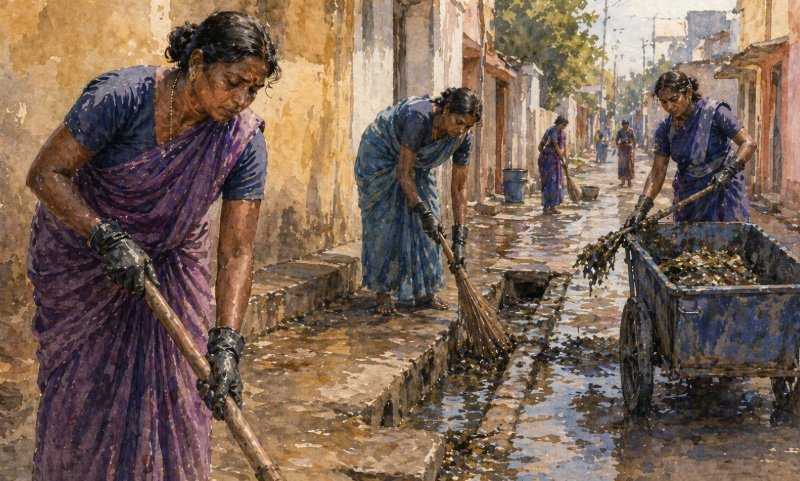
Dalit women working as manual scavengers or housemaids in Delhi face severe menstrual discrimination from their employers and within their own families, with some workers seeing their wages cut and others hiding their periods to avoid punishment at work, according to a report by the Kathmandu-based advocacy organisation Global South Coalition for Dignified Menstruation (GSCDM).
The report, shared with Newsreel Asia, is based on GSCDM’s March 2026 field visit to the Delhi office of Safai Karmachari Andolan (SKA), a human rights movement and campaign aimed at completely eradicating manual scavenging and rehabilitating those engaged in it. Manual scavengers belong primarily to Dalit communities and are engaged in cleaning human excreta in hazardous and degrading conditions.
During a one-day interaction programme organised by SKA, 16 participants, 14 of them women, shared accounts of the restrictions and punishments they face because of menstruation. The testimony covered conditions at home, at school, and at their workplaces.
At the employer’s home, the discrimination was also economic. When a domestic worker was menstruating, employers hired a second housemaid and divided the original worker’s pay between the two. Workers whose employer’s wife was herself menstruating were required to perform double the usual workload for no additional pay. Others said employers checked whether they had bathed after their period ended and barred them from speaking in the house once their menstrual status became known.

Several participants said they routinely lied about or concealed their periods to avoid these additional restrictions. Hiding menstruation, the report notes, created its own risks, including emotional distress and vulnerability to accusations or physical violence if the concealment was discovered.
Inside their own homes, the restrictions began in childhood. Participants reported being prohibited from entering temples, attending school, cycling or leaving the house while menstruating. They were required to stay in a separate room or corner, were barred from touching sacred plants or sitting on sofas, and were told to maintain physical distance from their fathers and brothers. Food was served to them separately, and they were forbidden from touching pickles or sour foods.
In-laws, several participants said, dismissed menstrual cramps as faked.
The report also points to challenges in menstrual management. Many participants said they rely on cloth rather than commercial sanitary products, and some reported limited access to facilities such as dustbins. To manage menstrual blood, they often use multiple layers of clothing or pads and handle the process quietly to avoid attention. Some said they reduce water intake to avoid frequent use of toilets, which points to constraints in both infrastructure and social acceptance.
The report, authored by GSCDM founder and CEO Radha Paudel, states that the socialisation of menstrual discrimination begins between the ages of six and nine, affecting both menstruators and non-menstruators. By that age, she says, girls already internalise a sense of inferiority tied to menstruation, while boys learn corresponding assumptions of superiority.

The report states that menstrual discrimination simultaneously violates rights to dignity, equality, freedom and non-discrimination. For manual scavengers and housemaids, it says, these violations compound caste-based abuse already entrenched in daily working life, at both formal and informal workplaces.
Paudel writes that menstrual discrimination remains largely absent from major international human rights frameworks, and from local and global activist movements, including Dalit rights campaigns. Because it is not named as a discrete rights violation, the women most harmed by it are pushed further to the margins, she says.
Religious tradition has reinforced the stigma, according to the report. Citing a 2024 academic volume on Hinduism and Buddhism, the report states that all major world religions, including Christianity and Islam, have historically treated menstrual blood as impure. That doctrinal consensus, the report argues, has given menstrual discrimination a legitimacy that makes it harder to contest.
The GSCDM report calls for a multi-state research to document the scale of the problem. It also urges organisations to embed the concept of “dignified menstruation” into its policies and programmes, and to pursue advocacy at every level of governance to protect the rights of those living under conditions of untouchability.
Manual scavenging has long been illegal under Indian law, but the practice persists, as do the caste hierarchies that assign it almost exclusively to Dalit communities.
You have just read a News Briefing, written by Newsreel Asia’s text editor, Vishal Arora, to cut through the noise and present a single story for the day that matters to you. We encourage you to read the News Briefing each day. Our objective is to help you become not just an informed citizen, but an engaged and responsible one.


On October 12, opposition leaders, MPs, MLAs, student organisations and political workers came together in a massive march against Chief Election Commissioner Gyanesh Kumar, raising serious concerns over the Special Intensive Revision (SIR) of electoral rolls and the alleged mass deletion of voters’ names. The march brought together a broad coalition, including the INDIA bloc, AISA, SFI and other student unions, as part of a wider nationwide mobilisation against the SIR exercise and concerns surrounding electoral integrity.