
Jobs Are Growing in South Asia, but Not the Quality of Work, ILO Data Suggests
From the Editor’s Desk
January 16, 2026
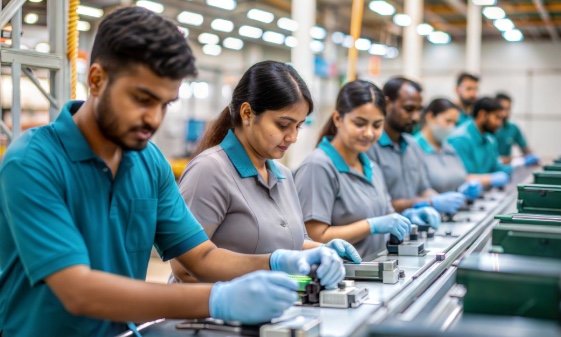
Is India’s workforce growing, but without a matching rise in job quality? The International Labour Organization’s World Employment and Social Outlook: Trends 2026 report shows that in Southern Asia, where India is a key contributor to regional trends, employment growth is concentrated in informal, insecure and low paid work. This means millions are working more but still not earning enough or building stable futures.
The strongest warning for India in this report comes from the data on informal work.
The ILO notes that global informality has begun rising again, after years of decline. This trend is driven largely by regions like Africa and Southern Asia, and India sits squarely in this category. By 2026, about 2.1 billion people worldwide will be in informal work, accounting for over 58% of all workers. This is especially significant for India, where employment is expanding but largely in informal sectors with no contracts, job security or social protection like health cover or pensions.

Another key issue is the failure to turn these countries’ growing workforce into a demographic dividend.
The report explains that in countries with large youth populations, such as India, job creation is not keeping up with the rise in working-age people. Labour productivity growth, which refers to the value a worker produces in a given time, remains too low to lift incomes. As a result, many new workers are either underemployed or stuck in poor-quality jobs, especially in agriculture and informal services, rather than moving into better-paid, higher-productivity sectors like manufacturing.
Youth unemployment is a third concern.
The ILO reports that global youth unemployment in 2025 is around 12.4 percent, with nearly 257 million young people neither working, studying, nor training. In low and lower-middle income countries, the rate of youth who are not in education, employment or training (NEET) is nearly 28 percent. The report adds that higher education does not guarantee better job outcomes in these regions.
For India, where graduate unemployment and skill mismatch are already pressing issues, this suggests that simply expanding education access won’t solve the problem unless job markets are reshaped too.

The report also points to persistent gender gaps in the labour force.
Globally, women make up only 40 percent of the employed population. Southern Asia shows some of the widest gender gaps, both in terms of how many women are working and the quality of jobs they hold. For India, this means that low female workforce participation continues to slow both overall economic growth and improvements in family well-being. These gaps also reflect deep-rooted social and institutional barriers that prevent women from entering or staying in paid work.
Several global trends mentioned in the report carry risks for India as well.
One is rising trade policy uncertainty. The ILO shows that countries dependent on export-linked jobs, especially in Asia, are vulnerable to shifts in global trade. In India, where manufacturing and services exports are expected to absorb large numbers of workers, slower global trade or unstable supply chains could limit opportunities for upward mobility.
Another trend is the disruption caused by artificial intelligence. While the report says AI has not yet transformed employment overall, it warns that early effects are already visible in hiring for high skill roles. Young workers entering fields like software or digital services may face tightening job markets if AI tools replace routine tasks. This matters for India’s IT sector, which has long absorbed college graduates and provided relatively high-wage employment.
The report also flags growing public debt worldwide, showing how debt crises often lead to long-term unemployment and weak labour recovery, the process through which employment levels, wages and job quality return to stable or improved conditions after a period of economic disruption such as a recession, crisis or shock. India isn’t in a debt crisis, but the government has limited money to spend on services like education, health care and job schemes. The ILO report warns that without enough investment in these areas, countries will struggle to improve the quality of jobs.
The ILO’s data also shows that wage growth is not keeping pace with GDP growth in many low and middle income countries. This means that even where economies are expanding, workers see little improvement in their earnings or job security. India fits this pattern. The formal economy grows, but most people still work in informal conditions, and the benefits of growth do not spread widely.
The ILO warns that countries like India have little time left to turn their growing young populations into a stable, productive workforce. Unless the governments invest more in social security, gender equality, better skills training and formal jobs, millions risk being trapped in low-paid, unstable work for years to come.
You’ve just read a News Briefing written by Newsreel Asia’s Text Editor, Vishal Arora, meant to cut through the noise and bring you one important story of the day. We invite you to read the News Briefing daily. Our aim is to help you become a sharp, responsible and engaged citizen who asks the right questions.
What happened in Mumbai on October 2 may have been only one day of protest, but the issues behind it are unlikely to disappear with the dispersal of the crowd. The protest was centred around concerns over the Election Commission, electoral rolls and the Special Intensive Revision (SIR) exercise, with protesters demanding accountability from Chief Election Commissioner Gyanesh Kumar. At the same time, similar mobilisation has been taking place across different parts of the country, with student groups, Opposition parties and civil society organisations raising concerns over the electoral process. Newsreel Asia spent the day at Mumbai Protest capturing the preparations, the police presence, conversations with protesters, the atmosphere on the streets and how the day unfolded. The speech of Cockroach Janta Party's leaders and sentiment of protestors seemed larger than the concerns regarding the electoral process. Will this lead to something bigger?