
Why India’s Heat Crisis Falls Hardest on Dalits and Muslims
From the Editor’s Desk
June 18, 2026
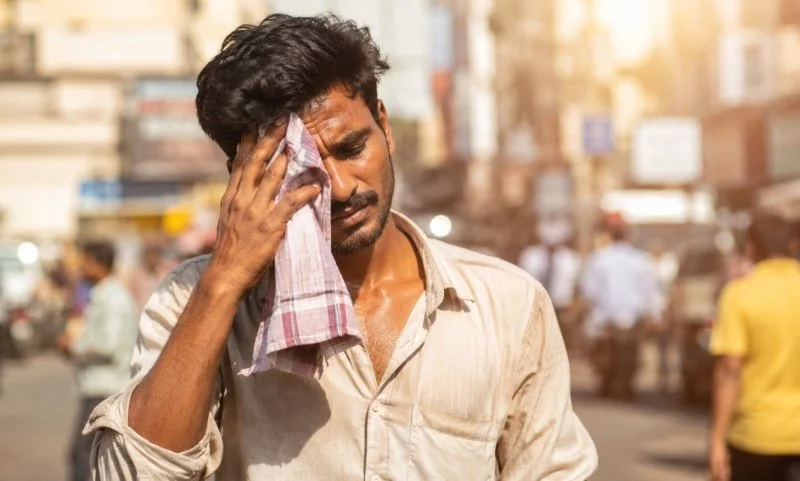
India’s caste system has long assigned the most physically exposed forms of labour to the communities least able to refuse them. That old arrangement has taken on new urgency as summer temperatures push past the limits of human endurance. Sections of the Muslim community also bear a disproportionate burden during heatwaves because of residential exclusion.
On 27 April, every one of the world’s 50 hottest cities sat inside India’s borders, with average peak temperatures across those cities reaching about 44.7°C, according to the air-quality platform AQI.in and reported by CNN. Banda, in Uttar Pradesh’s Bundelkhand region, topped the list, recording a high of roughly 46.2°C even before the hottest months of the year had properly begun.
That early intensity carried into May. By May 25, Delhi’s land surface temperature ranged from 31.59°C to 54.61°C, with a city-wide mean of 43.15°C, and the capital recorded its warmest May night in nearly 14 years that same day, at 32.4°C, according to findings from the Centre for Science and Environment’s report “Making Delhi Heat-Resilient.” The India Meteorological Department maintained heatwave and warm-night alerts across north-western and northern India through much of this period.
Government tallies have long understated what this heat actually does to people. A study by Piyush Narang and Ashok Gadgil of the India Energy and Climate Center at the University of California, Berkeley, published in Frontiers in Environmental Health on May 26, estimated that a single day of extreme heat produces around 3,400 excess deaths nationally, a figure that can climb to nearly 30,000 over a five-day heatwave. The researchers treated even these numbers as conservative, since they excluded humidity, which would likely push the toll higher in coastal regions.
Official records have rarely broken heat mortality down by caste or religion, so neither this study nor the government data behind it could say which communities have carried the heaviest losses.
Mukul Sharma, whose book “Caste and Nature” explores how caste structures Indian environmental experience, has argued that disaggregating heat mortality data would almost certainly reveal disproportionate deaths among Dalits, who remain overrepresented in the outdoor and informal occupations that carry the greatest heat exposure. Comparable analysis of Muslim communities is harder to find at all, even though researchers working on housing and urban exclusion argue the impact is comparably severe.
The lack of official data stands in contrast to the lived experience of people like Pappu Kumar, a Dalit migrant from Bihar who has spent the past eight months working on a high-rise construction site in Jasola, South Delhi, as he told Newsreel Asia. He wakes before five each morning so he can finish as much work as possible before the concrete, still radiating the previous day's heat, makes the construction site almost impossible to work on by midday.
‘There is weakness in the body, you feel you might fall,” he said, adding that “but if we don’t work, what do we eat.” A thin cotton cloth wrapped around his head is his only protection; no cooling equipment has been supplied, and drinking water arrives only intermittently.

The construction and brick kiln sectors rely mostly on Dalit, Adivasi and other historically marginalised groups within an informal workforce that researchers estimate makes up close to 90 percent of India’s labour market, leaving most outdoor workers without contracts, mandated breaks or cooling provisions.
The same pattern runs through sanitation work, where heat exposure compounds already hazardous conditions and entrenched caste hierarchies. Vishwajeet, a spokesperson for the Safai Karmachari Andolan, told Newsreel Asia that while exact figures for sanitation and informal sector workers have not been compiled, the pattern is evident from who performs these jobs. Those who clean sewers, drains and public spaces are predominantly Dalit and are rarely provided with clothing or protective equipment suited to extreme heat, he said.
In a statement issued in early June, the Safai Karmachari Andolan described these deaths as “caste violence intensified by climate injustice,” arguing that the heat emergency has pushed already-collapsing workers into greater danger from dehydration, suffocation and toxic exposure while protective measures discussed for other sectors have left sanitation workers untouched, with women in the profession facing particularly severe conditions because of long hours on roads and in public spaces without access to drinking water, toilets, shade or medical assistance.
The Centre for Science and Environment’s June report found that nearly 80 percent of the city’s workforce is employed in the informal sector, with 75 percent of its women workers in the same position, and that 92 percent of active construction projects are in areas where land surface temperatures have crossed 45°C at least once between 2015 and 2024, with more than three-quarters of those sites experiencing such heat recurrently, as reported by Outlook. The report concluded that Delhi had yet to develop targeted resilience measures for construction workers or residents of informal settlements.
Combining satellite-derived heat-stress data with a labour force survey covering more than 100,000 (1 lakh) people, researchers in 2025 found that the relationship between heat stress and lost working hours was between 25 and 150 percent steeper for marginalised caste groups than for dominant caste groups, across thermal thresholds between 26°C and 35°C, even after controlling for age, gender, education and economic status. That study was published in the journal Demography and was conducted by Arpit Shah, Sneha Thapliyal, Anish Sugathan, Vimal Mishra and Deepak Malghan.
Kayly Ober of the Carnegie Endowment for International Peace noted in a June commentary that only about eight percent of Indian households have air conditioning, a resource concentrated overwhelmingly among wealthier households even as roughly three-quarters of the national workforce labours in heat-exposed sectors.
For Muslim communities, the exposure runs through housing as much as occupation.
Fatima Ansari, who works at a garment factory in Okhla Industrial Area in Delhi, told Newsreel Asia that her shift often runs past its official hours on a factory floor where industrial fans circulate hot air rather than easing it. She lives in Jamia Nagar, where she says power cuts leave her family’s single cooler “just a box,” and where her eldest daughter recently missed school after symptoms a local pharmacist attributed to heat exhaustion.
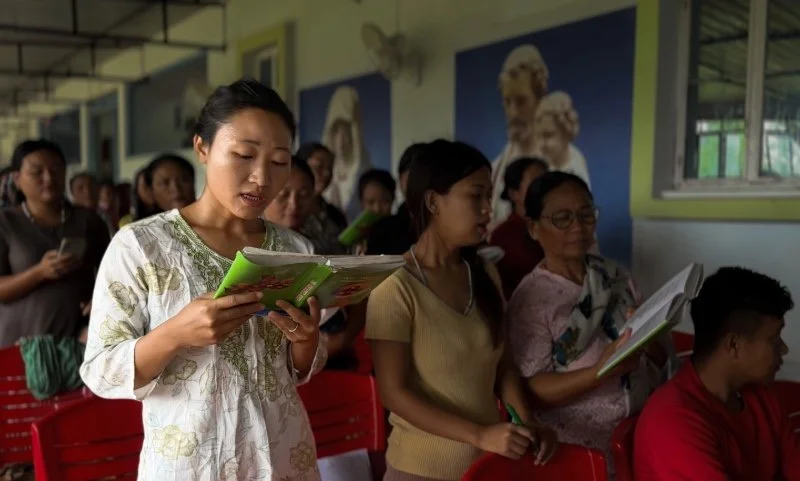
Jamia Nagar’s Muslim majority is itself a product of years of residential exclusion that has narrowed where Muslim families can find housing elsewhere in Delhi. Reem Rafat, who holds a master’s degree in Middle East Studies from SOAS University of London, has argued in Muslim Climate Watch that this kind of housing discrimination and rising Islamophobia have concentrated Muslim communities in neighbourhoods with weaker access to public services, sanitation, cooling infrastructure and green space, making climate adaptation policy incomplete without addressing that spatial segregation directly.
Demolition drives since 2014, carried out under administrative claims of unauthorised construction, have deepened this pattern by removing Muslim homes, businesses and places of worship and pushing displaced families toward peripheral settlements with even less reliable electricity, water, healthcare and tree cover, extending the distance to hospitals and workplaces in the process.
While the National Disaster Management Authority developed Heat Action Plans through state and district administrations after India adopted the Sendai Framework for Disaster Risk Reduction in 2015, early disaster-management plans gave little explicit attention to Scheduled Castes and Scheduled Tribes as a vulnerability category before a 2019 revision broadened the framework to include them alongside groups such as the elderly and people with disabilities.
Even after that revision, campaigners argue the gap persists in practice. Beena Pallical, General Secretary of the National Campaign on Dalit Human Rights, has said that heat action plans still treat categories like “informal workers” as neutral when they are in fact influenced by caste hierarchy, pointing to cases where the only nearby water source is in an area dominated by a higher caste community, putting it out of reach for those who need it most.
Muslim communities remain largely absent from these frameworks altogether, despite documented patterns of residential segregation and infrastructure inequality.
The economic estimates attached to this crisis are large enough to divert attention from the question of who actually bears them. The International Labour Organization has projected that India could account for 34 million of a global 80 million job losses by 2030 tied to heat-related productivity decline. The Lancet Countdown’s 2024 India data sheet put potential income losses from heat-linked labour capacity reduction at $141 billion in 2023, with agriculture accounting for the largest single share.
Prakash Kashwan, author of Climate Justice in India, has argued that the urban poor, Dalits, Adivasis and Muslims have borne disproportionate environmental costs because political and economic inequality has restricted their access to resources and public investment, and that this unequal burden has received limited attention in mainstream public discourse, reducing pressure for policy that might address it directly.
A meaningful public response would require mortality statistics disaggregated by caste and religion, alongside Heat Action Plans that explicitly recognise Dalit Muslim, and other marginalised communities as populations facing elevated environmental risk through occupational exposure and residential disadvantage. It would also require investment in areas that have endured decades of underdevelopment, firmer enforcement of laws against manual scavenging and unsafe sewer entry, and a housing policy that closes off discrimination in rental and property markets.
You have just read a News Briefing, written to cut through the noise and present a single story for the day that matters to you. We encourage you to read the News Briefing each day. Our objective is to help you become not just an informed citizen, but an engaged and responsible one.

On October 12, opposition leaders, MPs, MLAs, student organisations and political workers came together in a massive march against Chief Election Commissioner Gyanesh Kumar, raising serious concerns over the Special Intensive Revision (SIR) of electoral rolls and the alleged mass deletion of voters’ names. The march brought together a broad coalition, including the INDIA bloc, AISA, SFI and other student unions, as part of a wider nationwide mobilisation against the SIR exercise and concerns surrounding electoral integrity.