
What Proposed FCRA Amendment Means for Democracy, NGOs and Millions Who Depend on Them
From the Editor’s Desk
March 30, 2026

The central government has proposed changes to the Foreign Contribution Regulation Act, which regulates how non-profit organisations receive foreign funding for work in health, education, nutrition and other welfare sectors. The amendment would give the government greater power to halt funding and also take control of assets, including property, created with that money, potentially reducing humanitarian, rights-based and climate-related advocacy work in the country.
The foreign funding regulation regime is meant to serve national security and protect the country from undue foreign influence. However, the provisions, viewed alongside the government's record in dealing with the non-profit sector, raise concerns about the extent of government control over NGOs.
‘Concentration’
Under the FCRA system, about 14,996 associations are registered as of March 30, 2026, according to the Union Ministry of Home Affairs, whose data also shows that the registration of 21,954 associations has been cancelled and the registration of about 15,174 more groups has expired. The number of registered associations in 2025 was 16,000, according to the draft of the Foreign Contribution (Regulation) Amendment Bill, 2026.
In 2014, as many as 42,529 organisations were registered under the law, according to a Rajya Sabha reply at the time. This means the number of organisations registered under FCRA has fallen by 27,533, or nearly 65 percent, since 2014, due to cancellations and suspensions.
FCRA registrations have been cancelled in an “arbitrary and non-transparent manner,” the All India People's Science Network alleged in a July 2024 statement. “An unmistakable common thread is that many of these organizations are known for their stout defence of civil rights, government accountability, democratic norms and people's interests, and have often been critical of government policies and actions,” the statement read.
Human Rights Watch has said authorities have “routinely revoked or suspended licenses” and that this can function as a way for the government to gain control over organisations, including those working on democracy and rights issues.
The organisations that have lost their FCRA licence include Greenpeace India, the Centre for Policy Research, the Centre for Financial Accountability and Amnesty International India.
The cancellation of licences has already led to the filtering out of organisations that engage in advocacy or challenge government policies, especially in sectors such as the environment and human rights, resulting in foreign funding being concentrated among a much smaller number of organisations.
Citing 2025 figures, the Bill says that about 16,000 associations received around 220 billion rupees (equivalent to $2.56 billion at the average 2025 exchange rate) annually. In 2012–13, a total of about 118.38 billion rupees ($2.18 billion) was received as foreign contribution, according to a 2014 Rajya Sabha reply. That is an increase of about 86 percent, or roughly 1.86 times, in about 12 years.
However, a substantial part of that increase is due to the rupee’s fall against the dollar over the same period. Using the 2012–13 average exchange rate of 54.41 rupees to the dollar and a 2025 average of about 85.99, much of the increase looks bigger because the rupee was weaker against the dollar in 2025 than it was in 2013. So the jump in rupees does not mean foreign contributions grew by the same amount in real value.
Moreover, prices in India were about 77.3 percent higher in 2025 than in 2013, based on the Consumer Price Index from the Ministry of Statistics and Programme Implementation, which tracks changes in the prices paid by ordinary consumers. Adjusting the 2012–13 foreign contribution figure of 118.38 billion rupees to 2025 prices gives about 209.9 billion rupees, which means the current figure of 220 billion rupees is only about 4.8 percent higher in real terms. However, the increase in the value of foreign funding by about 4.8 percent despite a 65 percent fall in the number of associations receiving it points to a concentration of funds among a smaller set of organisations.
Against this backdrop, the provisions in the draft raise concerns.
Provisions
The draft says that if an organisation does not renew its registration in time, the registration can expire. It also allows the government to take control of foreign funds and assets created with that money after cancellation, surrender or expiry, and that control can later become permanent. The assets can then be transferred to government bodies or sold, with the proceeds going to the Consolidated Fund of India, the general pool of government revenue.
From the perspective of foreign donors, this changes the meaning of giving. Donors may worry that contributions made for specific communities or social needs could ultimately be absorbed into general state revenues.
The Bill says that if foreign funds or property created with those funds had already come under government control under Section 15 of the existing FCRA law, they will automatically move into the new legal framework once the amendment takes effect. Proposed Section 16B says those funds and assets will be treated as provisionally vested in a new “Designated Authority,” meaning an officer or authority appointed by the central government for this purpose.
Proposed Section 16A(5) says that if the organisation does not secure a fresh certificate, renewal or restoration within the prescribed period, that provisional takeover becomes permanent. Proposed Section 16A(6) then allows the government to transfer the assets to a ministry, department, agency or local authority, or sell them and place the proceeds, along with any unspent foreign contribution, in the Consolidated Fund of India.
This means property created with foreign funds never becomes fully secure in the hands of an organisation. It remains open to government takeover whenever a renewal is denied, a registration is surrendered or a certificate is deemed to have lapsed. Control over that property therefore depends on the organisation retaining FCRA approval for as long as it exists.
The Bill also widens the category of people who can be held responsible for violations under the law. A new definition of “key functionaries” in Section 2(1)(ja) covers not only directors, partners and trustees, but also office bearers, members of governing bodies and others seen as having control over an organisation's affairs. This may deter individuals from serving on boards or committees and deepen the pressure on already vulnerable organisations.

Essential Services
In addition to the proposed law’s impact on rights and democracy, millions of people who depend on essential services are also at risk. In low- and middle-income settings, research and policy studies have consistently shown that the state's ability to deliver basic services remains uneven, especially in remote and marginalised regions. A confrontational relationship between the state and the non-profit sector therefore carries direct implications for service access.
For example, the Rural Health Statistics 2021–22 found that community health centres faced a 79.5 percent shortfall of specialist doctors, including surgeons, physicians and paediatricians, indicating major gaps in rural healthcare capacity.
Similarly, a 2025 state-level analysis of public health system capacity in tribal regions, conducted by researchers at the Association for Socially Applicable Research, found that overall health system capacity indices declined between 2011 and 2021 and that access to public healthcare in tribal areas remains lower than in non-tribal rural areas across India.
A 2024 task-force report on tribal health, prepared with inputs from the Ministry of Tribal Affairs and the Ministry of Health, states that tribal communities face limited access to quality healthcare, higher mortality and morbidity rates, and geographic isolation in forested and hilly regions, with almost 90 percent living in rural areas where services are harder to reach.
A 2023 scoping review published in BMC Health Services Research examined NGO roles in low- and middle-income countries, drawing on studies from sub-Saharan Africa, South Asia and parts of Latin America. It found that NGOs contribute to core health system functions identified by the World Health Organization, including service delivery, workforce support, access to essential medicines and health financing, and that they often operate in areas where public systems face capacity constraints, particularly in underserved rural regions and among marginalised populations.
This relationship is widely understood in development theory as co-production: the idea that basic services for the poor are most reliably delivered through a combination of public systems and civil society actors, with the state providing scale and NGOs ensuring access, flexibility and local engagement.
The concern with the proposed amendment is that regulatory pressure, funding restrictions and institutional hostility may reduce the presence of NGOs in precisely those spaces where state capacity is weakest, contracting the civil society activity that the most marginalised communities depend on.
You have just read a News Briefing, written by Newsreel Asia’s text editor, Vishal Arora, to cut through the noise and present a single story for the day that matters to you. We encourage you to read the News Briefing each day. Our objective is to help you become not just an informed citizen, but an engaged and responsible one.

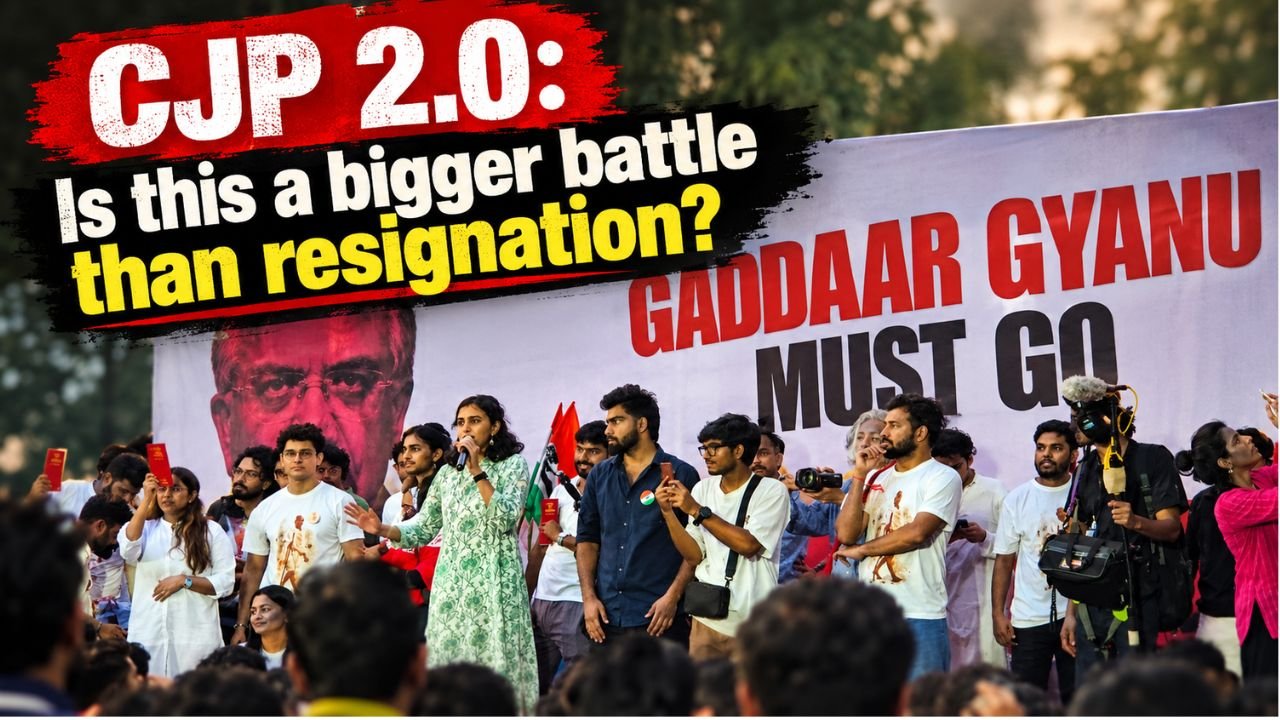
On October 12, opposition leaders, MPs, MLAs, student organisations and political workers came together in a massive march against Chief Election Commissioner Gyanesh Kumar, raising serious concerns over the Special Intensive Revision (SIR) of electoral rolls and the alleged mass deletion of voters’ names. The march brought together a broad coalition, including the INDIA bloc, AISA, SFI and other student unions, as part of a wider nationwide mobilisation against the SIR exercise and concerns surrounding electoral integrity.