
The India Thread in the Epstein Files: Everything That’s Been Documented
From the Editor’s Desk
April 10, 2026
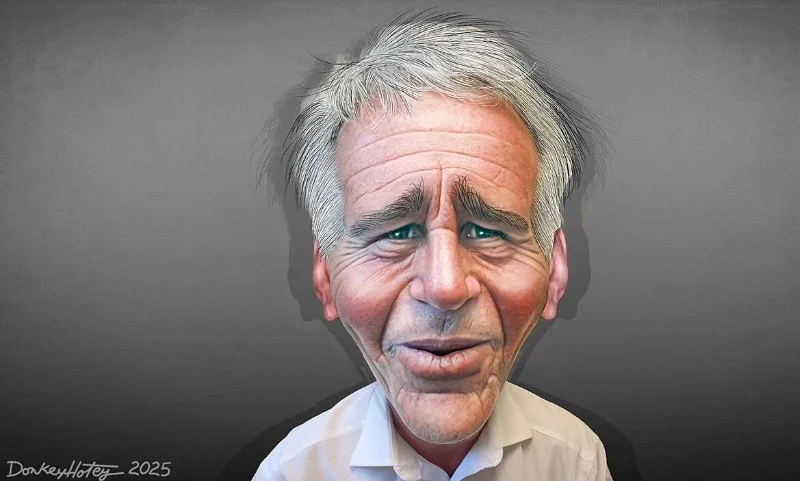
This caricature of Jeffrey Epstein, by DonkeyHotey, was adapted from a Creative Commons licensed photo from U.S. Virgin Islands, Department of Justice / Wikimedia (PD).
The documents linked to Jeffrey Epstein, a U.S. financier who built a network of relationships with political leaders, business figures and public personalities, contain several references involving India, including instances of direct contact between Epstein and Indian political and business figures. Here is a clear account of what the Epstein files say about India and how to read those references.
The references on India and Indians in the vast archive of nearly 3.5 million pages of material, more than 2,000 video files and 180,000 images released by the U.S. Department of Justice on January 30, 2026, appear in fragments in emails, meeting logs, internal notes and conversations gathered during investigations in the United States.
Alongside Indian political and business figures, including Prime Minister Narendra Modi, Minister for Petroleum and Natural Gas Hardeep Singh Puri, Indian billionaire industrialist Anil Ambani and businessman and investor Ravi Mantha, the material also includes references to Indian-American author and public speaker Deepak Chopra, filmmakers Mira Nair and Anurag Kashyap, and actor Nandita Das.
A smaller but far more serious set of references concerns Epstein’s victims. Epstein was arrested in 2019 on federal sex trafficking charges after pleading guilty in 2008 to procuring prostitution from a minor in Florida.

PM Modi
The most widely discussed references involve Prime Minister Modi. Epstein claimed in a private message that Modi had taken his advice on his July 2017 visit to Israel, and that the visit served American and Israeli interests. There is no public evidence of any direct engagement between Epstein and Modi, and the references amount to Epstein’s own assertions in private correspondence, not confirmed records of contact. The Ministry of External Affairs responded by saying that, apart from the known fact of the official Israel visit, the rest were unreliable claims made by a convicted criminal.
The opposition Congress party has said that Epstein’s claim, made in communication with a foreign official, that he advised the Prime Minister calls for a clear explanation of how such a claim emerged, since any suggestion of access to the Prime Minister by an individual with no official role brings scrutiny to how decisions are taken.
Industrialist Ambani
The second strand concerns Anil Ambani, an Indian billionaire industrialist and chairman of Reliance Group. The files, according to media reports, include direct communication between Ambani and Epstein. These exchanges refer to U.S. political figures such as President Donald Trump, his son-in-law and adviser Jared Kushner, and political strategist Steve Bannon. They also refer to the appointment of American ambassadors to India and the timing of diplomatic engagements. On May 19, 2017, four days before the meeting, Epstein sent a message to Bannon saying “modi sending someone to see me on thurs.” After Ambani visited Epstein’s townhouse on May 23, Epstein messaged Bannon describing a “really interesting modi meeting” and said Modi’s representative had told him that no senior Washington figures were engaging with Modi and that China was Modi’s main adversary. It is not established in the documents whether Epstein was referring to Ambani as Modi’s representative or to a separate, unidentified individual.
The files indicate that there was communication and at least one in-person meeting involving discussions about political access and networks. There is no public record of any criminal charge or court finding arising from these exchanges. The material shows how Epstein operated as a connector, presenting himself as someone who could link business interests with political access in different countries.
The exchanges raised concerns about informal access to power, since a private figure like Epstein appears able to discuss or facilitate contact with political leaders outside formal channels. That invited scrutiny about how influence operates, who gets entry into decision-making circles, and whether such interactions follow transparent and accountable processes. There was also a question of judgment and due diligence in engaging with individuals whose networks rely on projecting access, along with the larger concern that such brokerage can concentrate influence within a narrow circle, affecting public trust in how decisions are made.
Minister Puri
A third strand concerns Hardeep Singh Puri, now a minister and senior politician in the ruling Bharatiya Janata Party (BJP), though at the time the exchanges began he was a retired diplomat and BJP member who had not yet entered government. The released material includes email exchanges between Puri and Epstein starting in June 2014, which reportedly refer to investment opportunities in India, including references to Reid Hoffman, an American entrepreneur known for co-founding LinkedIn, and discussions about India’s growing internet economy. The records suggest that Puri was present at Epstein’s residence in Manhattan on at least three occasions between 2015 and 2017, based on scheduling emails and meeting confirmations.
Puri has said publicly that his interactions with Epstein were professional and related to economic discussions. The material released so far does not link these interactions to any of Epstein’s criminal activities.
The Puri strand raises the same concerns about informal channels of access to government thinking, especially in areas like investment and the digital economy. Such interactions invite scrutiny about transparency, due diligence in choosing interlocutors and whether private networks can gain proximity to policy discussions without the checks that apply to formal advisory processes, which in turn affects public confidence in how decisions are influenced.
Businessman Mantha
Some media reports mention Ravi Mantha, who served as an adviser to the BJP in 2014, in connection with discussions about arranging meetings or exploring business opportunities. The available details remain limited, making this a less clearly documented part of the India-related references.

Author Chopra
Another set of documents includes email exchanges between Epstein and Chopra, an author and public speaker known for his writing on mind-body medicine and spirituality. The emails span several years and include informal exchanges. Some drew attention because they reportedly contained language that has been described as crude or inappropriate, including one email containing the phrase “God is a construct. Cute girls are real,” which has been attributed to Chopra in media reports. Chopra acknowledged the contact and said he regretted the tone of some emails. He also said his contact with Epstein was limited and unrelated to any abusive activity.
Filmmakers and Actors
A further layer consists of references to Indian film and cultural figures. Mira Nair, known internationally for films such as “Monsoon Wedding” and “Amelia,” appears in a reference connected to an afterparty at Ghislaine Maxwell’s townhouse in 2009 following the premiere of “Amelia.” Nandita Das, an actor and director, and Anurag Kashyap appear in contexts involving invitations or proposed events.
The mentions are limited to social or professional settings, without any suggestion of close association with Epstein or involvement in wrongdoing. The references merely indicate the wide range of settings Epstein sought to enter, including cinema and cultural events.
Epstein’s Victims
The most serious references relate to victims. One email chain dated January 2020 refers to a victim described as living in India at the time. The exchange discusses how she might receive therapy or support, including whether embassy officials could help establish contact and coordinate assistance. Her identity is withheld in the released material.
A separate email from 2009 mentions a “beautiful Indian model” in Dubai, apparently in the context of how women were identified, discussed and circulated within Epstein’s social and recruitment environment, which often relied on introductions through intermediaries, travel circuits and elite social spaces such as parties or business gatherings.
Other parts of the files, though not tied specifically to India, show that victims were frequently moved between locations including New York, Florida, the U.S. Virgin Islands and international destinations, and that recruitment was sometimes facilitated through personal networks, modelling contacts or social referrals.
The material does not clarify whether any part of the trafficking network operated within India or whether these references involve individuals of Indian origin located elsewhere.
You have just read a News Briefing, written by Newsreel Asia’s text editor, Vishal Arora, to cut through the noise and present a single story for the day that matters to you. We encourage you to read the News Briefing each day. Our objective is to help you become not just an informed citizen, but an engaged and responsible one.
What happened in Mumbai on October 2 may have been only one day of protest, but the issues behind it are unlikely to disappear with the dispersal of the crowd. The protest was centred around concerns over the Election Commission, electoral rolls and the Special Intensive Revision (SIR) exercise, with protesters demanding accountability from Chief Election Commissioner Gyanesh Kumar. At the same time, similar mobilisation has been taking place across different parts of the country, with student groups, Opposition parties and civil society organisations raising concerns over the electoral process. Newsreel Asia spent the day at Mumbai Protest capturing the preparations, the police presence, conversations with protesters, the atmosphere on the streets and how the day unfolded. The speech of Cockroach Janta Party's leaders and sentiment of protestors seemed larger than the concerns regarding the electoral process. Will this lead to something bigger?