
Kuki-Zo Woman Survived the Violence, but Not the Wait for Justice
By Gunjan Handa
January 23, 2026
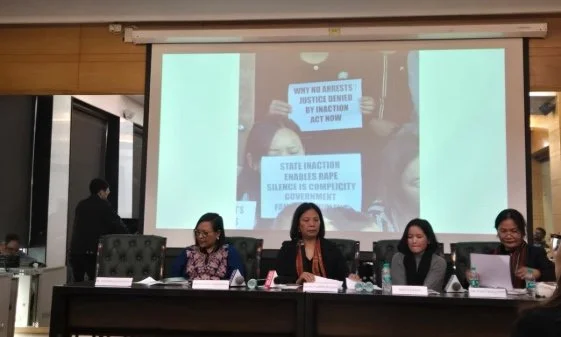
Abducted and gang-raped at the age of 18 during the early days of violence in Manipur, a Kuki-Zo woman died waiting for justice on January 10, 2026, in a hospital in Guwahati, more than 500 kilometres away. Her death has triggered renewed outrage and demands for accountability and structural overhaul in Manipur’s administration.
On Thursday afternoon at the Constitution Club of India, I attended a press conference by the Delhi and NCR chapter of the Kuki Students’ Organisation (KSO) to announce the death and accuse the system of failing its most vulnerable citizens.
The details of the crime, reconstructed by the KSO and corroborated by First Information Reports (FIRs), reveal the extent of lawlessness that took hold in Imphal at the time. In the early weeks of the violence, which began on May 3, 2023, the victim was at an ATM booth in the New Checkon area of Imphal. According to witnesses and her family, she was abducted in broad daylight by an armed group of Meitei women known as the Meira Paibis. She was then taken to a secluded hilltop and subjected to hours of brutal sexual violence before being dumped in a nearby creek.
Though she survived the immediate ordeal, the physical toll was catastrophic. She suffered from “severe and irreversible injuries,” including uterine damage and chronic infections, according to the KSO. “She survived violence but she couldn’t survive the wait,” said a KSO representative. “Her death is the direct consequence of the violence of 2023 and the systemic neglect that followed.”
The KSO specifically cited Article 14 of the Indian Constitution, which guarantees equality before the law and equal protection of the law. It argued that the state’s failure to investigate the crime, despite an FIR being filed, amounts to a “state-enabled” violation of this fundamental right.
In the three years since the assault, two accused were arrested but later released on bail of 30,000 rupees each. “Was her life only worth ₹30,000?” the KSO asked.
One of the victim’s sisters took to the podium. “Are we not the daughters of India? Is the country blind to our suffering?” she asked. Her grandmother followed with a stark message: “My granddaughter did not die of illness, she died because an unwanted force violated her dignity and broke her spirit.”
The woman was moved from one hospital to another before being admitted to a facility in Guwahati, where she died. She had to be taken there because the hill districts inhabited by the Kuki-Zo lack specialised medical care. The nearest such facility is in Imphal, about 60 kilometres away, but all routes to the city remain inaccessible to residents of the hills.
I wondered why, in so many conflicts, women’s bodies become battlegrounds. Sexual violence persists across all kinds of unrest and is rarely met with justice. It forces one to ask whether women are truly treated as equal citizens. It also signals a deeper erosion of civil rights protections. The silence of institutions in the face of such crimes has only deepened public mistrust and pushed communities into a state of guarded vigilance.
“When the machinery of the state refuses to identify perpetrators in a case of gang rape for nearly three years, it is no longer just a failure of the police; it is a declaration that certain citizens are outside the protection of the law,” reads a statement by the KSO.
Manipur has remained fractured since the eruption of ethnic violence following a High Court suggestion that the majority Meitei community could be granted Scheduled Tribe status. The move raised alarm among the Kuki-Zo tribal people, who feared it would undermine their constitutional land protections in the hill districts. What began as protests by the Kuki-Zo escalated rapidly, with the spread of rumours and targeted misinformation turning tensions into full-blown conflict.
The violence displaced over 40,000 people and left more than 250 dead. Nearly 15,000 Kuki-Zo residents are still confined to makeshift relief camps, with no clear path to resettlement or justice. Civil society groups report the destruction of more than 360 churches and synagogues and the burning of at least 200 tribal villages, pointing to the scale and intensity of the targeting during the unrest.
While the press conference centred on the death of one woman, the KSO also reiterated the community’s demand for a “Separate Administration,” specifically a Union Territory with a Legislature. They framed the demand as a matter of survival.
The KSO argued that as long as the Kuki-Zo people remain under Manipur’s current administrative structure, justice will remain out of reach and safety unattainable. “The continued denial of justice in this case is the ultimate proof that we cannot coexist in an administration that fails to hold even the most brutal criminals accountable,” they said.
The call for a Union Territory, they stressed, is not a secessionist demand but a “necessary and unavoidable” constitutional step to secure peace and protection. Asked if any alternative existed, the panel replied, “No other solution is possible other than a separate administration, it is the least we should get.”
The Centre is suspected to be planning the formation of a new popular government in Manipur in February, a year after imposing President’s Rule, but the KSO said the Kuki-Zo community will not support such a government.
The KSO’s parting message to the press was a challenge to the national conscience: “If this death does not spark a change in how the Indian state views the Kuki-Zo people, then the Constitution is merely paper, and our right to life is an illusion.”
Life has not been easy for Meiteis either. A Meitei man, identified as Mayanglambam Rishikanta, was killed on the night of January 21 in Manipur, according to The Indian Express. Police identified Rishikanta as a native of Kakching Khunou area in the Meitei-majority valley. He had reportedly been living in a village near Tuibong, with his wife Chingnu Haokip, who belongs to the Kuki-Zo community. The village, Natjang, lies just half an hour from Churachandpur town, where the Kuki-Zo form the majority. The killing, which was caught on video, has further strained relations.
You have just read a News Briefing, written by Newsreel Asia’s journalist Gunjan Handa. The News Briefings cut through the noise and present a single story for the day that matters to you. We encourage you to read the News Briefing each day. Our objective is to help you become not just an informed citizen, but an engaged and responsible one.
What happened in Mumbai on October 2 may have been only one day of protest, but the issues behind it are unlikely to disappear with the dispersal of the crowd. The protest was centred around concerns over the Election Commission, electoral rolls and the Special Intensive Revision (SIR) exercise, with protesters demanding accountability from Chief Election Commissioner Gyanesh Kumar. At the same time, similar mobilisation has been taking place across different parts of the country, with student groups, Opposition parties and civil society organisations raising concerns over the electoral process. Newsreel Asia spent the day at Mumbai Protest capturing the preparations, the police presence, conversations with protesters, the atmosphere on the streets and how the day unfolded. The speech of Cockroach Janta Party's leaders and sentiment of protestors seemed larger than the concerns regarding the electoral process. Will this lead to something bigger?