
If Millions of Indians Can’t Vote Now, Why Were They on the Rolls Before?
From the Editor’s Desk
January 7, 2026

India’s Election Commission (EC) has deleted over 1.2 million names from electoral rolls in just two districts of Uttar Pradesh as part of its “Special Intensive Revision” (SIR) exercise. Some deletions may involve Absent, Shifted or Deceased cases, but such entries cannot explain the removal of over a quarter of the electorate. One is, therefore, left to ask whether the Commission has any explanation beyond the two clear possibilities, that these voters were either wrongly included in the past or are wrongly excluded now. Both reflect poorly on the institution.
In Gautam Budh Nagar district, which includes Noida, Dadri and Jewar, the electorate has dropped from 1.87 million to 1.4 million. In neighbouring Ghaziabad, it has fallen from 2.84 million to 2.01 million, as reported by The Times of India. This means 24 percent of voters have been removed in Gautam Budh Nagar and 29 percent in Ghaziabad. These deletions follow a 62-day verification exercise carried out by booth-level officers, who visited homes to identify cases marked as “Absent, Shifted or Deceased.”
The language used by the Commission seeks to present the deletions as maintenance. However, the scale of deletionmakes that characterisation difficult to accept. What is being revised is the list of people authorised to participate in the country’s democratic process. That process is being treated as an administrative task rather than a constitutional responsibility. The electoral roll is the official register of those who exercise political power. Removing a name from that list is a constitutional act.
To understand the impact of such a “revision,” consider this. If a census removed one in every four residents from the population register of a district, it would cause immediate concern and require public investigation. If a passport office cancelled 25 percent of valid passports in a region, it would face questions in Parliament. Here, the Commission has deleted over a quarter of voters in one district and nearly a third in another.
Such actions create an “accountability vacuum,” which means an institution takes a major decision, but avoids responsibility for the meaning and effect of that decision.
This also raises the problem of “retroactive disenfranchisement.” In a democratic system, citizens who have been voting regularly, and whose names have not been challenged through due process, are presumed to retain that right. If those names are now removed, the state must explain what has changed.
Although the Commission may claim that the SIR is part of due process, its implementation doesn’t appear to meet the basic conditions required for one. Voters whose names were removed do not seem to have received individual advance notice, and the opportunity to object arose only after deletion through the draft roll. There is no indication that the process allowed citizens to contest removal before their rights were affected.
The burden lies with the authority that made the change, not with the voter who has been silently excluded.

The requirement for voters labelled as “unmapped” to prove their eligibility using parent identity documents adds a second layer of confusion. Those born after 2004 are now being asked to produce not just their own documents but those of both parents. These are voters who had already been included. They must now re-establish their status as if inclusion was only temporary.
This turns the right to vote into a conditional permission, granted once and withdrawn unless re-confirmed.
The SIR raises the possibility that Indian citizens who had been part of the electorate for years were either wrongly included from the start or have now been wrongly removed. The Commission has not clarified which it believes to be the case, or whether it has another explanation. An institution that signals large-scale irregularities through its own actions cannot avoid explaining what those irregularities were or how they occurred.
Certainty in the franchise is essential to the functioning of a democracy. The exclusion of lawful voters cannot be defended, and the presence of unlawful voters in past elections demands explanation. The Commission must be held accountable for either outcome. If it accepts neither, it must justify how over a million deletions were carried out in these two districts alone, and explain the basis for similar exercises conducted in other states.
The inclusion of a name is a declaration of who belongs. Its removal is a declaration of who does not. That decision cannot remain unexplained. Can the EC simply shrug and say they failed to produce documents, and leave it at that?
You’ve just read a News Briefing written by Newsreel Asia’s Text Editor, Vishal Arora, meant to cut through the noise and bring you one important story of the day. We invite you to read the News Briefing daily. Our aim is to help you become a sharp, responsible and engaged citizen who asks the right questions.
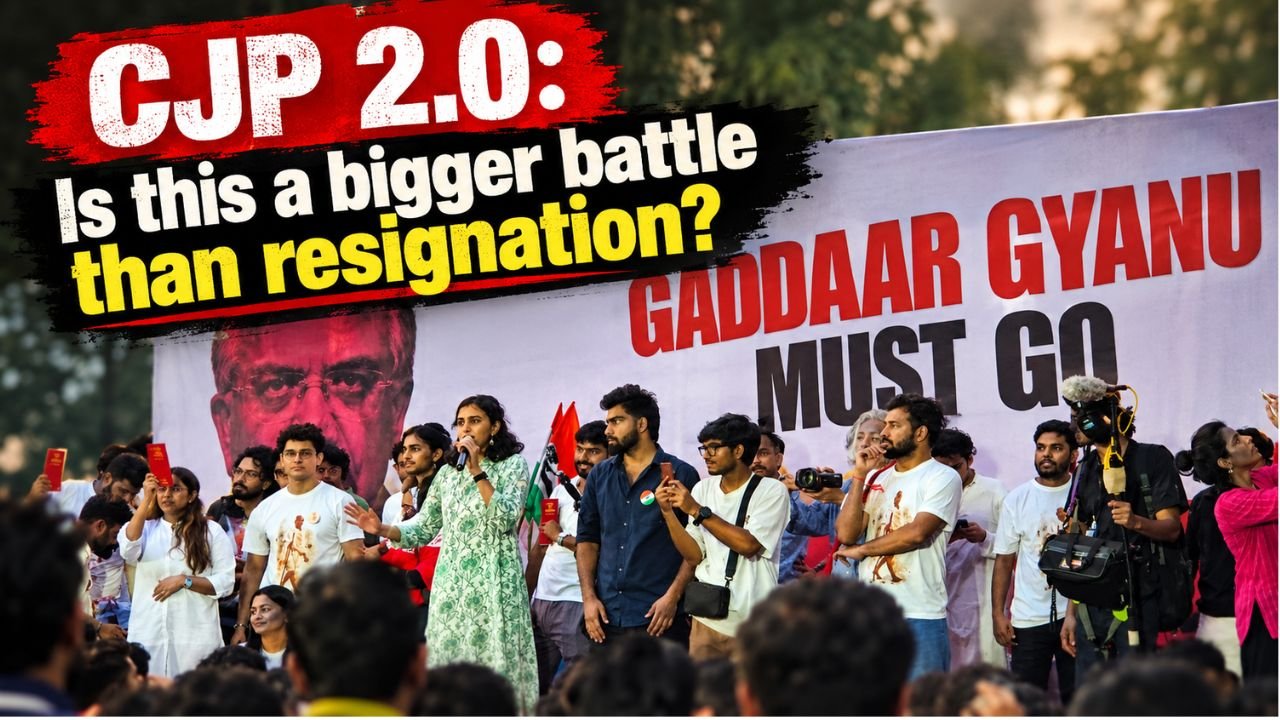
On October 12, opposition leaders, MPs, MLAs, student organisations and political workers came together in a massive march against Chief Election Commissioner Gyanesh Kumar, raising serious concerns over the Special Intensive Revision (SIR) of electoral rolls and the alleged mass deletion of voters’ names. The march brought together a broad coalition, including the INDIA bloc, AISA, SFI and other student unions, as part of a wider nationwide mobilisation against the SIR exercise and concerns surrounding electoral integrity.