
Bengaluru Cannot Drain an Evening’s Rain and Still Calls Itself a World City
By Mariya Rajan in Bengaluru
April 30, 2026
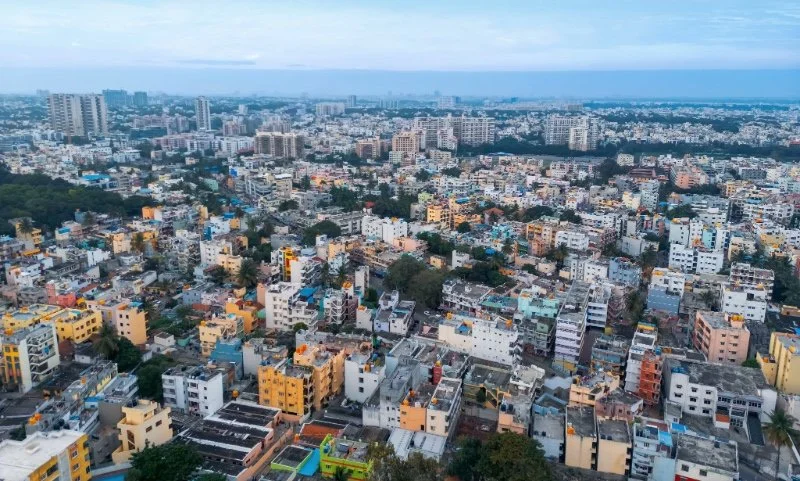
Bengaluru is no longer the Bengaluru many of us remember, or the one we still speak of with nostalgia. This was once the city people came to for its weather, its trees and lakes, and an easier pace of life. Today, summer feels harsher, water has become uncertain, and ordinary life has become more expensive and more exhausting.
This April, much of India was already struggling under extreme heat. On April 29, the India Meteorological Department (IMD) said maximum temperatures were in the range of 40°C to 46°C across most parts of the country. Bengaluru too had been unusually hot. Its airport recorded 38.2°C, the third-highest April temperature logged there since 2014, according to Deccan Herald. For many residents, the rain was not just welcome. It felt necessary. After weeks of high heat touching 37 degrees Celsius, besides water scarcity and health issues, people were waiting for the sky to open.
Then, it finally rained, on April 29.
At first, many people felt relief. Social media filled with the familiar joy of Bengaluru rain. That joy did not last. The rain quickly exposed the city’s broken foundations. At Bowring and Lady Curzon Hospital in Shivajinagar, a compound wall collapsed during the rain, killing seven people, among them five street vendors, two visitors from Kerala on a study tour, and a six-year-old girl, according to media reports. Seven others were injured. Chief Minister Siddaramaiah visited the site, ordered an investigation and announced compensation of 500,000 (5 lakh) rupees to the families of each of those who died. Deputy Chief Minister D.K. Shivakumar later confirmed the total rain-related toll for the city at eight, including one death at Vega City Mall.

The tragedy at Bowring Hospital was the most visible of the evening’s disasters. Roads flooded, traffic slowed to a crawl, power supply was affected in several areas, and vehicles were trapped in waterlogged parking spaces. People who had prayed for rain were suddenly stuck in cars, stranded on roads, or sitting in homes without power or water. A metropolitan city had come to a standstill.
The question is not whether Bengaluru received heavy rain; it did. By 5:30 PM, the city had recorded 78 mm of rainfall, while the HAL Airport station recorded 24.7 mm. The IMD had issued an orange alert for Bengaluru Urban, Bengaluru Rural, Chikkaballapura and Kolar districts, warning of intense thunderstorms, hailstorms and gusty winds of 40–50 kmph.
The more consequential question is this: how can one spell of rain bring a city like Bengaluru to its knees?
Bengaluru’s rainfall pattern over the last two decades, according to an analysis by Newsreel Asia using Cravis AI, suggests the city’s flood risk is being driven less by a constant rise in extreme rain events and more by a growing number of unusually wet years. An analysis of district-level rainfall data for Bengaluru Urban and Bengaluru Rural from 2004 to 2024 shows that the later period was wetter on average than the earlier one, with monsoon rainfall also rising. However, even a small number of intense rain events can trigger major flooding in a densely built city, and the findings suggest Bengaluru is increasingly vulnerable to disruption when high-rainfall years coincide with peak pre-monsoon or monsoon conditions.
Can we blame the floods on weather alone?
Was Bengaluru built for this many people? Was it allowed to grow with any real planning? Or did the city simply expand wherever money, construction and migration pushed it? The city’s population has grown rapidly over the last two decades, driven by the IT, services and real estate economy – from 6.78 million in 2005 to an estimated 14.77 million by 2026, representing one of the fastest growth rates among global cities, according to Macro Trends. The Bangalore Development Authority puts a possible population of 20.3 million by 2031.

This growth did not come with matching infrastructure. Researchers have long linked the city’s urban floods to unplanned development, disappearing wetlands, poor drainage, intensified construction and weak management. The city kept building; it did not keep preparing.
So when it rains, rain is only one part of the problem. Roads that cannot drain it, lakes and wetlands lost to construction, buildings and walls whose structural safety was never properly checked, a traffic system that cannot absorb disruption. These are the conditions that turn a heavy pre-monsoon shower into a civic emergency. Bengaluru has been treated as an endless economic machine while its basic civic systems have been neglected.
The Chief Minister’s visit to Bowring Hospital was the right thing to do. The families who lost loved ones deserve compensation, accountability and justice. But what about the daily-wage worker who was stuck in flooded streets? The family without power? The person whose vehicle was submerged in a basement? The vendor who earns only if the street remains functional?
Bengaluru’s rain on April 29 exposed a painful truth yet again, that the city is facing a planning problem, a governance problem and a development problem simultaneously. Climate change is making extreme weather more frequent and more intense. And bad planning is making its impact deadlier.
Bengaluru does not need only more flyovers, apartments and tech parks. It needs working drains, protected lakes, safer public buildings, honest construction checks, reliable power systems and roads that do not collapse into chaos after one heavy shower.
A city cannot call itself global if its people cannot get home when it rains.
You have just read a News Briefing, written by us to cut through the noise and present a single story for the day that matters to you. We encourage you to read the News Briefing each day. Our objective is to help you become not just an informed citizen, but an engaged and responsible one.

What happened in Mumbai on October 2 may have been only one day of protest, but the issues behind it are unlikely to disappear with the dispersal of the crowd. The protest was centred around concerns over the Election Commission, electoral rolls and the Special Intensive Revision (SIR) exercise, with protesters demanding accountability from Chief Election Commissioner Gyanesh Kumar. At the same time, similar mobilisation has been taking place across different parts of the country, with student groups, Opposition parties and civil society organisations raising concerns over the electoral process. Newsreel Asia spent the day at Mumbai Protest capturing the preparations, the police presence, conversations with protesters, the atmosphere on the streets and how the day unfolded. The speech of Cockroach Janta Party's leaders and sentiment of protestors seemed larger than the concerns regarding the electoral process. Will this lead to something bigger?