India Faced Daily Extreme Weather in 2025, Averaging 12 Deaths Every Day
At Least 4,419 People Died as Extreme Events Struck Nearly Every Day
December 28, 2025
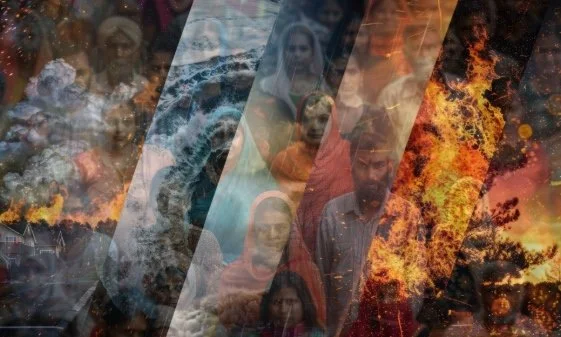
India experienced extreme weather on 331 of 334 days between January and November 2025, with an average of 12 deaths reported daily, according to an analysis by the Centre for Science and Environment and Down To Earth.
The total death toll stood at 4,419, the highest in four years, while widespread floods, storms, landslides and heatwaves damaged crops, homes and livestock across all 36 states and Union Territories, according to the report.
In total, around 17.4 million hectares of farmland were affected, along with the destruction of more than 181,000 homes and the deaths of nearly 77,200 animals. Maharashtra bore the brunt of agricultural loss, with 8.4 million hectares of crop damage. Gujarat and Karnataka followed with 4.4 million and 2.75 million hectares, respectively.
The north-west region, which includes Punjab and the Himalayan states, recorded extreme weather on 311 days, the most of any region. The east and north-east followed with 275 such days. The north-west also reported the highest number of deaths, at 1,459, followed by central India with 1,120.
Across the year, extreme weather occurred daily in nine of the eleven months: February, April, May, June, July, August, September, October and November. In comparison, such frequency was recorded in six months of 2024 and five in 2023, reflecting a steady shrinkage in the duration of normal weather conditions.
For the third consecutive year, all 36 states and Union Territories experienced extreme weather events. The 331 days of incidents in 2025 surpassed the 295 recorded in 2024, 296 in 2023 and 292 in 2022.
Among specific hazards, lightning and thunderstorms proved deadliest, killing 1,538 people. Andhra Pradesh recorded the highest state-wise toll at 608 deaths, followed by Madhya Pradesh with 537 and Jharkhand with 478.
The figures come amid continued criticism of the government for clearing high-emission infrastructure and extractive projects even as climate-linked disasters become more frequent and severe.
Extreme events began early in the year. Winter saw events on 97 percent of days, a sharp rise from 64 percent in 2022, driven largely by an increase in heavy rain and flood days. Rainfall occurred on 51 of the 59 days between January and February, disrupting what is typically a dry season.
The first heatwave of the year was recorded on February 25 in Goa and Maharashtra, marking the earliest appearance of heatwave conditions during the winter period. February also turned out to be the warmest in 124 years, with extreme weather reported in 31 states and Union Territories, nearly double the spread seen in February 2024 and five times higher than in 2023.
Between March and May, extreme weather continued without a break, occurring on nearly every day of the season. Heatwaves became more frequent and widespread, affecting 19 states, including higher-altitude regions such as Himachal Pradesh, Jammu and Kashmir, and Ladakh.
At least 990 deaths were reported during this three-month period, more than triple the 302 deaths recorded in the same season in 2022. Heavy rain, floods and landslides emerged as the dominant events, overtaking hailstorms that had previously been more common.
The monsoon season, spanning June through September, brought extreme weather on all 122 days. Heavy rain, floods and landslides were reported daily across 35 states and Union Territories, while lightning and storms occurred on 104 days, cloudbursts on 17 days and heatwaves on eight days. During this period, at least 11 million hectares of cropped land were damaged, accounting for roughly 65 percent of the total loss nationwide. The actual extent of damage may be higher due to incomplete state-level reporting.
Flooding and landslides proved to be the deadliest hazards of the year, together causing 2,707 deaths. Yet, despite the relentless downpours, around one-fifth of the country’s districts experienced rainfall deficits. By the end of September, 147 of 727 districts had received deficient or largely deficient rain, underscoring the uneven and erratic nature of monsoon distribution.
Extreme weather continued into the post-monsoon months of October and November. All 61 days in this period recorded events across 34 states and Union Territories. Himachal Pradesh reported the highest frequency, with events on 50 days, followed by Andhra Pradesh with 38 and Kerala with 26. October was particularly wet in the southern peninsula, ranking as the 13th wettest since 1901.
Coldwaves arrived earlier than usual, beginning on November 7, nearly two weeks ahead of the November 21 onset in 2022. In contrast to past years, when coldwaves were largely limited to Maharashtra and Rajasthan, 2025 saw such conditions spread across 13 states covering all four regions of the country, marking a significant expansion in reach.
Environmentalists say the government has allowed major road, hydropower and mining projects to go ahead in fragile areas like the Western Ghats and Himalayan states by weakening environmental rules. In many cases, environmental impact assessments have been skipped or watered down, meaning these projects are approved without fully examining the long-term damage they could cause.
Activists have also raised concerns over limited investment in climate adaptation measures. While early warning systems have improved, critics say rehabilitation, resilient housing and agricultural support remain underfunded. India’s National Action Plan on Climate Change has been revised, but implementation at the state level remains uneven and poorly financed.
Activists have also raised concerns about the lack of investment in helping communities adapt to climate risks. They say that while early warning systems have improved, there is still not enough support for rebuilding homes, restoring livelihoods or strengthening farming systems after disasters. India has updated its National Action Plan on Climate Change, but critics say many states are struggling to put it into action due to weak planning and limited funding.
You have just read a News Briefing by Newsreel Asia, written to cut through the noise and present a single story for the day that matters to you. Certain briefings, based on media reports, seek to keep readers informed about events across India, others offer a perspective rooted in humanitarian concerns and some provide our own exclusive reporting. We encourage you to read the News Briefing each day. Our objective is to help you become not just an informed citizen, but an engaged and responsible one.