6.5 Million Children Dropped Out of School in 5 Years
Dropouts Reveal How Poverty, Migration and Gender Norms Block Education
December 7, 2025
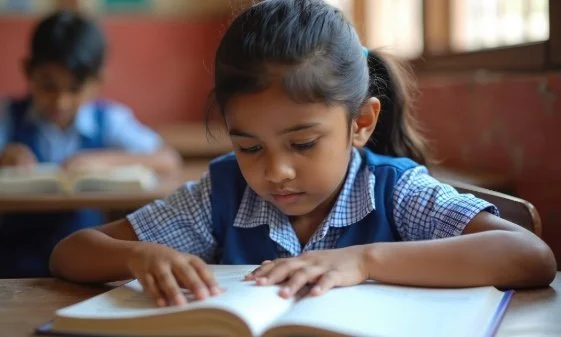
Over the last five years, more than 6.5 million (65 lakh) children in India have dropped out of school, Minister of State for Women and Child Development Savitri Thakur revealed in Parliament. Among them, nearly 3 million (30 lakh) are adolescent girls. The numbers point to a large-scale rupture in India’s promise of universal education, and also to structural gaps in the way schooling is planned, supported and delivered, especially for children from marginalised families.
The data shows that 65.7 million children left school between 2019 and 2024. Of these, 2.98 million were girls in the adolescent age group, as reported by India Today.
A state-wise breakdown revealed that Gujarat recorded the highest number of out-of-school children in the 2025–26 academic year. The state identified 240,000 (2.4 lakh) such children, including 110,000 (1.1 lakh) girls. In comparison, Gujarat had reported only 54,541 out-of-school children in 2024. This marks a jump of over 340 percent in a single year.
Other states with high dropout numbers included Assam, which reported 150,906 (1.5 lakh) out-of-school children, of whom 57,409 were girls. Uttar Pradesh recorded 99,218 dropouts, including 56,462 girls.
The Ministry cited a range of factors contributing to the dropout of girls from school. These included migration, poverty, household responsibilities, child labour and social pressures.
To address the issue, the Centre pointed to initiatives under the Samagra Shiksha scheme.
From the perspective of development economics, the figure represents a long-term loss in human capital. A reduction in schooling years directly reduces the productive capacity of the labour force. For adolescent girls, it also limits their access to better jobs, lowers their lifetime earnings and restricts their chances of social mobility. Over time, this affects not just individuals, but also the economy. When millions of future workers leave school prematurely, the country’s capacity to generate inclusive growth narrows.
From a social policy lens, the dropout data shows how social protection systems are failing to adapt to local realities. It suggests either a significant failure in schooling access or a change in how dropouts are being identified and reported. Either way, such volatility is a red flag.
From the perspective of education sociology, dropout is not just as an event, but a process. Children do not wake up one morning and stop going to school. The path to dropping out is often gradual and shaped by household circumstances, school conditions and social norms.
For girls, the dropout journey is even more layered. They are expected to take care of younger siblings, fetch water, cook meals and sometimes even earn income. In many families, especially in rural and tribal areas, there is pressure for early marriage or fear about girls’ safety if they travel to far-off schools. Each of these factors pushes them out of classrooms.
A recent state-level policy in UP may have worsened the problem. The government decided to merge schools with fewer than 50 students into nearby institutions. While this may sound efficient from an administrative point of view, for many children, particularly girls, it means having to walk longer distances, often alone. For families already hesitant to send girls to school, this can be the final push towards dropping out.
Further, when families move seasonally for work, say, from Bihar to Punjab for farm labour or from Odisha to Gujarat for construction, children are taken along. These children may be enrolled in a school for a few months, then pulled out again. There is no national mechanism to track their education continuity across states.
Furthermore, if a girl’s family does not have enough to eat, it is hard to argue for sending her to school instead of letting her help at home or earn money. This is where conditional cash transfer schemes and nutritional support programmes can help. But these need to be predictable, easy to access and backed by well-functioning schools.
Regarding the various government schemes, many of these solutions work only when they are well-implemented. A hostel for girls means little if it is poorly staffed or lacks toilets. Free textbooks do not help if the teacher is absent for half the year.
Moreover, re-enrolment drives that identify children who have dropped out and bring them back to school depend heavily on how local governments and community bodies are involved.
A national campaign such as “Bringing Children Back to School” will only succeed if School Management Committees and local panchayats actively follow up on each child’s case. Reimbursement of fees under the Right to Education Act is a welcome step, but it cannot solve the social pressures and opportunity costs that families weigh when deciding whether to send a child, especially a girl, to school.
The dropout data is a signal of how far India is from the goal of universal, equitable and meaningful education.
You have just read a News Briefing by Newsreel Asia, written to cut through the noise and present a single story for the day that matters to you. Certain briefings, based on media reports, seek to keep readers informed about events across India, others offer a perspective rooted in humanitarian concerns and some provide our own exclusive reporting. We encourage you to read the News Briefing each day. Our objective is to help you become not just an informed citizen, but an engaged and responsible one.