Why Delhi’s Deadly Air Suits Big Business
Most Coal Plants Near the Capital Still Operate Without Emission Control Systems
December 2, 2025
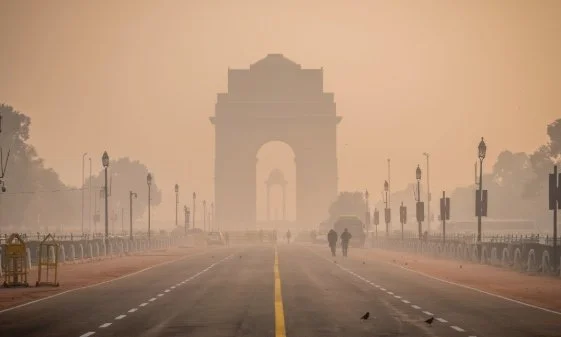
As pollution levels in Delhi trigger emergency measures once again this December, the public is told the usual causes: crop burning, vehicle emissions and weather. But a far more persistent source of pollution continues throughout the year, worsens the crisis each winter, and is enabled by government policy. It comes from coal power plants operating within 300 kilometres of the city.
Coal-fired power plants emit sulphur dioxide, nitrogen oxides and fine particulate matter, which combine in the atmosphere to form secondary pollutants such as sulphates and nitrates. These particles contribute to PM2.5 pollution (smaller than 2.5 microns in diameter, or about 30 times smaller than the width of a human hair), which remains suspended in the air during winter due to low wind speeds and temperature inversion.
According to a 2024 study by the Centre for Research on Energy and Clean Air, thermal power stations within 300 kilometres of Delhi–NCR released sixteen times more sulphur dioxide over a year than all seasonal stubble burning in Punjab and Haryana, as reported by The New Indian Express.
Sulphur dioxide (SO₂) is a toxic gas that irritates the respiratory system and poses serious health risks, especially for children, the elderly and people with asthma or other lung conditions. When inhaled, SO₂ can cause inflammation of the airways, coughing, shortness of breath and a tightening of the chest. Even short-term exposure can trigger asthma attacks or worsen existing respiratory diseases. Long-term exposure is linked to reduced lung function and increased risk of respiratory infections. SO₂ also reacts with other chemicals in the atmosphere to form fine particulate matter, which further deepens its impact on human health.
The Centre for Science and Environment has estimated that coal plants contribute around eight percent of Delhi’s PM2.5 load. These emissions, though less visible than crop fires or vehicular exhaust, add to local pollution and help sustain the dense smog that builds up across northern India each winter.
In July, around five months before the current air pollution crisis, the central government removed environmental obligations from most coal power plants, allowing them to emit harmful gases without controls and without consequences. The environment ministry issued a notification that reclassified coal-fired power stations based on their distance from major urban areas, as reported by Reuters.
Under the new system, most plants were no longer required to install flue-gas desulphurisation units, the only proven technology for reducing sulphur dioxide emissions. Nearly four-fifths of India’s coal capacity became exempt. These plants continue to operate without equipment that was once legally mandated, and the pollution they release spreads across state borders and into the lungs of millions.
The financial gains from this decision have gone to the country’s largest corporate coal operators.
Adani Power, Reliance, the Jindal Group, Vedanta and JSW together operate tens of thousands of megawatts of coal-based power generation capacity that no longer requires flue-gas desulphurisation (FGD) systems, which are pollution control technologies installed at coal-fired power plants to remove SO₂ from the exhaust gases before they are released into the air. Following the government’s relaxation of FGD installation rules, these companies stand to save between 190 billion (19,000 crore) rupees and 240 billion (24,000 crore) rupees in annual tariff expenses, as reported by IANS.
That money had once been allocated to reduce health damage from their operations. It now remains on their books. The cost has been passed on to the public.
Between November 1 and 19, at least 15 units across six such plants were running without SO₂ controls, according to The Indian Express. These include units at Panipat and Yamuna Nagar in Haryana, and at Talwandi Sabo, Guru Hargobind and Ropar in Punjab. Together, they represent a major source of sulphur emissions. As of April 2025, only 13 out of 35 units in this zone had installed FGD systems.
Installed FGDs at regional plants could, in principle, reduce sulphur‑dioxide emissions from the 300‑km cluster by roughly two‑thirds. However, there is no comprehensive public monitoring of emissions or health impacts from these plants, and no schedule mandating retrofits for those still without scrubbers.
The rollback of environmental requirements has also created market distortions.
Companies that installed pollution control systems under the earlier policy now face a commercial disadvantage. Indian manufacturers that scaled up to produce the equipment required for flue-gas desulphurisation are now seeing tenders cancelled and business vanish. The government’s decision has rewarded firms that delayed compliance and weakened the position of those that followed the law.
The original justification for the rollback was cost. The government claimed that pollution control upgrades were expensive and difficult to enforce. But instead of creating phased support or incentives for compliance, it erased the requirement entirely. Consumers have received no reduction in power tariffs. The savings remain with companies operating under merchant models.
SO₂ often escapes public attention in air quality reports because the AQI system highlights only the pollutant with the highest relative concentration at a given time. In cities like Delhi, this is usually PM₂.₅ or PM₁₀, which dominate the index due to frequent and extreme spikes. As a result, even when SO₂ levels are elevated, they rarely appear as the leading pollutant in AQI updates. This masks its real contribution to air pollution, as SO₂ does not simply dissipate; it reacts in the atmosphere to form sulphate particles, which increase PM₂.₅ concentrations. By the time its impact is visible in the AQI, it is already part of another pollutant category, making it harder for the public to trace the source.
This allows major emitters, especially coal plants, to remain out of public scrutiny even as they release large volumes of sulphur dioxide into the air.
You have just read a News Briefing by Newsreel Asia, written to cut through the noise and present a single story for the day that matters to you. Certain briefings, based on media reports, seek to keep readers informed about events across India, others offer a perspective rooted in humanitarian concerns and some provide our own exclusive reporting. We encourage you to read the News Briefing each day. Our objective is to help you become not just an informed citizen, but an engaged and responsible one.