
Know the Real Meaning of Development Beyond Roads and Buildings
December 27, 2025
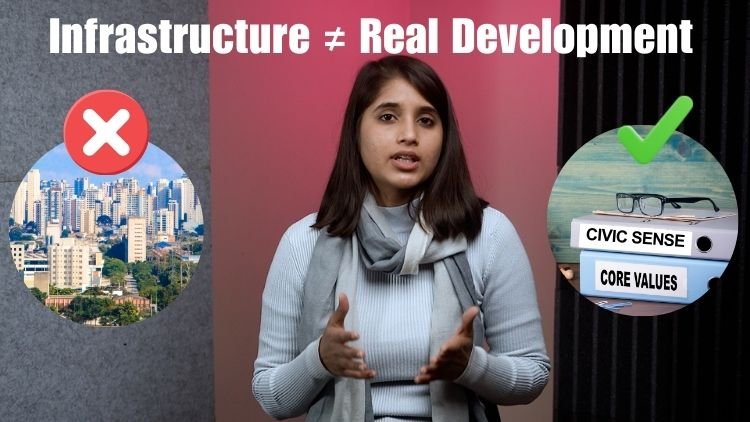
Do Roads and Buildings Really Show a Country’s Progress?
Hello and welcome to Newsreel Asia’s explainer series, where we explain political, economic, social and psychological concepts that help news readers like you understand the core of the stories you read and watch everyday. I and Harshita and in this episode, I will talk about “development,” or “vikas,” and particularly its less visible but essential aspect.
When we picture development, the first things that come to mind are often visible and grand. Smooth highways, shiny airports, fast metros, tall towers, smart cities. These are easy to see, easy to count, and look impressive in photos. That’ why governments love to showcase them in billboards and campaigns. But is this really how we know a country is doing well? Do modern roads mean people are living fuller, freer lives?
Development is also about the values a society holds and how people treat one another. It’s what citizens believe in. Nobel-winning economist Amartya Sen put it clearly. He said development is a process of expanding the real freedoms that people enjoy, not just about raising incomes or building industries. In other words, it means helping people live the kind of life they truly want, with real choices and dignity.
But freedom doesn’t work in isolation. It depends on the world people live in, on how others behave and how public life functions. That’s why values like trust, fairness and responsibility are just as important as roads and factories. And one way to see these values in action is civic sense. In a society that has truly progressed, people follow rules not because someone is watching, but because they believe it helps everyone. They dispose of garbage carefully because they care about public spaces.
In Japan, for instance, schoolchildren clean their classrooms themselves. It teaches them early on that shared spaces deserve care. Now think of a city with new flyovers, but with paan stains and trash littered across it. The concrete may be new, but the habits haven’t changed.
The same idea applies to ethics. In a large democracy, there simply can’t be enough inspectors or police to check every corner. So the system depends on people doing the right thing on their own. Political theorist Robert Putnam once said that the health of a democracy relies on norms, or those unwritten rules we follow because they feel right. If bribery becomes routine, if cheating is expected, public life will begin to rot. Even if a country’s economy grows, its moral core will weaken.
Picture two countries with the same income levels. One has fair elections, good public services and trust in its institutions. The other sees frequent scams, vote buying and services that only the rich can access. Both may show GDP growth. But only one reflects what social scientists call “social capital,” which is simply a society’s ability to cooperate through shared values and trust. Without it, institutions will become hollow and citizens will become suspicious.
Economist Douglass North wrote that institutions thrive only when the people within them support their rules both formally and informally.
You can see this difference most clearly in a crisis. During the COVID-19 pandemic, countries like South Korea and New Zealand responded quickly and calmly. Their success was not just due to medical facilities, but also because people trusted public messaging and cooperated. Meanwhile, some richer countries struggled with fake news, hoarding and disobedience. The issue wasn’t money. It was whether people trusted each other and their institutions.
Now, the government’s role in this essential aspect of development is to create and maintain the conditions in which such norms can grow and stabilise.
The state cannot directly manufacture trust or civic sense, but it can influence them through the structure and tone of its institutions.
American political philosopher John Rawls argued that citizens are more likely to act fairly and responsibly when institutions are themselves fair, transparent and predictable. The government must act with integrity to set the moral tone of society. If people see leaders abusing power or bending rules, it sends a signal that civic norms are optional.
Nobel-winning economists Elinor Ostrom and Douglass North explained that people are more likely to cooperate when rules are fair and clearly enforced. That’s because public trust grows when laws reward honest behaviour and make it harder to cheat the system. One simple example is this: when public services treat everyone the same, people begin to feel the system is worth respecting.
Italian thinker Antonio Gramsci spoke about how elites can influence what a society sees as normal or acceptable. Ethical conduct by government officials, along with respect for criticism and obedience to the law, sets an example. Over time, these behaviours become part of everyday public life.
So, to really understand a country’s progress, we have to look deeper. Do people feel responsible for the places they live in?
Do they act with care toward strangers? Do they stay honest even when no one is checking? Do they hold power to account, and still follow the law? These are harder to track than how many kilometres of road were built. But they tell us much more about how strong a democracy really is.
So let’s remember this, development includes more than roads and buildings. It also depends on a society’s collective conscience. With that in mind, do you think India is truly progressing? Tell us in Comments.