
NEWS BRIEFINGS OCTOBER 2023

Imagine you’re at a poker table, and one player has a special deck of cards. He knows what’s coming next, but you and your friends are left guessing. Wouldn’t you be sceptical about the fairness of the game? Welcome to the high-stakes world of electoral bonds in India—a subject that’s headed for the courtroom on Oct. 31, and one that we should all care deeply about.

As citizens, we want to believe in the sanctity of our laws. They are meant to serve and protect us. But what happens when the very structure that upholds justice becomes an instrument for silencing voices?

The tussle over what to call the country—Bharat or India—has become a contentious issue with a recent recommendation to switch the term “India” with “Bharat” in NCERT school textbooks. Amid this name game, Kerala stands out for its clear rejection of the change.

Imagine turning on your tap one day and nothing comes out. A parched land, dry wells and vanishing rivers may soon be India’s stark reality, says a UN report. Alarm bells are ringing particularly loud for the northwest, India’s “food basket,” where water scarcity could hit home by 2025.

Recently, a young girl in tattered clothes knocked on doors in Madhya Pradesh state’s Ujjain district, seeking help after a horrific rape. She’s home now, but what she and her family have gotten from the government suggests victims who are poor and/or Dalits receive a form of “justice” that corresponds with their perceived social standing.

When the Uttar Pradesh state police recently arrested 10 activists, mostly Dalits, the alarm bells didn’t just ring for them. They echoed through the entire fabric of Indian society. Their supposed crime? A peaceful protest for land rights in Gorakhpur. They had a simple demand—an acre of land for marginalised communities.

Imagine your family has a budget for home improvements—things like fixing the roof, upgrading the kitchen, or building a new garage. Now, what if someone in the family proudly announced, “We’ve tripled our budget for improvements!” but then used the money to pay off debts or go on a vacation?

Let’s imagine two cities, Alwar and Jaipur, both in Rajasthan state. Alwar is a smaller town, while Jaipur is a bustling metropolis. Yet, they’re both governed by the same set of laws—the Rajasthan Municipalities Act, 2009. You may wonder, how can one-size-fits-all rules serve two cities so different in character and needs?

Government officials are being asked to highlight the achievements of the governing party, raising concerns about the misuse of state resources and the erosion of democratic institutions. The move appears designed to enlist civil servants in activities closely resembling political campaigning.

Mariya Rajan, a journalist-producer for Newsreel Asia, received the 2023 Laadli Award on Oct. 21. The award recognises her video story about the shifting dynamics of human trafficking in the Siliguri region of West Bengal state.

The Indian Army has reportedly been asked to set up 822 “selfie points” across the country to promote government schemes, sparking allegations of political misuse and weakening of the military institution by the Central government.

The Union government plans to expand palm oil plantations into six northeastern states, covering an area that exceeds the size of the entire state of Sikkim, Hindustan Times reported. This move comes despite international and local evidence cautioning that such expansion could have devastating impacts on farmers, cultural heritage and biodiversity.
While we frequently scrutinise the creators of fake news and deepfake videos, we seldom question why consumers readily accept disinformation without verifying its accuracy. Evidently, the creators recognise that “confirmation bias” has likely reached unprecedented levels in recent years.

The Maharashtra Institute of Technology-World Peace University (MIT-WPU) has rescinded its journalism award that had been slated to go to Safina Nabi, a Kashmiri reporter. She was told there was “a lot of political pressure.”

The Oct. 16 ruling on abortion by a three-judge bench of the Supreme Court of India involves a complex debate that extends beyond women’s reproductive rights and foetal right to life, encompassing disability rights as well.

India’s objection to the European Parliament’s recent resolution on ethnic violence in Manipur suggests that New Delhi fails to grasp the essential equilibrium between national sovereignty and international human rights commitments in the modern world.

While India is on a path to rapid economic growth and has a burgeoning technology sector, the Global Hunger Index (GHI) 2023 report has ranked India 111th among 125 countries in combating hunger and malnutrition. The country has slipped four positions compared to last year, with only 17 nations faring worse, among them Timor-Leste, Afghanistan and Somalia.

The Adani Group, India’s largest private coal importer, is grappling with damning reports accusing it of artificially inflating coal prices, consequently forcing both consumers and industries to bear higher electricity costs. It has drawn attention to a possible opaque symbiosis between business magnates and political elites in the country.

A man in Karnataka state took the life of his 20-year-old daughter, citing her relationship with a Dalit man as the reason. The father became enraged after his daughter, a college student, ignored his warnings to end the relationship.

Three officials, responsible for auditing key government projects, have been transferred by India’s Comptroller and Auditor General (CAG). The transfer orders follow their involvement in revealing irregularities in high-profile government schemes.

Funding cuts to the Mahatma Gandhi National Rural Employment Guarantee Scheme (MGNREGS) is straining rural India, as was expected. About 93% of this year’s budget is already spent in the first half, according to a report by the Economic Times.

Upcoming elections in five Indian states, leading up to national elections next year, may overshadow voter concerns in favour of political spectacle and divisive issues. It’s likely because, during an election, focus of media coverage often strays from governance, the core responsibility of elected officials.

Justice S. Muralidhar, former Chief Justice of the Orissa High Court and a judge of the Delhi High Court, spoke openly on Oct. 8 about a midnight hearing he conducted during the 2020 Delhi riots—a move that both saved lives and apparently upset the central government, which regulates the police in the national capital.

A law, purportedly aimed at safeguarding the personal data of Indian citizens, passed recently. However, critics argue that the legislation could serve as a tool to stifle investigative reporting and limit public access to information.
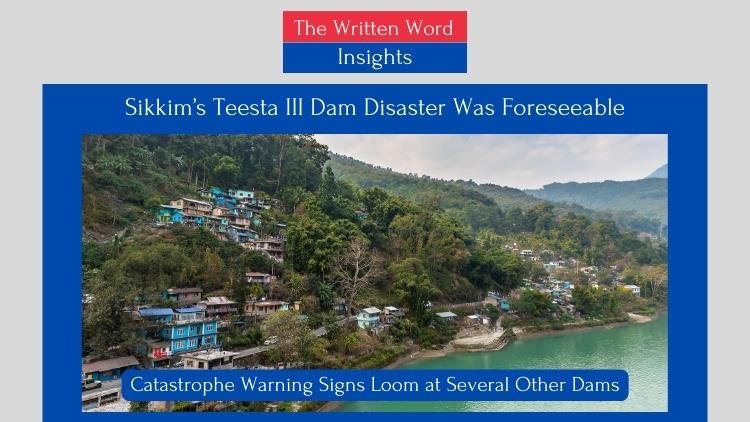
A glacial lake burst in the northeast Indian state of Sikkim led to flash flooding that killed at least 40 people and displaced thousands, a disaster long warned about by experts and environmental activists.

The recent raids targeting 46 journalists, editors and professionals associated with the independent media outlet NewsClick have set off alarm bells about press freedom in India. Conducted by Delhi Police’s Special Cell, these actions seem excessive in both their severity and scope.

The recent findings from Bihar’s caste census have sparked demands for a nationwide survey, calling into question current affirmative action policies and potentially reshaping India’s political landscape. Here are at least four ways such a survey could affect the majority of Indians.

Strained relations between India and Canada have far-reaching implications, affecting Indians in both countries in areas ranging from diplomacy to education.
The Women’s Reservation Bill was tabled in Parliament in 1996, the same year I was born. Now, at 27, I see it has finally passed. Yet, it won’t take effect until I’m 33. Beyond this glaring delay, I have two other criticisms, one apprehension and eight suggestions for the legislation to make a difference.

Cleanliness campaigns in India these days invoke Mahatma Gandhi, but the iconic leader’s vision for the country went far beyond sanitation. Gandhi’s writings and speeches reveal a broader mission that contrasts sharply with the current direction of Indian governance.